


What gas pressure does a 500 kW gas generator set need to run reliably?
A 500kW gas generator set does not have one universal gas-pressure requirement. The correct value is the pressure specified by the engine manufacturer at the defined measuring point, usually the gas inlet to the generator’s gas train or engine mixing system. In practice, many natural-gas units of this size operate with a stable supply pressure in a low-pressure range, often around 5–30 kPa (approximately 0.7–4.4 psi), but the acceptable range can be narrower or higher depending on the engine, regulator arrangement, fuel type, and site gas system.
This becomes important when a set starts normally during a low-load test but alarms or loses output once electrical demand increases. A pressure gauge may show an acceptable reading while the engine is idling, yet pressure can collapse during acceleration because the pipeline, filter, regulator, or gas source cannot deliver enough volume. Reliable operation depends on pressure and flow remaining within specification under the highest expected load.
Start with the pressure stated for your specific engine
Before adjusting any valve or regulator, confirm what the manual means by “gas pressure.” Equipment documents may refer to different points in the fuel path:
- Supply pressure: pressure available upstream of the generator-set gas train.
- Gas-train inlet pressure: pressure entering the skid-mounted shutoff valves, filter, regulator, and safety devices.
- Engine inlet or mixer pressure: pressure after regulation, close to the engine fuel-control system.
- Differential pressure: the pressure relationship across a mixer, control valve, filter, or zero-pressure regulator.
These values are not interchangeable. A site may supply gas at a relatively high pressure, while the engine requires the set’s gas train to reduce that pressure to a lower, tightly controlled value. Raising upstream pressure without checking regulator ratings, shutoff-valve limits, and engine requirements can create a safety risk or cause unstable fuel metering.
For a 500kW gas generator set, the engine OEM’s data sheet should be treated as the operating authority. It normally identifies the permitted inlet-pressure range, the minimum pressure required at rated load, allowable pressure fluctuation, gas temperature limits, and fuel-gas quality requirements. When that document is unavailable, do not assume the pressure used by another generator of similar electrical rating is appropriate.
Why pressure falls when the generator is loaded
Gas demand rises as the generator produces more electricity. At full load, the engine requires far more fuel flow than it does during cranking, warm-up, or no-load operation. Pressure that appears adequate at idle may therefore be misleading.
A typical field situation involves a unit that starts, synchronizes, and runs smoothly at light load, then develops low-gas-pressure alarms as load is applied. The root cause may not be the engine itself. Restrictions in the fuel supply path often become visible only when gas velocity and flow demand increase.
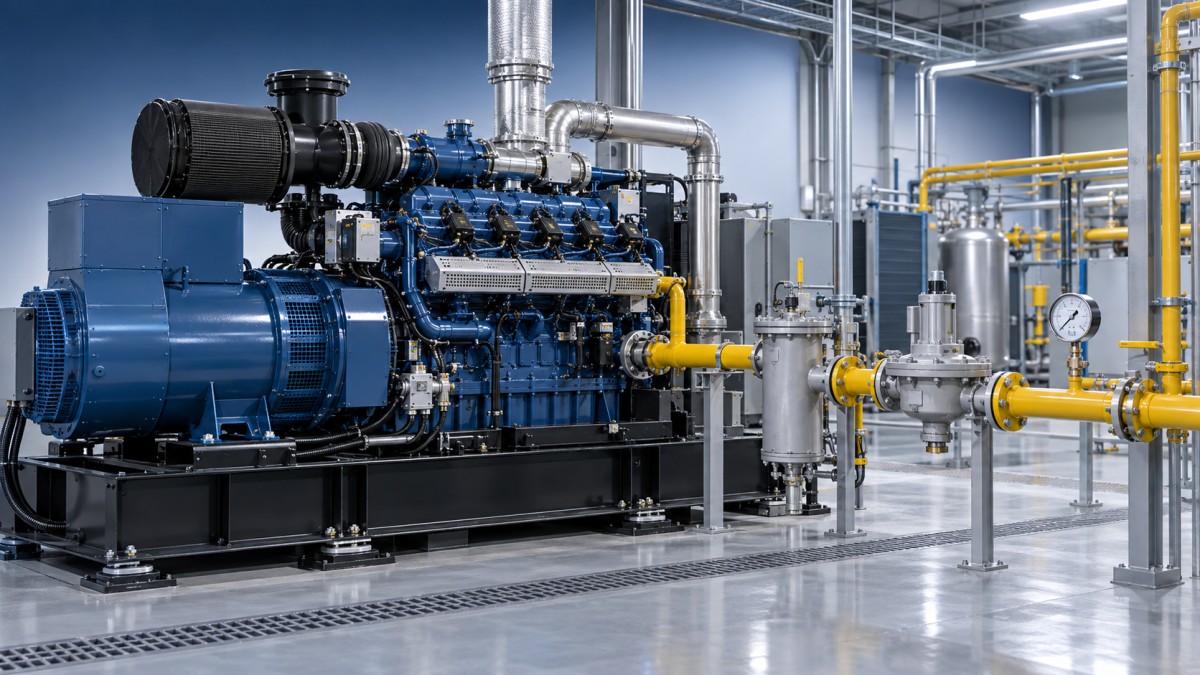
The most frequent causes include undersized gas piping, a partially blocked filter, a regulator selected for insufficient flow capacity, an upstream pressure-control problem, or a gas source with limited delivery capacity. Long pipe runs, excessive elbows, elevation changes, and incorrectly sized flexible connections can also create pressure drop. A regulator may have the correct outlet setting but still fail to maintain it when the engine approaches rated output.
Pressure stability matters as much as the setpoint
A steady pressure within the approved range helps the fuel-control system maintain the intended air-fuel ratio. Pressure that hunts, surges, or drops sharply can lead to unstable speed, poor load acceptance, misfiring, high exhaust temperatures, reduced output, or shutdowns triggered by low fuel pressure or combustion-related protection.
Do not judge pressure from a single static gauge reading. Record the value with the generator stopped, while cranking, at no load, during load steps, and near the normal operating load. This pattern is more useful than one reading because it shows whether the supply system can respond to changing fuel demand.
A practical way to check the gas supply
Begin only after following the site’s approved isolation, venting, ignition-control, and gas-safety procedures. Work on fuel systems should be carried out by personnel authorized for gas equipment.
- Identify the correct test location. Use the point referenced in the generator documentation. Testing upstream of a regulator when the manual specifies downstream pressure can lead to the wrong conclusion.
- Use a suitable calibrated gauge or transmitter. The measuring range should allow meaningful readings around the expected pressure. A gauge with an excessively large range may not show important fluctuations.
- Inspect the visible gas path. Check manual valves are fully open, emergency shutoff devices are reset as intended, pipe supports are intact, and flexible hoses are not kinked or damaged.
- Check the filter and condensate traps. A dirty filter element or accumulated liquid can restrict flow. Replace or service components according to the maintenance instructions rather than bypassing them.
- Observe pressure under load. Apply load gradually where operating conditions permit. A significant fall in pressure as kW rises indicates a delivery-capacity issue, not simply an incorrect gauge setting.
- Compare upstream and downstream readings. A large drop across a filter, regulator, valve, or undersized section helps locate the restriction.
If the supply pressure is above the permitted inlet limit, do not rely on a partially closed manual valve as a permanent control method. A correctly selected pressure-regulating system is needed to provide stable downstream pressure across the generator’s full fuel-flow range.
Gas quality can look like a pressure problem
Even when pressure is correct, poor fuel condition can disrupt operation. Natural gas, associated petroleum gas, flare gas, and other field gases can vary in methane content, heating value, moisture, hydrocarbon liquids, sulfur compounds, and inert-gas content. A change in heating value affects how much gas volume the engine needs to produce the same electrical output. Gas with lower energy content may require greater flow, which can expose limitations in the supply piping or regulator.
Liquids and contaminants can foul filters, damage regulators, interfere with gas valves, and produce erratic readings. Where gas composition or moisture varies, fuel conditioning, separation, filtration, and appropriate control settings may be as important as the nominal pressure value.
For oilfield applications using associated petroleum gas or flare gas, the fuel system must be matched to the actual gas condition rather than to a generic natural-gas assumption. Larger packages such as a 1000kW Gas Generator set can be used where available site gas is converted into electricity instead of being flared, but dependable performance still relies on suitable gas pretreatment and correctly controlled pressure at the engine.
When adjustment is not the right fix
It is tempting to increase a regulator setting whenever low-pressure alarms appear. That may temporarily mask a restriction, but it does not correct an undersized pipe, blocked filter, weak gas source, or regulator that lacks sufficient flow capacity. It can also push pressure outside the engine’s approved range.
Further technical review is appropriate when pressure repeatedly falls below specification at normal load, pressure oscillates after regulator adjustment, gas composition has changed, liquid is found in the gas train, or the generator cannot maintain output despite apparently adequate upstream pressure. The required correction may involve gas-source capacity, pipe sizing, regulator selection, filtration, fuel conditioning, or control-system calibration rather than a simple pressure adjustment.
For reliable operation, use the manufacturer’s specified pressure range at the correct measurement point, verify it while the unit is carrying load, and treat pressure, flow capacity, and fuel quality as one connected system. A stable reading at idle is useful, but it is the pressure available during real electrical demand that determines whether the generator can run dependably.

Contact Us
Please use the form below to contact us.
If you require a response, we will contact you as soon as possible.