


Why flexible gas generator sets matter in volatile power markets
Why Flexible Gas Generator Sets Matter in Volatile Power Markets
Power-market volatility is no longer limited to occasional price spikes or isolated grid events. Industrial operators may face changing natural gas availability, constrained grid capacity, variable renewable output, demand charges, and production schedules that do not tolerate interruptions. In that environment, the value of on-site generation is not simply its rated capacity. It is the ability to respond predictably when operating conditions change.
For commercial evaluators, flexible Gas Generator Sets deserve attention because they can turn power supply from a fixed operating expense into a manageable system decision. A well-matched unit can support prime power, peak shaving, standby duty, isolated operation, or parallel operation with the utility grid. But flexibility should not be treated as a vague promise. It has practical implications for fuel strategy, load response, controls, maintenance planning, and ultimately the total cost of ownership.
The Cost of Inflexibility Is Often Hidden
The purchase price of a generating unit is visible. The cost of an inflexible power asset is usually less obvious. It appears as fuel waste during low-load operation, lost output after an unplanned trip, expensive grid purchases during peak periods, or a system that cannot accept a different gas source without extensive modification. These costs can be material even when the generator itself is technically sound.
A common procurement mistake is to size equipment only for the highest expected load. If the facility spends much of its operating time well below that point, the selected engine and auxiliary systems may not deliver the expected economic performance. Conversely, undersizing can force constant high-load running, leave no room for process expansion, and reduce resilience during a grid disturbance. The question is not merely “How many kilowatts are needed?” It is “How does demand vary by hour, season, shift, and operating mode?”
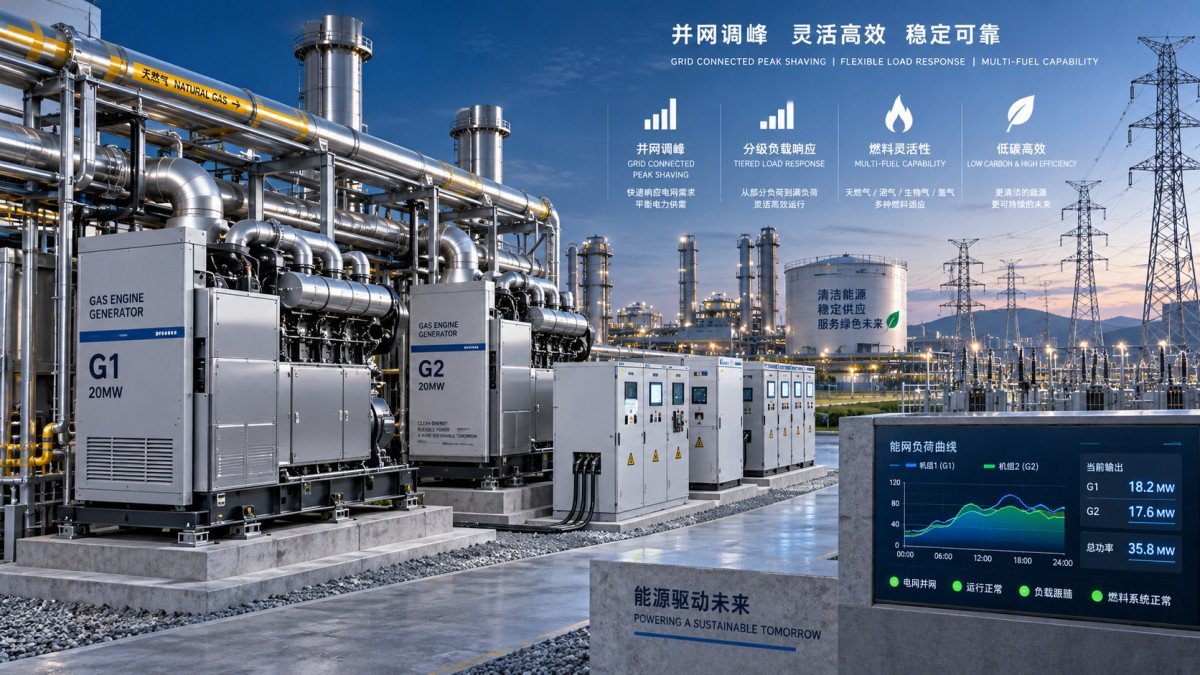
This is why modular configurations are often worth examining. Multiple units can be dispatched in stages, allowing part-load demand to be served without keeping one oversized machine online. The best arrangement depends on the site’s load curve, redundancy requirement, space constraints, and maintenance windows. It should be validated against actual interval data where available rather than estimated from monthly electricity bills alone.
What Flexibility Should Mean in a Gas Power Project
In practical terms, flexibility begins with fuel. Natural gas is not always a uniform input. Pipeline gas, associated petroleum gas, biogas, coal mine methane, and other gaseous fuels can differ in composition, pressure, contaminants, and heating value. These differences affect combustion behavior, output derating, emissions performance, and service requirements. A supplier should be asked to define the acceptable fuel range clearly and to identify what pretreatment, pressure regulation, or gas analysis is needed before committing to a configuration.
The second dimension is electrical behavior. A generating plant may need to start after an outage, synchronize with an unstable grid, pick up motor loads, reject sudden load loss, or operate in island mode. Those duties depend on more than the engine. Generator sizing, governor response, switchgear, protection logic, synchronization equipment, and the operating philosophy all matter. A unit that performs well under a steady factory load may require a different control approach for compressors, pumps, crushers, or other equipment with substantial transient demand.
Control architecture is therefore a procurement issue, not an engineering detail to defer until late in the project. Evaluators should ask who is responsible for the boundary between generator controls, site switchgear, the utility interface, and any energy-management platform. Ambiguous responsibility at these interfaces is a recurring source of commissioning delay.
Compare Lifecycle Value, Not Just the Quotation
A useful commercial comparison separates capital expenditure from operating exposure. The lower initial quotation is not automatically the lower-cost choice if it excludes fuel conditioning, heat rejection equipment, controls integration, spare parts, commissioning support, or required site modifications. Likewise, a higher-specification package may not pay back if the plant will only run for limited emergency hours.
Before comparing bids, request a common basis of evaluation. This should state the fuel assumptions, ambient conditions, site elevation, electrical output definition, load profile, operating hours, included auxiliaries, and performance-test expectations. If one supplier quotes output at ideal ambient conditions while another includes expected site derating, the comparison is not meaningful. The same applies to fuel consumption: it should be considered at the likely operating points, not only at full load.
Maintenance economics should be treated with equal care. Clarify routine service intervals, major overhaul assumptions, recommended critical spares, diagnostic access, local technical support, and whether planned shutdowns can be coordinated with production. A plant designed for continuous duty needs a different support model from a standby installation. The commercial team does not need to prescribe maintenance methods, but it should understand what operational commitments are being purchased.
Questions that expose weak assumptions
- What fuel composition, pressure, and cleanliness range has the proposed system been designed to accept?
- What net electrical output is expected under the project’s actual ambient and elevation conditions?
- Can the system operate in parallel with the grid, and what protection and utility approvals may be required locally?
- How will the plant respond to the site’s largest motor start, step-load change, or sudden load rejection?
- Which equipment, civil works, and control interfaces are excluded from the quoted scope?
- What information will be available remotely for operations, fault diagnosis, and energy-cost review?
Fuel Optionality Can Protect a Long-Lived Asset
Gas-based distributed generation is also evolving alongside alternative fuels and decarbonization plans. For some industrial applications, a procurement team may need to preserve options beyond conventional pipeline natural gas. That does not mean every project should adopt a new fuel immediately. It means the evaluation should distinguish between a current operating requirement and a future fuel pathway.
Where fuel logistics, storage arrangements, and site safety conditions support it, Methanol/Hydrogen generator sets may be relevant to a broader resilience discussion. Their potential role should be assessed through the same disciplined lens: reliable energy output under the intended duty cycle, fuel availability, handling requirements, operating expertise, and the cost of supporting infrastructure. A fuel-flexible strategy is valuable only when its complexity is proportionate to the risk it is meant to reduce.
Capability Matters at the Integration Stage
The strongest projects bring equipment engineering and operational realities together early. Amico Gas Power Co., Ltd. combines gas-power equipment manufacturing with oilfield engineering services, distributed power applications, gas power control technology, and smart energy management. That breadth is relevant because many gas generation projects fail to meet expectations at the interfaces: fuel supply quality, field conditions, protection coordination, controls, and ongoing operation.
Based in Chengdu, AMICO operates an R&D and manufacturing facility exceeding 20,000 square meters, with systems for gas engine and generator development, testing, and inspection. Its R&D workforce represents more than 40% of its personnel, and the company has undertaken the “863-Natural Gas Engine” national project. For an evaluator, such information should not replace project-specific due diligence. It does, however, point to the value of selecting a partner able to discuss controls, fuel conditions, generation equipment, and field integration as one connected system.
Volatile power markets reward preparation rather than optimism. The appropriate Gas Generator Sets solution is the one whose output, fuel tolerance, dispatch logic, maintenance plan, and commercial assumptions match the site’s real operating conditions. Before approving a purchase, confirm the load profile, fuel specification, grid operating mode, scope boundary, and lifecycle service plan in writing. Those details will usually determine whether flexibility becomes a measurable business advantage or an expensive feature that never gets used.

Contact Us
Please use the form below to contact us.
If you require a response, we will contact you as soon as possible.