


How methane variation affects a 500 kW gas generator set
A 500 kW gas generator set does not respond to methane variation as if it were simply receiving “more” or “less” fuel. A change in methane concentration changes the fuel’s heating value, air-fuel ratio requirement, combustion speed, knock tendency, and the amount of gas that must pass through the fuel train to hold the same electrical load. In a field installation, the first signs may be load hunting, rising exhaust temperatures, unstable frequency, unexplained derating, or protective trips during a gas-source change.
The practical selection judgment is straightforward: a generator set should be assessed against the full expected methane range, not the nominal gas analysis. A unit designed around stable pipeline-quality natural gas may require gas conditioning, derating, revised calibration, or a different engine-control strategy when supplied by variable biogas, associated gas, landfill gas, or blended fuel. The key question is not only “Can the engine run?” but “Can it sustain 500 kW safely and efficiently when gas quality moves away from the target value?”
Why methane percentage changes available power
Methane is normally the primary combustible component in gaseous fuel. When its concentration falls, the gas usually contains a larger proportion of carbon dioxide, nitrogen, water vapor, or other non-combustible components. The lower heating value of each cubic meter of fuel then declines. To produce the same brake power, the engine needs a higher gas volume flow.
This becomes important at the upper end of the generator’s load range. The gas mixer, control valve, pressure regulator, piping, and air-handling system all have finite flow capacity. A 500 kW gas generator set may operate satisfactorily at part load on reduced-methane fuel, yet fail to reach rated output because the fuel system cannot deliver enough usable energy at the required pressure and mixture condition.
High methane content is not automatically easier. Richer fuel can increase the risk of excessive energy input when the control system is not properly calibrated. Depending on the engine design and ignition strategy, a sudden shift toward higher methane concentration can alter combustion timing, cylinder pressure, and knock margin. Gas composition therefore has to be treated as a live operating variable rather than a one-time commissioning value.
What changes at the engine when gas quality moves
Combustion control is usually tuned around a defined fuel quality, often expressed through methane percentage, lower heating value, Wobbe index, or a combination of these values. Methane concentration alone is useful, but it does not describe every fuel behavior. Two gases with a similar methane percentage may perform differently if one contains more carbon dioxide while the other includes hydrogen, heavier hydrocarbons, or inert nitrogen.
A lean-burn engine is particularly sensitive to mixture control. It operates with excess air to improve efficiency and control emissions, but the workable combustion window can be narrow. As methane declines, the system may need to open the gas control valve further while maintaining a stable lambda value. If the valve reaches its limit, the engine cannot maintain the commanded load. If correction is too slow, some cylinders may approach misfire while others run hotter, creating uneven exhaust temperatures and unstable combustion.
At the opposite extreme, a richer gas composition may require reduced fuel valve opening and revised ignition timing. Without sufficient knock margin, cylinder-pressure peaks can rise before an operator sees a clear change in generator output. Knock sensors, cylinder temperature monitoring, and conservative control limits are therefore more valuable than relying only on periodic laboratory gas analysis.
Symptoms that should not be dismissed as a generator fault
When output becomes unstable, maintenance teams often begin with spark plugs, ignition coils, turbocharger condition, or the governor. Those checks are valid, but gas variation should be investigated early when the symptoms coincide with changes in feedstock, well production, gas blending, compression duty, or weather conditions that influence condensation.
- Repeated inability to carry 500 kW: low heating value or inadequate gas flow capacity may be limiting available fuel energy.
- Frequency drift after a gas-source change: the engine governor may be responding to unstable combustion rather than an electrical load problem.
- High exhaust-temperature spread between cylinders: inconsistent mixture distribution, reduced methane quality, or fuel contamination may be involved.
- Misfire alarms during low-load operation: weak fuel energy, excess dilution, or unsuitable lean-limit calibration can reduce ignition stability.
- Knock alarms following a composition increase: the fuel may have become more reactive or higher in energy than the existing timing map expects.
These indications do not prove methane variation by themselves. Air leaks, failing gas-pressure regulators, blocked filters, damaged ignition components, and inaccurate lambda sensors can create similar behavior. The useful distinction is timing: if the issue appears when gas quality changes, during condensate carryover, or after switching between gas sources, fuel analysis and fuel-train measurements should move near the top of the diagnostic sequence.
Use a fuel envelope instead of a single methane number
For selection and acceptance testing, request a declared operating envelope from the equipment supplier. It should state the permitted fuel composition range, minimum gas pressure at the generator inlet, acceptable gas temperature, moisture and contaminant limits, expected derating behavior, and whether automatic adjustment is available across the stated range.
A single statement such as “suitable for biogas” is not enough for a technical decision. Biogas quality can move significantly with digester loading, feedstock changes, gas storage conditions, and carbon dioxide removal performance. Associated gas can vary with well conditions and separation efficiency. Even nominally stable natural gas may change after blending or pressure-reduction stages.
Evaluate the system using the lowest realistic methane condition, not just the average. At that point, confirm whether the unit can still provide the required electrical output or whether the project must accept a reduced power rating. It is often better to define an intentional derating threshold than to expect an engine to hold 500 kW while the fuel system is operating at its control limit.
Information worth collecting before final selection
- Obtain gas samples over time rather than relying on one commissioning sample. Record methane, carbon dioxide, oxygen, nitrogen, hydrogen sulfide where relevant, moisture, and heavier hydrocarbons where applicable.
- Identify the lowest, highest, and fastest-changing expected heating values. A slow seasonal change creates a different control challenge from minute-to-minute variation.
- Calculate whether inlet piping, regulators, and valves can supply the required volumetric flow at the minimum gas heating value and minimum available pressure.
- Determine whether gas cleanup is required for moisture, particulate matter, corrosive components, or compressor oil carryover.
- Check how the generator controller reacts when fuel quality exceeds its calibrated range: derating, alarm, load shedding, or shutdown should be intentional and documented.
Control features that reduce operational risk
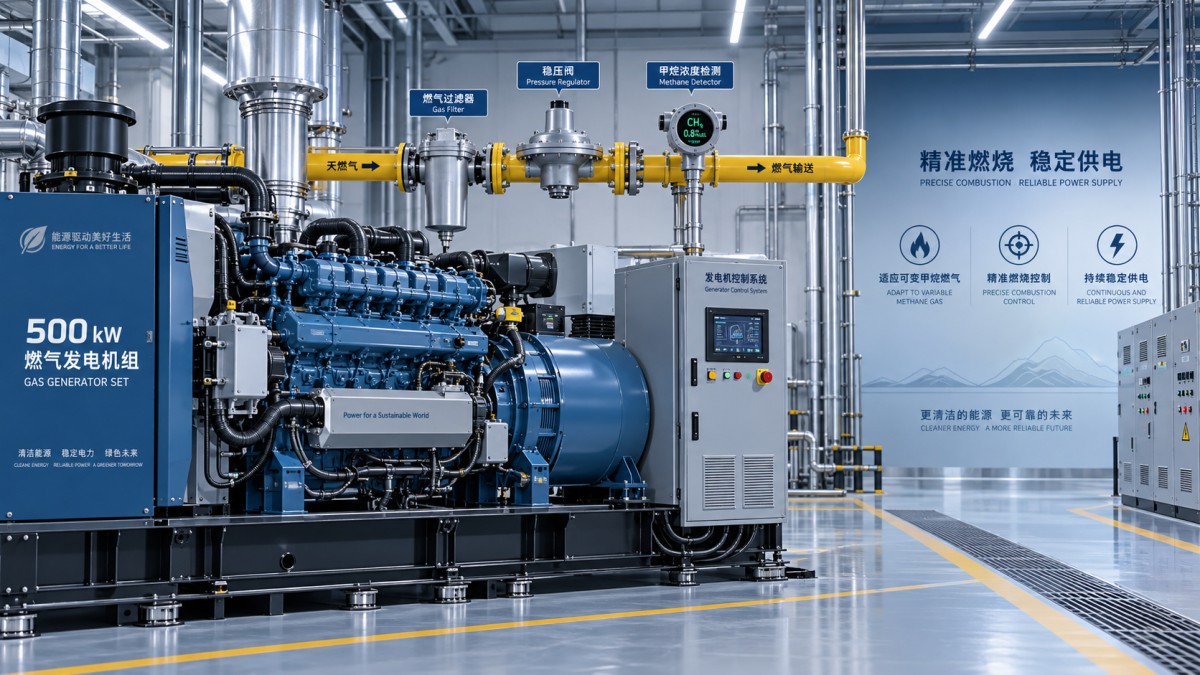
A stable gas supply begins upstream of the engine. Water separators, condensate traps, filtration, pressure regulation, and properly sized gas piping protect the fuel-delivery system from disturbances that may be mistaken for methane fluctuation. Gas temperature also matters because it affects density and pressure behavior, especially where compression, cooling, or long outdoor piping runs are involved.
At the generator, closed-loop lambda control helps maintain the commanded air-fuel ratio, while knock monitoring can protect the engine when combustible content rises. These controls are most effective when their calibration range matches the actual gas envelope. A controller cannot compensate indefinitely for a fuel stream that falls below the engine’s minimum combustible-energy requirement.
Where a site expects a wide fuel-quality range or future capacity expansion, it can be useful to compare the 500 kW requirement with a larger engine platform that offers operating-speed flexibility. For example, the 810kW Gas-Powered Engine is specified at 810 kW/1300 rpm with an adjustable speed range of 800 rpm to 1300 rpm. That specification does not by itself confirm suitability for any particular variable gas source, but it illustrates why evaluators should examine engine operating range, control philosophy, and available margin rather than matching only the nominal electrical rating.
When derating is the correct engineering answer
Derating is sometimes viewed as a deficiency, but it can be the proper response when methane concentration drops below the fuel condition required for full-load operation. A controlled reduction in electrical output protects combustion stability, exhaust components, and engine hardware. The alternative—forcing the engine to maintain rated load with insufficient fuel energy or unstable mixture control—can create repeated trips and higher maintenance exposure.
Define the operating logic before commissioning: at what gas-quality or fuel-pressure condition should the set reduce load, hold a lower load, alarm the operator, or shut down? The thresholds should reflect engine limits, electrical demand priorities, and the ability of the upstream gas-treatment system to recover. For critical loads, a parallel fuel source, gas buffer, or additional generation capacity may be more appropriate than assuming all fuel-quality variation can be corrected at the engine.
The most reliable 500 kW gas generator set installation is therefore not the one rated highest on a brochure. It is the one whose fuel system, combustion controls, protection settings, and derating plan are matched to the actual methane range and rate of variation at the site.

Contact Us
Please use the form below to contact us.
If you require a response, we will contact you as soon as possible.