


How to prepare crane access for a 1000 kW containerized gas genset
Preparing crane access for a 1000kW Containerized GasGenset is not a task to leave until the delivery truck is already at the gate. A containerized unit may look straightforward from a distance, but its lifting plan depends on far more than the generator’s rated output. Container dimensions, actual shipping weight, lifting-point arrangement, site geometry, crane reach, soil condition, and nearby structures all affect whether the installation can be completed safely and without expensive rework.
For operators, the practical question is simple: can the crane arrive, set up, lift the unit within its working chart, and place it onto the foundation without forcing the crew to improvise? If any answer is uncertain, access planning should be resolved before the genset leaves the factory or transport yard.
Start with the actual lifting data, not an estimate
The first document to request is the approved lifting information for the specific containerized genset. Do not select a crane based only on a broad statement such as “this is a 1000 kW unit.” Two containers with similar electrical ratings can have different weights because of enclosure design, acoustic treatment, cooling equipment, gas train layout, auxiliary skids, or transport configuration.
The lifting package should identify the gross lifting weight, center of gravity, certified lifting points, sling angles, required spreader beam if applicable, and any restrictions on lifting from one side. The crane contractor needs this information before preparing a lift plan. A unit that can be lifted easily at a short radius may require a substantially larger crane once the operator considers the distance from crane centerline to the final foundation position.
A common mistake is to use the crane’s headline capacity as the decision point. Crane capacity changes with boom length, radius, outrigger configuration, counterweight, and site setup. A crane described as “large enough” in a phone call may have inadequate capacity at the required working radius. The lift supervisor should check the applicable load chart, including the weight of hooks, rigging, spreader bars, and other lifting accessories.
Walk the route from the public road to the foundation
Crane access is really two routes: the transport route for the genset container and the crane route for lifting equipment. They may use the same entrance, but they often need different clearances and turning space. Review the route in person where possible. Satellite images are helpful for early planning, yet they rarely reveal soft shoulders, low cables, drainage channels, parked equipment, temporary fencing, or tight gate geometry.
Check gate width and height, internal road width, turning radius, bridge or culvert limitations, overhead lines, trees, pipe racks, lighting poles, and building eaves. A low branch or cable that seems harmless to a truck can become a serious obstruction once the boom is raised. Where overhead electrical lines are present, the responsible site team must establish the required clearance and isolation arrangements in accordance with local rules and the lift contractor’s procedures. This should never be handled as an on-the-day judgment call.
Also consider whether the delivery trailer can reverse into the unloading area. If it cannot, the lift may have to take place farther from the foundation, increasing the crane radius. That one change can affect crane selection, ground preparation, traffic control, and installation cost.
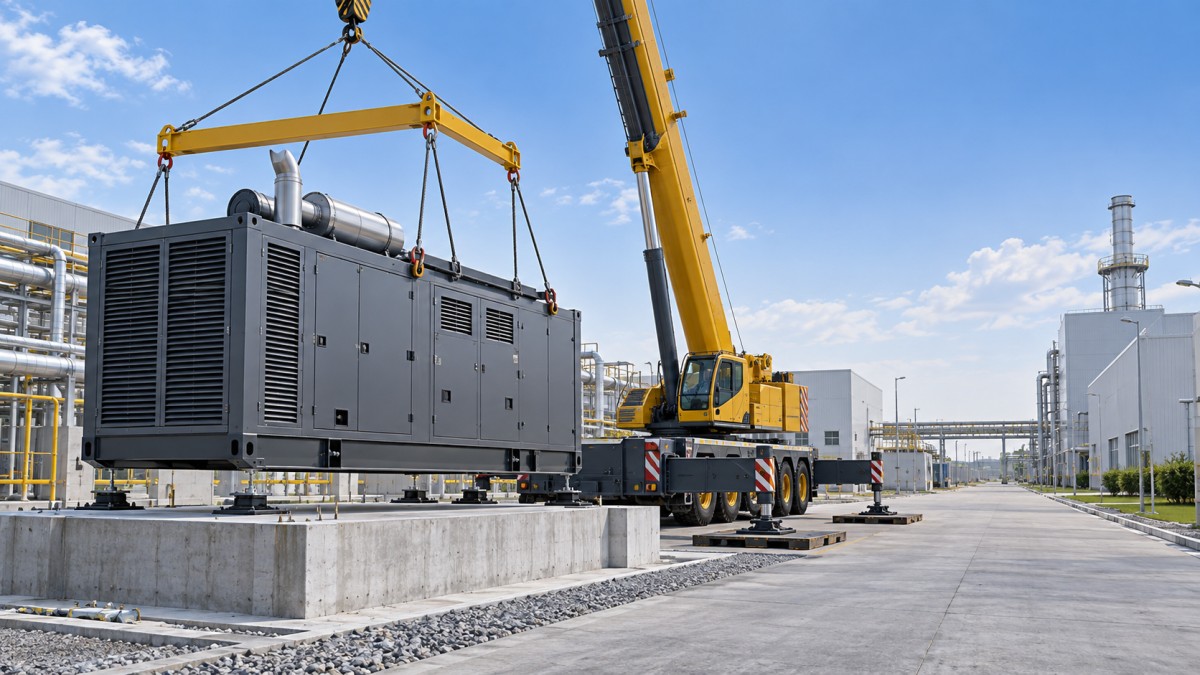
Treat ground bearing as a lifting requirement
A level-looking surface is not necessarily suitable for crane outriggers. The ground must support concentrated outrigger loads, not merely the weight of a moving truck. Recently backfilled soil, wet ground, trench covers, underground utility corridors, and pavement edges are all areas that deserve attention. A crane can become unstable even when the genset itself is within the rated lifting capacity.
The crane contractor will normally specify outrigger reactions and mat requirements after selecting the crane and lift configuration. The site owner or civil contractor should then confirm that the proposed setup area can carry those loads. If there is uncertainty, involve a qualified civil or geotechnical professional rather than assuming a concrete slab or compacted gravel area is sufficient. A temporary access road may need reinforcement, while a permanent foundation may need protection from outrigger loads during installation.
Drainage deserves the same attention. A good crane pad can become unreliable after rainfall if water is trapped near the outriggers. On oilfield and industrial sites, access may also be affected by excavation activity, buried services, or temporary pipework. Mark these conditions clearly during the pre-lift walkdown.
Plan the set-down area before the crane arrives
The final foundation should be complete, accessible, and clearly marked. Confirm its dimensions, elevation, anchor arrangement if used, and the direction in which service doors, control panels, exhaust connections, cable entries, gas piping, and ventilation openings must face. Rotating a container after it has been placed is not a minor correction. It may require another crane mobilization and can delay electrical and gas works.
Leave enough clear working space around the enclosure for riggers to remove slings safely and for installation crews to begin their work. Avoid placing the genset so close to walls, tanks, or cable trenches that routine service becomes difficult later. Operators often inherit the consequences of a poor layout: blocked access doors, restricted radiator airflow, or no practical route for replacing a major component.
Before the lift, agree on one person who has authority to direct final positioning. This person should understand the site layout and be in communication with the lifting supervisor. Hand signals and radios are useful, but they do not replace a clear positioning drawing and a pre-lift briefing.
Coordinate lifting with the rest of the installation sequence
A 1000kW Containerized GasGenset is usually one part of a wider package that may include gas conditioning equipment, switchgear, transformers, heat recovery equipment, fuel piping, exhaust routing, and remote monitoring connections. Crane access can disappear quickly once these items are installed. In many projects, the main container should be placed before adjacent skids, pipe racks, fencing, or permanent landscaping restrict the crane’s working envelope.
This is particularly relevant when a site uses several distributed energy assets. Smaller units may have more flexible handling requirements, but they still need sensible access for replacement and maintenance. For commercial and industrial projects considering combined heat and power, 18-150kW Natural Gas CHP Generators can be arranged as part of a staged energy layout; the important point is to preserve service lanes and lifting corridors rather than filling every available space with equipment.
Equipment manufacturers can help clarify interface requirements during the planning stage. AMICO Gas Power combines gas power equipment development with oilfield engineering and smart energy applications, so installation discussions should include not only the container placement but also realistic access for gas, electrical, cooling, and control-system work. The manufacturer’s drawings are useful, but the final lift plan must still reflect the actual site and the selected crane contractor’s method.
Use a pre-lift checklist that crews can act on
- Confirm the exact genset lifting weight, approved lifting points, center of gravity, and rigging requirements.
- Verify crane capacity at the planned radius, including hook block, slings, spreader beam, and other below-hook gear.
- Inspect the delivery and crane routes for turning restrictions, overhead obstructions, soft ground, and utility hazards.
- Confirm ground bearing conditions and outrigger mat requirements before crane mobilization.
- Mark the genset orientation and final foundation position, including service-side clearance.
- Keep non-essential people and vehicles out of the lifting zone and define a controlled exclusion area.
- Review weather conditions, especially wind, rain, lightning risk, and reduced visibility.
- Hold a short lift briefing so transport staff, riggers, crane operators, and site representatives understand the sequence.
The safest crane setup is usually the one that looks almost uneventful: a clear route, firm outriggers, verified rigging, no last-minute repositioning, and a foundation ready to receive the container. If the plan requires guesswork about weight, reach, ground condition, or clearance, pause and resolve it before delivery. That is far easier than correcting a problem with a suspended genset over the site.

Contact Us
Please use the form below to contact us.
If you require a response, we will contact you as soon as possible.