


Why a 500 kW gas generator set may misfire under changing loads
Why a 500 kW Gas Generator Set May Misfire Under Changing Loads
A 500 kW gas generator set can misfire when loads change rapidly, causing unstable output, higher fuel consumption, and unexpected downtime.
For operators, the key issue is rarely one defective part. Misfire usually results from delayed coordination between fuel, air, ignition, and engine controls.
Why Load Changes Trigger Misfire in a 500 kW Gas Generator Set
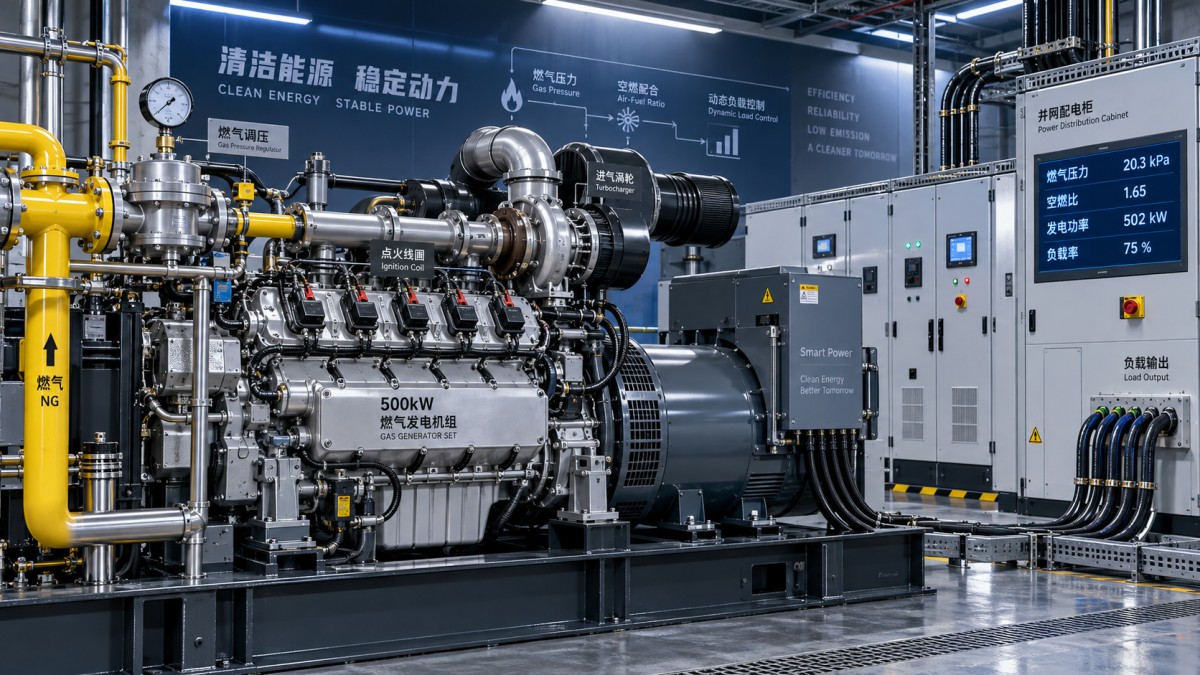
When electrical demand rises suddenly, the generator must produce more torque immediately. The engine requires additional fuel and air before speed and frequency decline.
If the gas supply system, throttle actuator, mixer, or electronic control unit responds too slowly, cylinders may receive an incorrect air-fuel mixture.
A mixture that becomes too lean may burn slowly, burn inconsistently, or fail to ignite completely. This is a common reason for misfire alarms.
A mixture that becomes excessively rich can also reduce combustion quality. It may cause unstable exhaust temperatures, blackened spark plugs, and increased emissions.
Load rejection creates the opposite challenge. When demand drops quickly, fuel delivery must decrease fast enough to prevent overspeed and rich combustion.
Operators often notice symptoms first as frequency fluctuation, unstable engine sound, high exhaust temperature deviation, reduced power output, or repeated cylinder misfire codes.
These symptoms should not be treated as isolated electrical faults. They often indicate that the complete combustion control system needs inspection and adjustment.
Check Gas Pressure Before Adjusting Ignition or Fuel Settings
Gas pressure stability is one of the first items to verify when a 500 kW gas generator set misfires during changing loads.
Low inlet pressure can prevent the engine from receiving enough fuel during a load step. The controller may command more fuel, but flow remains limited.
High pressure can make fuel delivery difficult to control, especially when the regulator response is slow or the gas train is incorrectly sized.
Record gas pressure at steady load, during load acceptance, and during load rejection. A stable no-load reading does not prove dynamic pressure performance.
Inspect filters, pressure regulators, shutoff valves, flexible connections, and gas piping diameter. Restrictions may only become obvious when fuel flow increases sharply.
Fuel composition also matters. Methane number, heating value, propane content, moisture, and contaminants can change combustion behavior and control calibration requirements.
Where site gas quality varies, operators should use trend records rather than relying only on occasional laboratory reports or supplier declarations.
Compare misfire events with gas pressure and fuel-quality changes. This helps distinguish an engine fault from an upstream fuel supply problem.
Air-Fuel Balance Must Follow the Load Fast Enough
Correct air-fuel ratio is essential for reliable combustion. Under fluctuating loads, the required ratio changes faster than many operators expect.
Turbocharged gas engines need time to build boost pressure after a load increase. Fuel flow may rise sooner than available intake air.
Conversely, a poorly calibrated fuel control system may limit fuel too aggressively. The result is a lean mixture and intermittent firing across affected cylinders.
Check the condition of the air filter, intercooler, turbocharger, intake ducting, and charge-air temperature sensors before changing software calibration.
A blocked air filter or contaminated intercooler reduces available air at high load. The unit may run normally at 50 percent load but misfire near rated output.
Leaks downstream of the airflow measurement point can also confuse control calculations. Small leaks may become significant when boost pressure rises.
Review oxygen sensor readings, lambda control commands, manifold pressure, throttle position, and fuel valve position together rather than examining each value separately.
A trend that shows lambda moving lean immediately after a load step usually points toward fuel delivery delay, pressure instability, or incorrect transient tuning.
Ignition Problems Often Appear Only During High Cylinder Pressure
Ignition components may appear acceptable during idling or moderate loading, yet fail when combustion chamber pressure rises during heavy operation.
Higher cylinder pressure requires more ignition voltage. Weak coils, worn spark plugs, damaged leads, or poor electrical connections may then cause cylinder misfire.
Inspect spark plug gap, electrode wear, deposits, insulation condition, and tightening torque according to the engine manufacturer's maintenance specification.
A plug with excessive gap may fire at low load but fail during rapid loading. A fouled plug can similarly create irregular combustion.
Check ignition coil output and connector condition where diagnostic tools are available. Heat, vibration, and oil contamination can weaken components over time.
Ignition timing also affects transient performance. Timing that is too advanced may lead to knocking, while overly retarded timing can reduce power response.
Do not make large timing changes without confirming fuel quality, knock sensor function, and applicable engine parameters. Incorrect adjustment can cause severe engine damage.
When one cylinder repeatedly misfires, swap comparable ignition components only under approved procedures. A moving fault strongly supports a component-level diagnosis.
Control Response and Load Management Can Prevent Repeated Trips
The generator controller must interpret load demand, command the engine, regulate speed, and maintain voltage within a very short operating window.
Incorrect governor gain, unstable PID settings, delayed actuator movement, or poorly configured load sharing can produce oscillation after load changes.
In parallel systems, one machine may accept too much reactive or active load while another responds slowly. This can push individual units into unstable operation.
Review the size and sequence of connected loads. Large motors, compressors, pumps, and welding equipment may create steps beyond the expected transient capability.
Soft starters, variable-frequency drives, staged loading, and properly configured automatic transfer controls can reduce sudden demand on the generator set.
Operators should also confirm that the set is not routinely operated outside its recommended load range. Very light loading can cause separate combustion and temperature issues.
For sites with highly variable demand, use logged load profiles to identify recurring events. Misfire timing often matches a specific process start or stop sequence.
Stable operation depends on the generator, switchgear, gas train, and driven facility responding as one coordinated system rather than independent components.
A Practical Troubleshooting Sequence for Operators
Start by recording the exact operating condition: load percentage, step size, engine speed, frequency, gas pressure, alarms, and affected cylinder numbers.
Next, determine whether misfire occurs during load increase, load decrease, steady high load, or random operation. This distinction narrows the likely causes.
Inspect gas pressure trends before replacing ignition parts. A supply problem can create multiple-cylinder misfires that resemble an ignition system failure.
Then inspect intake restriction, boost pressure, charge-air temperature, and lambda values. These measurements reveal whether combustion is becoming lean or rich.
Check spark plugs and ignition coils after reviewing fuel and air data. Replace consumable ignition parts according to condition and maintenance history.
Verify controller event logs and actuator feedback. A fuel valve or throttle command that differs from actual movement may reveal mechanical delay or calibration issues.
After repairs, test the unit with controlled load steps. Increase load gradually while monitoring frequency, exhaust temperatures, gas pressure, and misfire counters.
Do not clear alarms and return directly to unattended service. Confirm stable performance through repeated load acceptance and rejection cycles.
Choose Equipment and Support That Match the Actual Fuel Application
Reliable gas power generation depends on selecting equipment that suits the available fuel, expected load profile, environmental conditions, and operating strategy.
For applications using liquefied petroleum gas, correctly matched fuel controls and pressure regulation are particularly important because fuel behavior differs from pipeline natural gas.
AMICO develops gas power control technologies, generation equipment, distributed energy solutions, and smart energy management systems for demanding industrial applications.
Its gas-engine development, testing, and inspection capabilities support configuration decisions that consider fuel conditions, dynamic loads, and long-term operating reliability.
For smaller distributed applications, the AMC300LS model provides 300 kW common power, 415 V rated voltage, and 542 A rated current.
Operators evaluating fuel-specific equipment can review LPG generator sets when planning an LPG-based generation solution.
Conclusion
A 500 kW gas generator set usually misfires under changing loads because combustion control cannot maintain the correct air, fuel, and ignition conditions quickly enough.
Begin troubleshooting with dynamic gas pressure, load-step records, air-fuel data, and ignition condition. This sequence avoids unnecessary part replacement and reduces downtime.
When recurring misfire follows a known operating event, address the load profile and control response together. Reliable generator performance requires a complete system view.

Contact Us
Please use the form below to contact us.
If you require a response, we will contact you as soon as possible.