


Can a 1000 kW containerized gas genset meet grid synchronization rules?
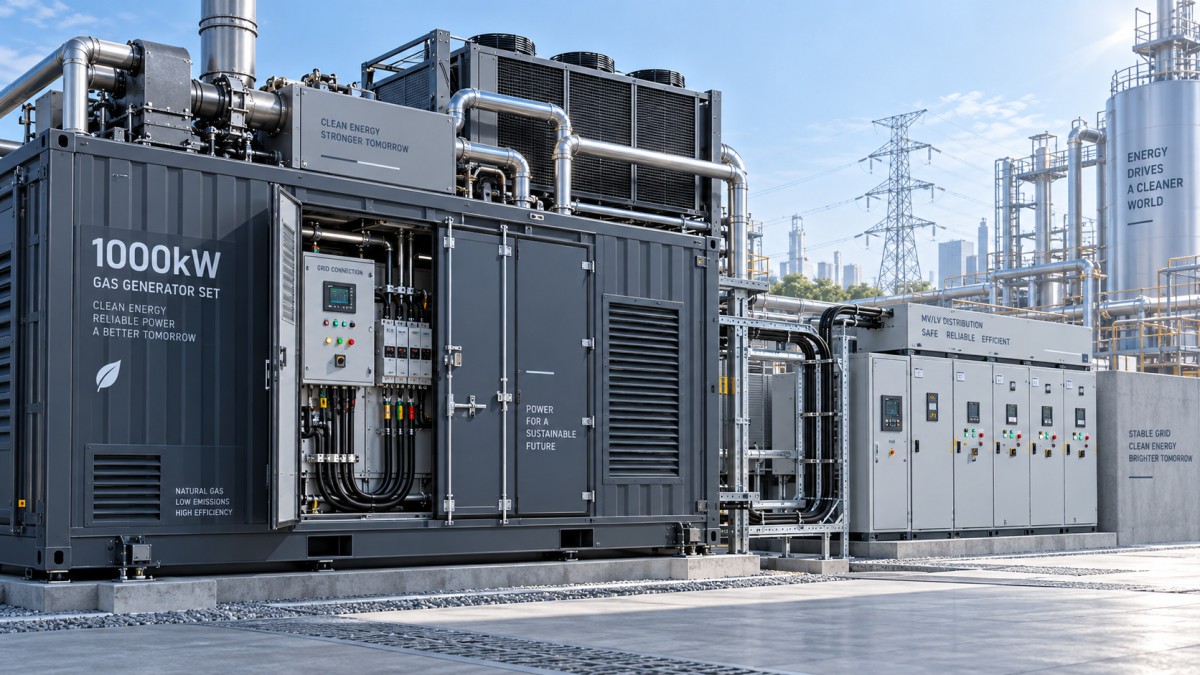
Can a 1000kW Containerized GasGenset meet modern grid synchronization rules without compromising stability or efficiency? For a technical evaluator, the short answer is yes—but only when the package is designed as a coordinated power plant system rather than simply a gas engine and alternator placed inside a container.
Successful grid-parallel operation depends on more than matching voltage, frequency, and phase angle at the breaker. The genset controller, generator excitation system, gas engine governor, protection relays, switchgear, utility interface, and site operating philosophy must all work together. A 1000 kW unit can be technically capable of synchronization, yet still fail an interconnection review if its protection settings, reactive power response, communications, or islanding logic do not match the local grid code.
Synchronization is a controlled closing event—not a single feature
Before a generator breaker closes onto a live bus, the control system must verify that generator voltage, bus voltage, frequency, phase sequence, and phase angle are within permitted limits. The exact closing window is determined by the utility, project specification, generator inertia, breaker operating time, and the selected synchronizer.
For a 1000kW Containerized GasGenset, automatic synchronizing normally involves three connected functions:
- Speed governing: adjusts engine output so generator frequency approaches grid frequency.
- Automatic voltage regulation: controls excitation to align generator voltage and manage reactive power after closing.
- Synchronism checking: supervises voltage difference, slip frequency, phase angle, and breaker closing timing.
These functions should not be evaluated in isolation. A fast synchronizer cannot compensate for an unstable gas engine speed loop, and a well-tuned AVR cannot solve a poorly coordinated reactive power control scheme. Technical reviewers should ask for the full control architecture, including the controller model, governor interface, AVR mode, synchronizing method, and protection relay arrangement.
What grid rules usually require
Interconnection rules vary by country, utility, voltage level, and whether the installation exports power. In North American projects, IEEE 1547 and utility-specific interconnection requirements may be relevant. Other markets may refer to IEC-based protection practices, national grid codes, or local distribution network requirements. The applicable standard must be identified during project engineering; no containerized generating set should be described as universally “grid-code compliant” without defining the target jurisdiction and operating mode.
Even so, most reviews examine a familiar group of functions:
- Over/under-voltage and over/under-frequency protection
- Overcurrent, short-circuit, and earth-fault protection coordination
- Reverse power protection to prevent unintended motoring
- Loss-of-mains or anti-islanding detection
- Vector shift, rate-of-change-of-frequency, or transfer-trip logic where required
- Synchronism-check protection and controlled breaker closing
- Reactive power, power factor, or voltage control at the point of common coupling
- Event recording, alarms, and remote communications for utility supervision
A 1000 kW rating does not itself create a synchronization barrier. However, it is large enough that an uncontrolled trip, poor load transfer, or reactive power step can be noticeable on a weak distribution feeder. The local short-circuit ratio, transformer impedance, feeder capacity, and existing distributed generation therefore matter as much as the genset nameplate.
The operating mode changes the engineering answer
A technical assessment should begin with a simple question: What is the generator expected to do after it synchronizes?
Peak shaving is relatively straightforward when the utility remains the dominant source and the genset is controlled to a fixed kW output or site import limit. The engine governor must respond smoothly to load commands, while the AVR maintains the required power factor or kvar target.
Parallel standby operation adds transition requirements. The system may need closed-transition transfer, soft loading, soft unloading, and controlled separation from the grid. Breaker timing and load ramp rates become important because abrupt steps can cause frequency excursions, reverse power trips, or nuisance protection operation.
Export operation is more demanding. The plant must accurately regulate exported active power, comply with utility limits, and demonstrate protection selectivity. The point of measurement also becomes critical: controlling power at generator terminals is not the same as controlling power at the point of common coupling after transformer and auxiliary loads.
Intentional islanding is the most complex case. If a facility must remain energized after a grid outage, the controls need a clearly engineered sequence for grid separation, load shedding, frequency recovery, voltage control, and later resynchronization. A standard grid-parallel package is not automatically a microgrid controller.
Where containerization helps—and where it does not
Containerization can improve integration because the engine-generator set, control cabinet, cooling circuit, ventilation, fuel train, and local switchgear are assembled in a defined factory environment. This reduces field wiring uncertainty and can make functional testing more repeatable. It is particularly useful for remote oilfield facilities, distributed energy sites, and projects where installation time is tightly managed.
Yet the enclosure alone does not establish grid readiness. The interface equipment outside or beside the container may be decisive: utility metering, step-up transformer, main paralleling switchboard, point-of-common-coupling protection, remote trip circuit, and communication gateway all require project-specific design.
Environmental controls also deserve attention. At sustained 1000 kW output, heat rejection, combustion-air quality, and exhaust backpressure directly affect engine stability. In emissions-sensitive or enclosed-site applications, the exhaust system should be considered alongside electrical compliance. A properly matched exhaust treatment arrangement can support permitting objectives while avoiding excessive backpressure that may reduce available engine performance.
Control performance to verify during technical evaluation
Rather than accepting a general statement that a genset “supports parallel operation,” evaluators should request documented answers to practical questions. Can the controller perform dead-bus closing as well as live-bus synchronization? Does it support isochronous load sharing, droop control, base-load control, and import/export control? Which signals are hardwired, and which depend on a network? What happens if communications fail?
The gas engine’s fuel control is equally important. Natural gas quality can vary across pipelines, biogas sources, associated gas streams, and field production sites. Changes in methane number, heating value, or pressure may affect combustion stability and load acceptance. For grid-parallel duty, the fuel system and engine management strategy should maintain stable kW response within the anticipated gas specification, rather than only under ideal test conditions.
AMICO Gas Power’s background in gas power control technologies, gas generation equipment, oilfield engineering, and smart energy management reflects why these interfaces should be reviewed as one system. At a 1000 kW scale, the best result comes from aligning engine behavior, electrical controls, site gas conditions, and the grid connection study early in the design process.
A practical acceptance checklist
Before approving a 1000kW Containerized GasGenset for grid synchronization, confirm the following items are available and project-specific:
- A single-line diagram showing the utility interface, breakers, CTs, VTs, transformer, meters, and protective devices.
- A protection coordination study with proposed relay functions and settings.
- Controller and AVR documentation covering synchronizing, kW/kvar control, load sharing, and fallback behavior.
- A grid study addressing fault level, voltage rise, harmonic considerations where applicable, and feeder strength.
- A defined commissioning procedure for rotation checks, dead-bus tests, first synchronization, load ramps, trip tests, and utility witness testing.
- An operating narrative covering normal parallel operation, utility loss, planned disconnection, alarms, emergency shutdown, and resynchronization.
The most important distinction is between equipment capability and approved site operation. A well-engineered containerized gas genset can synchronize reliably and meet applicable rules, but compliance is established at the complete installation level. When control settings, protection philosophy, fuel quality, and grid requirements are treated as connected decisions, a 1000 kW gas generation package can become a stable and useful asset rather than a difficult interconnection risk.

Contact Us
Please use the form below to contact us.
If you require a response, we will contact you as soon as possible.