


What causes high container temperatures in a 300 kW gas generator set?
A high container temperature in a 300 kW gas generator set is not simply an “engine overheating” problem. The container can become excessively hot even when coolant temperature remains within limits, and the engine can overheat while the enclosure temperature sensor appears normal. The distinction matters because the corrective action is different: one condition points to heat rejection from the engine and radiator, while the other often points to ventilation, airflow short-circuiting, exhaust leakage, or site conditions.
For a 300 kW Containerized gasgenerator set, abnormal enclosure heat should be treated as an operational warning rather than an inconvenience. High temperatures accelerate deterioration of cable insulation, control modules, battery components, rubber hoses, sound-attenuation materials, and gas-system seals. They can also reduce alternator cooling margin, raise intake-air temperature, and force derating or protective shutdown.
Start by identifying which temperature is actually high
Before changing fan settings or opening access doors, compare the relevant readings:
- Engine coolant outlet temperature: indicates whether the engine cooling circuit is rejecting heat effectively.
- Container internal temperature: indicates whether hot air is being removed from the enclosure.
- Radiator air inlet and outlet temperatures: reveal whether the radiator is receiving sufficiently cool air and transferring heat to the exhaust stream.
- Engine intake-air temperature: helps show whether the engine is breathing recirculated hot air.
- Alternator winding or bearing temperature: can identify a localized cooling problem even if the general container temperature appears acceptable.
A rise in coolant temperature together with a rise in container temperature commonly indicates inadequate heat extraction. A normal coolant reading but elevated enclosure temperature more often points to poor ventilation of the machinery space, leakage of exhaust heat, or an obstruction around the hot-air discharge path. A single abnormal sensor reading should also be checked against a handheld thermometer or an independent sensor before a major intervention is made.
Restricted air movement is the most common cause
Containerized generating sets rely on a controlled air path: fresh air enters through intake louvers, passes across the engine, alternator, and auxiliary equipment, then is drawn through or expelled by the radiator system. If this path is restricted at any point, heat accumulates inside the enclosure.
Common restrictions include clogged intake louvers, dust-loaded screens, damaged insect mesh, blocked radiator fins, collapsed flexible ducting, and sound-attenuation panels that have detached into the airflow path. In dusty oilfield, landfill-gas, agricultural, or biogas locations, contamination can build up quickly. Fine dust and oily residue are particularly problematic because they bind to radiator fins and reduce both air volume and heat-transfer area.
Radiator cleaning should not be limited to the surface visible from an access door. Debris is often driven into the core and trapped between the radiator, charge-air cooler, oil cooler, or protective guard. Cleaning direction matters: where practical, air or water should be applied from the cleaner side toward the dirtier side, using pressure low enough to avoid folding fins. Bent fins and damaged core surfaces can restrict airflow just as effectively as dirt.
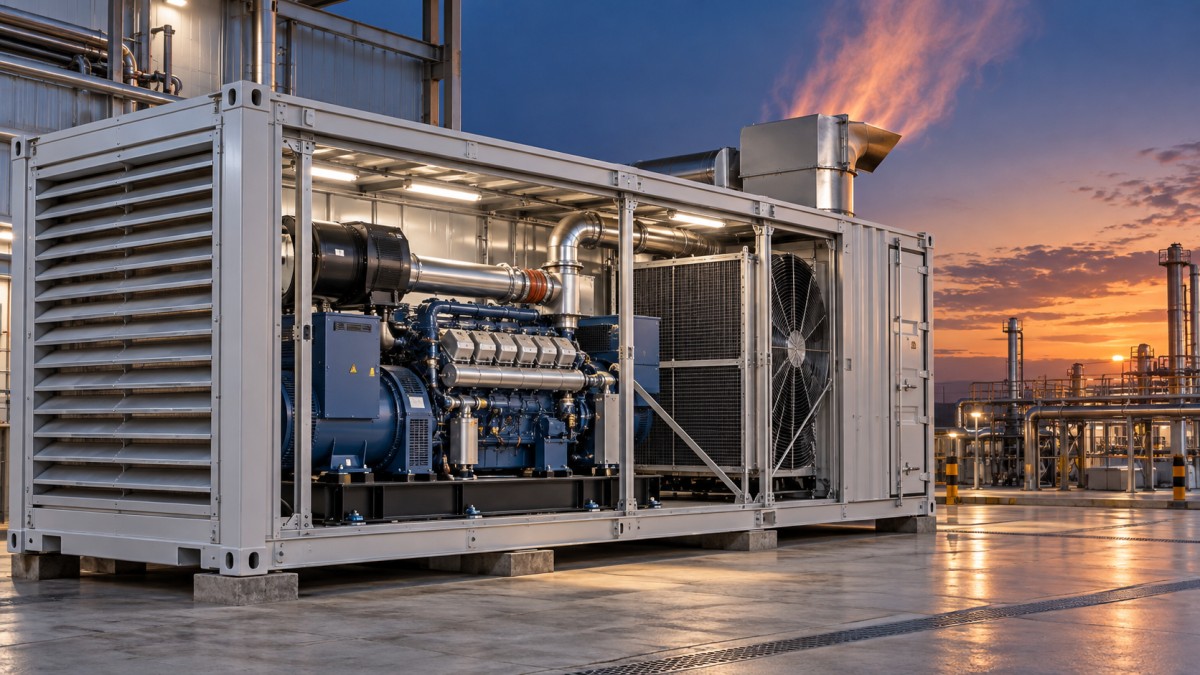
Airflow can also be reduced by a fan problem. A loose belt, slipping drive, incorrect fan rotation after electrical work, damaged blades, a failed fan clutch, or variable-speed fan control faults may leave the engine apparently functional while reducing cooling capacity. Fan performance should be judged by actual air movement and temperature response, not only by whether the fan is turning.
Hot-air recirculation can defeat an otherwise healthy radiator
A radiator needs cool ambient air. If its discharged hot air is pulled back toward the intake louvers, the set repeatedly cools itself with progressively hotter air. This is a frequent cause of elevated container temperatures after installation changes, especially where the unit is located close to a wall, inside a partially enclosed canopy, under a low roof, or beside another generator.
Recirculation is not always obvious from a visual inspection. The discharge path may look open, yet wind direction, nearby structures, cable trenches, acoustic barriers, or adjacent equipment can redirect hot air toward the intake. Temperature measurements at the inlet louver are more useful than assumptions. If the inlet air is substantially warmer than the surrounding ambient air while the generator is operating, recirculation should be investigated.
Seals around the radiator discharge duct are equally important. In a container design, the radiator fan must force hot air outside rather than allowing it to spill into the enclosure. Gaps around the radiator frame, damaged rubber seals, loose panels, or poorly seated service doors create a bypass route. The fan then draws some of its own discharge air back through the container, raising internal temperature and reducing the radiator’s effective cooling capacity.
High ambient temperature reduces the available cooling margin
The cooling system rejects heat according to the difference between coolant temperature and incoming air temperature. When ambient temperature rises, that difference becomes smaller. The same generator load that is stable during a cool morning may trigger an enclosure alarm in the afternoon without any mechanical failure.
Altitude adds another limitation. Less dense air carries away less heat, while high humidity and solar heat gain can further worsen enclosure conditions. A container exposed directly to sunlight can have a much higher internal air temperature than a shaded unit, particularly if the roof insulation or ventilation path is compromised.
The practical response is not to assume the set has a fixed 300 kW capability under every site condition. Operators should confirm the installation’s allowable ambient and altitude conditions against the generator documentation, then compare the actual operating load with those limits. If the issue occurs only during hot weather or at peak load, a cooling-margin problem is more likely than an intermittent sensor fault.
Engine-side cooling faults must not be overlooked
If both coolant and container temperatures are rising, inspect the engine cooling circuit as a complete system. Low coolant level, incorrect coolant concentration, air trapped in the circuit, a thermostat that does not open fully, a weak water pump, leaking hoses, or a restricted heat exchanger can all reduce heat removal.
Coolant chemistry matters as much as coolant quantity. Mixing incompatible formulations or repeatedly topping up with untreated water can encourage scale, corrosion, and deposits inside the radiator and engine passages. These internal restrictions cannot always be identified by looking at the external radiator core. A temperature difference across the radiator that is unusually small under load may indicate poor heat transfer, while a large difference combined with excessive coolant temperature may point more strongly to insufficient airflow.
Gas engines introduce another consideration: combustion quality can add heat load to the cooling system. Incorrect ignition timing, lean or unstable air-fuel control, poor gas pressure regulation, inadequate gas quality, or misfiring cylinders can produce abnormal exhaust temperatures and increase thermal stress. A high container temperature alone does not prove a combustion problem, but elevated exhaust temperature, unstable load acceptance, knocking alarms, or cylinder-to-cylinder temperature imbalance warrant engine-control checks.
Exhaust leaks heat the container directly
Exhaust leakage inside the enclosure is a serious and sometimes underestimated cause of high container temperature. Leaks at manifold joints, expansion bellows, turbocharger connections, flange gaskets, or flexible sections release extremely hot gas into the machinery space. Besides heating the container, exhaust leaks present fire, personnel-safety, and carbon monoxide risks.
Signs include localized discoloration, damaged insulation wraps, a sharp exhaust odor, soot deposits around joints, abnormal noise, or a temperature hotspot near the exhaust route. Inspection must be performed with appropriate safety controls; exhaust components remain hazardous long after shutdown. Do not use temporary insulation wrapping as the primary repair for a leaking joint. The leak source, failed gasket, cracked section, or loose fastener needs correction.
Electrical and auxiliary equipment can create localized heat pockets
Not every temperature alarm originates at the engine. Loose cable terminations, overloaded auxiliary circuits, failing contactors, battery-charger faults, poorly ventilated control cabinets, and alternator cooling restrictions can create concentrated heat within the container. Thermal imaging is useful after the set has stabilized under load because it can identify hot terminals, overheated busbars, and cabinet hotspots that ordinary visual inspection may miss.
Battery compartments deserve attention. High ambient temperature shortens battery life, while battery charging faults can generate additional heat. Ensure compartment vents are clear and that any battery-room airflow arrangement has not been blocked during maintenance or soundproofing modifications.
Smaller packaged units face the same basic air-management principles. For example, a 120-140 kW generator set used in biogas service still requires a clear separation between fresh-air intake and radiator discharge. The lower rating does not make poor airflow layout harmless; it merely changes the heat load and the size of the available margin.
A practical troubleshooting sequence
When the alarm occurs, record load, ambient temperature, coolant temperature, intake-air temperature, container temperature, fan status, and alarm time before unloading the set if safe operating procedures permit. A trend is more informative than an isolated value. Note whether the problem appears immediately after loading, only after extended operation, only at a certain load, or only during particular weather conditions.
Then inspect the external installation: clearances around intake and discharge openings, wall or roof obstructions, signs of hot-air recirculation, and accumulation of debris. Move inward to louvers, filters, radiator core, fan drive, duct seals, and access-panel condition. If airflow is satisfactory, assess coolant level and condition, radiator and heat-exchanger performance, exhaust integrity, and engine operating data.
Avoid the common shortcut of leaving enclosure doors open as a permanent solution. An open door may temporarily lower measured container temperature, but it bypasses the designed airflow pattern, exposes electrical equipment to dust and moisture, weakens acoustic performance, and can conceal the actual fault. It is useful only as a controlled diagnostic observation, not as a repair.
Stable container temperature depends on a matched system: clean heat-transfer surfaces, sufficient fan airflow, sealed discharge routing, unobstructed fresh-air intake, a sound engine cooling circuit, and an installation that does not recirculate its own heat. When these elements are checked in sequence, excessive temperature alarms become far easier to isolate than when attention is focused on the radiator alone.

Contact Us
Please use the form below to contact us.
If you require a response, we will contact you as soon as possible.