


Is a 300 kW containerized gas generator set practical for remote sites?
Is a 300 kW Containerized Gas Generator Set Practical for Remote Sites?
For an oilfield pad beyond the nearest utility line, a mine expansion camp, or a construction project moving from phase to phase, power is rarely a simple procurement item. It affects drilling schedules, worker accommodation, pumping systems, communications, safety equipment, and the cost of every hour spent waiting for a solution to arrive.
A 300kW Containerized gasgenerator set can be a practical choice when remote operations need a self-contained, transportable source of prime or standby power and have access to an appropriate gas supply. Yet “practical” depends less on the nameplate rating than on several site realities: the load profile, gas quality and continuity, delivery route, environmental requirements, service access, and plans for future expansion.
For business decision-makers, the most useful question is not simply whether 300 kW is enough. It is whether a containerized gas power package reduces operational risk more effectively than diesel generation, a smaller multi-unit setup, an oversized generator, or a delayed grid connection.
Start with the load curve, not the maximum connected load
A remote site may list more than 300 kW of connected equipment while drawing substantially less during normal operations. Conversely, a facility with a calculated 250 kW demand may still be a poor match for a single 300 kW unit if large motors, compressors, or pumps start simultaneously.
Before specifying a containerized gas generator, separate loads into three groups: continuous loads, intermittent process loads, and high-inrush starting loads. Lighting, accommodation services, telemetry, and base pumping demand may be steady. Welding, cranes, batch systems, and compressor starts are often less predictable. The generator must be assessed against both sustained demand and the most demanding operating sequence.
- Average demand: Indicates likely fuel use and operating efficiency.
- Peak demand: Determines whether the set can carry the site without nuisance trips or voltage instability.
- Motor starting requirements: May call for soft starters, variable-frequency drives, staged starts, or additional capacity.
- Growth allowance: Matters when a temporary camp or production facility is likely to expand within a year.
In many projects, a 300 kW rating works best where the expected running load sits comfortably below the unit’s maximum output and where startup events are managed. Running too lightly for extended periods can also undermine the economics of any generation asset. A power study should therefore test real operating patterns rather than rely on a single peak-demand estimate.
Gas availability is the deciding factor
Gas generation is especially compelling at sites with associated petroleum gas, pipeline natural gas, wellhead gas, or another dependable local gas source. It can turn a fuel logistics problem into an on-site energy strategy. For oilfield applications, that may mean using available gas that would otherwise require handling, flaring management, or disposal planning.
However, “gas available” is not the same as “gas suitable for an engine.” Pressure, methane content, heating value, moisture, hydrogen sulfide, heavy hydrocarbons, siloxanes, and other contaminants can influence fuel conditioning needs, combustion stability, component life, and maintenance planning. A project team should request a current gas analysis and understand how much that composition may change over time.
Where fuel is trucked in as LNG or CNG, the calculation becomes more complex. Gas may still offer emissions or operating-cost advantages, but those gains need to be weighed against delivery frequency, storage requirements, road access, vaporization equipment, and disruption risk during difficult weather. In such cases, the containerized generator is only one part of the energy system; fuel infrastructure deserves equal attention.
Why the container format matters in remote deployment
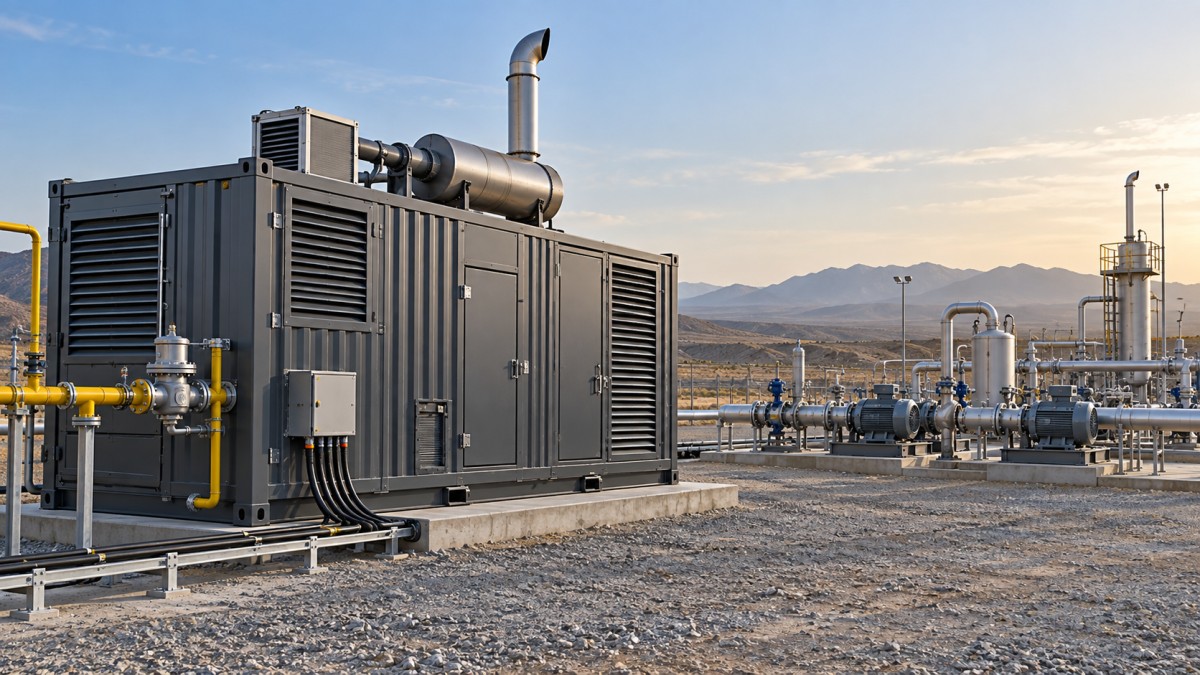
A conventional open generator may be suitable for a sheltered plant yard, but remote sites often need more protection and faster commissioning. A containerized package brings the generator, enclosure, acoustic treatment, controls, ventilation, and supporting systems into a more integrated form. This can simplify transport planning, site positioning, and protection from dust, rain, wind, and unauthorized access.
For project teams working under schedule pressure, the key benefit is not merely mobility. It is repeatability. A properly engineered containerized gas generator set can be prepared, delivered, connected, and later relocated with fewer field-built elements than a traditional generator room. That reduces some on-site coordination work, although it does not remove the need for foundations or leveling, cable routing, earthing, fuel-gas connections, exhaust clearance, and safe access for maintenance.
Noise can also shape the decision. Sites near accommodation blocks, environmentally sensitive zones, or neighboring operations may need a silent or acoustically managed arrangement. Container construction provides a practical platform for sound-control design, but buyers should request noise data measured at defined distances and operating conditions rather than assume every “silent” enclosure meets the same standard.
Operating cost: compare the complete system, not fuel price alone
Diesel remains familiar, widely available, and quick to deploy. It may be the right choice for a short-duration project with no reliable gas source. But at a site that runs day and night, diesel transport, fuel handling, storage losses, security, and resupply interruptions can become operational burdens as much as cost items.
A 300 kW containerized gasgenerator set may offer an attractive alternative when gas is already available at or near the site. The financial case should include fuel conditioning, pressure regulation, electrical distribution, planned maintenance, engine oil and consumables, remote monitoring, mobilization, and eventual relocation. Avoid comparing only generator purchase price against diesel fuel price; that shortcut often misses the costs that determine project performance over months or years.
Fuel efficiency also depends on control quality and load stability. Lean-burn, closed-loop fuel control is commonly used in gas generation to support efficient combustion, while electronic speed control helps maintain frequency as demand changes. These features are valuable, but they work best with suitable fuel quality, trained operators, and a correctly sized system.
Maintenance is manageable—but it cannot be an afterthought
Containerization protects equipment; it does not make maintenance disappear. Remote sites need a clear service model before commissioning. Who will inspect filters, ignition components, lubricants, cooling systems, battery condition, and safety devices? How quickly can critical spares arrive? Is there enough clearance around the container for technicians to work safely? Can the site team share operating data with an off-site specialist?
Gas engines have their own maintenance disciplines, particularly around ignition, air-fuel management, valve condition, and fuel quality. When these routines are planned into the operating schedule, gas generation can be dependable. When they are deferred because the unit is “out of sight” at a remote location, small performance changes can develop into avoidable downtime.
AMICO Gas Power Co., Ltd. develops gas power control technologies alongside gas generation equipment, oilfield engineering support, and smart energy management solutions. For purchasers, that integrated perspective is useful: the generator should be evaluated as part of the fuel, controls, electrical, and field-service system—not as an isolated box with a power rating.
When one 300 kW unit is not the best answer
A single 300 kW package is not automatically the most resilient configuration. If the site cannot tolerate any outage, two or more smaller synchronized units may provide redundancy and better part-load flexibility. One unit can be serviced while another carries essential loads. Conversely, when demand is stable and the consequence of a brief planned shutdown is acceptable, one appropriately sized containerized set may be simpler to manage.
Expansion plans should also be addressed early. A project expected to rise from 220 kW to 700 kW may benefit from parallel-ready controls, switchgear provisions, and a site layout that accommodates a second module. For higher-demand developments, solutions such as the 1200kW Silent type Containerized Gas Generator Set illustrate the value of integrated automatic control, one-key starting, paralleling, delivery, and shutdown functions. The principle applies at 300 kW as well: select controls for the operating strategy you will need, not just for today’s load.
A practical decision checklist
A 300 kW containerized gas solution deserves serious consideration when the site has a verified, continuous, engine-compatible gas supply; demand is reasonably stable or well managed; transport access supports container delivery; and the project requires fast deployment with controlled noise and weather protection. It is particularly relevant for isolated oil and gas facilities, temporary industrial camps, pumping stations, distributed-energy sites, and mining support operations.
It is less practical when gas composition is unknown or highly variable, the supply can be interrupted without backup, load spikes are uncontrolled, or the site requires N+1 redundancy but budgets for only one machine. In those circumstances, additional gas treatment, hybrid storage, parallel generation, or a diesel backup may be more prudent than forcing a single generator into an unsuitable role.
The strongest decision is built on a site survey, a measured load profile, a fuel-gas assessment, and a lifecycle operating plan. With those foundations in place, a 300kW Containerized gasgenerator set can be more than a temporary power source: it can become a practical, transportable energy asset that gives a remote operation greater control over its schedule and its fuel strategy.

Contact Us
Please use the form below to contact us.
If you require a response, we will contact you as soon as possible.