


Fire safety checks for a 300 kW containerized gas generator set
A 300 kW containerized gas generator set should not be treated as a conventional diesel unit placed inside a weatherproof enclosure. Its principal fire hazards arise from the interaction of fuel gas, ignition sources, hot surfaces, forced ventilation, electrical equipment, and the enclosed volume itself. A fire-safety inspection is therefore effective only when it verifies how these systems work together—not when it merely confirms that extinguishers are present and warning labels remain legible.
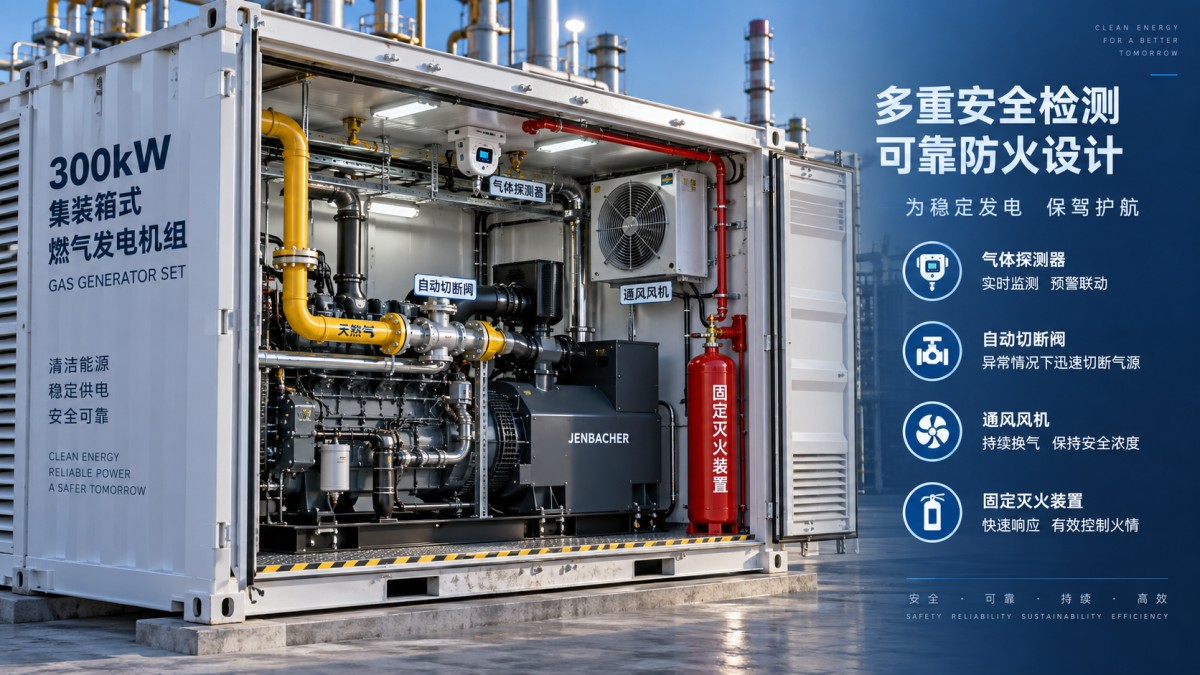
For a 300kW Containerized gasgenerator set, the most important safety conclusion is simple: gas containment, ventilation, detection, automatic isolation, and emergency shutdown must operate as one protective chain. Failure in any one link can leave an ignitable gas-air mixture inside the container, even when the engine, generator, and control system appear to operate normally.
Start with the fuel-gas boundary, not the engine
The first inspection priority is the complete gas path from the site connection to the engine gas train. This includes the upstream manual isolation valve, pressure-regulation equipment, flexible connectors where fitted, filters, solenoid shut-off valves, piping joints, and the engine-side gas admission components. The inspection should confirm both mechanical integrity and correct fail-safe behavior.
Visible damage, corrosion, loose fittings, unsupported pipework, degraded flexible hoses, and evidence of unauthorized modifications require immediate attention. Particular care is needed around threaded joints, valve bodies, pressure taps, and transitions between rigid pipework and engine-mounted components, since vibration can progressively affect these locations.
A leak-detection check should be completed using a method compatible with the gas system and site procedures. Open-flame leak testing is never acceptable. The objective is not simply to identify an active leak during a static inspection; it is also to establish whether the gas train holds pressure appropriately after isolation and whether automated valves close fully when their control signal is removed.
The shut-off logic deserves more scrutiny than the valve’s physical condition. On a gas detection alarm, emergency-stop command, fire signal, loss of control power, or engine trip, the required fuel valves should move to their designated safe state. The exact sequence must match the approved control narrative and local fire-safety requirements. A valve that appears closed but does not provide effective isolation is a hidden high-consequence defect.
Ventilation is a fire control function
Container ventilation is often reviewed as an engine cooling issue, but it is equally a hazardous-atmosphere control. Fresh-air intake, discharge openings, ventilation fans, dampers, louvers, and air paths must be inspected as a system. Blocked intake screens, damaged fan blades, stuck dampers, excessive dust accumulation, or altered duct arrangements can reduce air movement and allow gas to collect in pockets within the enclosure.
Inspection should establish that ventilation starts at the intended point in the operating sequence and remains available under the operating conditions defined by the generator design. Where the enclosure uses pre-start purging, the purge sequence, airflow-proving device, and start permissive should be tested according to the manufacturer’s procedure. A purge timer alone is not sufficient evidence of safety if there is no reliable indication that the ventilation path is actually open and moving air.
Gas behavior matters when selecting detector locations and interpreting readings. Methane-rich natural gas is lighter than air and can accumulate at high points, under the roof structure, or in poorly swept overhead spaces. LPG-related systems behave differently because released vapour may collect at lower levels. The fuel specification and the enclosure’s internal geometry should therefore govern detector positioning, rather than a generic layout copied from another installation.
Gas detection must trigger a proven response
A detector is not a complete safeguard unless it is calibrated, correctly located, powered, and linked to defined actions. The inspection record should identify the detector type, calibration gas or method, setpoints, calibration date, functional-test result, and the outputs initiated at each alarm level.
Typical protective actions may include local audible and visual alarm, engine trip, closure of gas shut-off valves, ventilation operation, remote alarm transmission, and prevention of restart until reset conditions are met. The required response is site- and design-specific; it should not be assumed from the display label on the detector.
Functional testing is more valuable than observing a healthy status light. The test should verify the complete chain: detector response, controller input, alarm annunciation, fuel isolation, engine shutdown where required, and remote indication if connected. Any bypass, inhibited input, overridden trip, or disconnected remote signal should be documented and controlled. Temporary bypasses are particularly risky during maintenance because they can remain active after the work is complete.
Control ignition sources inside the container
The engine exhaust system is an obvious hot surface, but it is not the only ignition source. Electrical terminals, battery systems, alternator components, crankcase heaters, chargers, relays, damaged cable insulation, and static discharge paths can all become relevant when combustible gas is present. Fire checks should therefore combine mechanical and electrical inspection.
Verify that exhaust insulation and guards are secure, undamaged, and free from contamination. Oil, dust, insulation debris, or combustible materials resting on or near exhaust components can ignite independently of a gas leak. Check flexible exhaust sections, clamps, thermal shielding, roof penetrations, and the condition of any exhaust lagging. Heat damage on nearby wiring, paint discoloration, or recurring alarm history may indicate an underlying installation or airflow problem.
Electrical enclosures should remain closed, correctly sealed for their intended environment, and free from moisture, condensation, dust build-up, or loose conductors. Cable entries must be protected against abrasion and should not compromise the container’s weather or fire barriers. Battery compartments require special attention: loose terminals, inadequate restraint, damaged insulation, and charging faults can create arcing or overheating hazards.
Bonding and grounding should be checked against the project electrical design. A proper grounding system does not prevent every fire scenario, but it supports fault clearing and reduces risks associated with exposed conductive parts and electrical faults. Grounding arrangements for the generator neutral must also align with the wider distribution system; arbitrary site modifications can create protection failures.
Fire suppression equipment must match the enclosure risk
The container’s fire-protection arrangement should be inspected against the approved project design and applicable local code. Portable extinguishers are useful for incipient fires only when access remains safe. They do not replace fixed detection, shutdown, ventilation control, or automatic suppression where those measures are required by the installation design.
Where a fixed suppression system is installed, inspect cylinder condition, agent quantity or pressure indication, release circuitry, manual release stations, discharge nozzles, piping, warning devices, and system impairment status. Nozzles must not be painted over, obstructed, redirected, or blocked by later-installed cables and equipment. A suppression system can be technically intact but ineffective if enclosure openings, ventilation dampers, or fuel isolation actions do not operate in the required sequence.
Fire doors, personnel doors, cable penetrations, and service openings also matter. Open penetrations can permit smoke or flame spread and can reduce the effectiveness of certain total-flooding systems. Door seals, closers, latches, emergency egress hardware, and exit access should be examined as part of the same inspection—not as separate civil-work details.
Emergency shutdown testing should distinguish safe trip from unsafe stop
An emergency-stop device that stops the engine but leaves the fuel path energized or fails to communicate the alarm is not an adequate result. Each emergency shutdown point should be tested for accessibility, identification, physical condition, control response, and restoration process. The test should confirm whether the shutdown command closes fuel valves, stops ignition and fuel admission, opens or trips the generator output as designed, activates alarms, and prevents unintended restart.
The restart condition is equally important. Following an emergency shutdown or gas alarm, the set should require deliberate investigation and reset in accordance with the control philosophy. Automatic restart without confirmation that the hazardous condition has cleared can reintroduce an ignition source into an unsafe enclosure.
For installations supplying essential loads, the shutdown logic must be coordinated with the site’s power continuity strategy. NFPA 37 addresses stationary combustion engines and associated installations, while NFPA 110 may be relevant where the generator forms part of an emergency or standby power system. NFPA 72 may apply to fire alarm interfaces, and NFPA 10 governs portable fire extinguishers. These references do not replace local building, fire, electrical, gas-installation, and authority-having-jurisdiction requirements. The applicable jurisdiction and approved project documentation remain decisive.
Use inspection records to identify repeat defects
A useful fire-safety record does more than mark items “pass” or “fail.” It identifies the equipment tag, inspection method, test condition, alarm or trip result, defect description, corrective action owner, completion date, and any compensating control used while the defect remains open. Repeated faults—such as low airflow alarms, detector drift, leaking fittings, nuisance trips, or recurring exhaust overheating—should be reviewed as patterns rather than closed as isolated events.
Inspection intervals should follow the manufacturer’s instructions, installed fire-system requirements, operating duty, fuel quality, site conditions, and legal obligations. A dusty, remote, high-vibration installation needs a different maintenance rhythm from a clean indoor standby unit. The key control is not a universal interval but documented evidence that each safety function has been examined and tested at a frequency justified by risk.
The same discipline becomes more important as gas generation capacity is aggregated. For example, a multi-unit arrangement such as a 1000kW Natural Gas Genset configuration introduces additional questions around common gas headers, shared ventilation effects, coordinated shutdown logic, and fire-zone separation. Capacity does not change the underlying safety principles; it increases the importance of verifying interfaces between units.
A containerized generator is fire-safe only when its protective systems remain functional under realistic fault conditions. The most defensible inspection outcome is therefore not “equipment present,” but documented proof that gas detection, ventilation, fuel isolation, electrical protection, suppression interfaces, and emergency shutdown act together before a release can become a fire or explosion event.

Contact Us
Please use the form below to contact us.
If you require a response, we will contact you as soon as possible.