


Can a 500 kW gas generator set use treated biogas safely?
Can a 500 kW Gas Generator Set Use Treated Biogas Safely?
A 500 kW gas generator set can operate safely on treated biogas, but “treated” is not a sufficient acceptance criterion by itself. The gas must be consistently suitable for the specific engine, not merely clean enough to burn. For quality-control and safety teams, the practical question is whether methane content, gas pressure, hydrogen sulfide, moisture, siloxanes, particulates, and oxygen remain within the limits agreed with the generator manufacturer under real operating conditions.
Biogas from anaerobic digestion, wastewater treatment, landfill operations, and organic-waste facilities can vary substantially from day to day. That variability is the main challenge. A generator may start and run during a short commissioning test, yet still suffer corrosion, unstable combustion, deposits, oil degradation, or repeated trips months later if gas treatment and monitoring are not designed as part of the power system.
Safe Operation Starts with a Defined Fuel-Gas Specification
A reliable project begins with a written fuel-gas specification. It should be issued or approved by the engine supplier and used by the site team as a measurable operating boundary. Generic biogas assumptions are risky because engine calibration, compression ratio, combustion strategy, derating behavior, and gas-train design differ between models.
Methane concentration deserves particular attention. It determines the gas heating value and directly affects the volume of fuel required to hold electrical output. When methane content falls, the generator needs more gas flow; if the gas system cannot deliver that flow at stable pressure, power output can decline or the engine can trip. Carbon dioxide is not combustible, but it is not harmless from an operational perspective: high or fluctuating CO2 reduces energy density and can make air-fuel control less stable.
A 500 kW gas generator set should therefore be assessed against the expected minimum, maximum, and normal gas composition—not only against an average laboratory result. Sampling should also reflect the full process cycle, including feedstock changes, digester upset conditions, seasonal temperature shifts, and periods after maintenance on the treatment plant.
Contaminants That Create the Greatest Safety and Reliability Risks
Hydrogen sulfide is usually the first contaminant examined, and for good reason. In the presence of water, it can contribute to corrosive conditions in pipework, gas trains, exhaust components, and lubricating oil. It also presents a serious personnel hazard because it is toxic. Removing H2S is not only an engine-protection measure; it is part of the site’s broader gas-safety strategy.
The removal system must be sized for peak sulfur loading, not simply normal loading. Media-based systems, biological desulfurization, chemical treatment, and other approaches may all be considered depending on the project. What matters is verified outlet performance, breakthrough management, safe handling of spent media where applicable, and an alarm response plan when H2S increases unexpectedly.
Moisture is another frequent source of avoidable failure. Raw biogas is normally saturated with water vapor. As gas cools in pipelines, condensate can form and carry corrosive compounds downstream. A properly arranged system uses cooling, separation, drainage, and, where needed, drying to control the dew point. Low points in piping, condensate pots, drain valves, and freeze protection should receive the same inspection discipline as the generator itself.
Siloxanes are especially relevant where the feedstock includes sewage sludge or certain municipal wastes. During combustion, they can form abrasive silica deposits on valves, piston crowns, cylinder heads, turbocharger parts, and exhaust-side components. Their presence cannot be judged by smell or by a basic methane reading. If the feedstock makes siloxanes plausible, laboratory testing and suitable adsorption or filtration arrangements should be considered before engine selection is finalized.
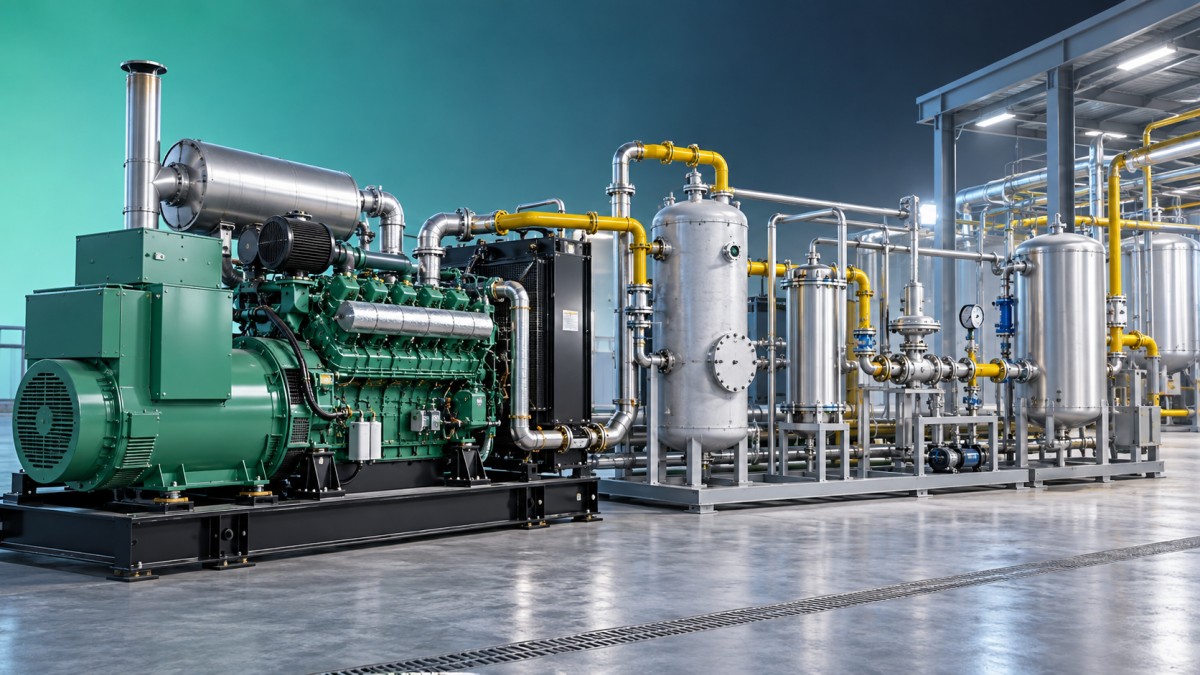
The Gas Treatment Skid and the Generator Must Work as One System
Treating gas is not just a matter of installing a scrubber upstream of the engine. The gas conditioning train must maintain pressure, temperature, cleanliness, and flow under transient conditions. Sudden demand changes, blower instability, a clogged filter, a full condensate trap, or treatment-media breakthrough can all reach the generator as a combustion problem.
At a minimum, the site’s design review should define the intended function of gas filtration, condensate removal, pressure regulation, overpressure protection, emergency shutoff, venting, and gas detection. Hazardous-area classification, electrical equipment selection, ventilation, ignition-source control, and emergency procedures must be confirmed against local requirements and the actual installation arrangement. These decisions belong to the project safety review, not to an afterthought during commissioning.
The engine control system also needs clear protective logic. Low gas pressure, high or low gas temperature, poor gas quality where online measurement is available, gas leakage alarms, overspeed, abnormal exhaust temperature, and misfire-related events should lead to defined warnings, load reduction, or shutdown actions. The right response depends on the engine manufacturer’s requirements and site risk assessment, but operators should never be left to interpret a developing fuel fault from a single alarm.
Quality Control Should Focus on Trends, Not Occasional Test Results
One clean gas report does not prove ongoing compatibility. A useful quality-control program combines continuous process indicators with scheduled sampling. Methane, oxygen, pressure, temperature, and H2S may require continuous or frequent observation depending on the system and risk profile. Moisture control should be verified through condensate management and dew-point-related checks. Laboratory analysis may be needed periodically for compounds that are not practical to measure continuously on site.
Generator operating data often reveals a problem before there is visible equipment damage. Watch for changes in specific gas consumption, load instability, exhaust temperature spread between cylinders, knock-control activity, oil condition, filter differential pressure, and unplanned shutdown patterns. These are not automatically proof of poor biogas, but they are valuable prompts to compare engine behavior with gas-quality records.
Lubricating-oil analysis is particularly useful in biogas service because corrosive contaminants and abnormal wear may not be visible during routine walkdowns. Maintenance intervals should not simply copy those used for pipeline natural gas. They should be reviewed after early operating data is available and adjusted within the engine supplier’s maintenance guidance.
Common Decisions That Lead to Trouble
The most common mistake is selecting a generator based only on nominal electrical capacity. A 500 kW rating says little about fuel tolerance. Teams should verify whether the quoted output applies to their actual gas composition, ambient conditions, altitude, and required operating mode. A set that is technically capable of using biogas may need derating when methane is lower than the reference fuel condition.
Another mistake is treating oxygen as a minor quality issue. Oxygen can enter through air leaks, poor digester sealing, or inappropriate gas-handling arrangements. Beyond its impact on fuel composition, it can affect combustion behavior and creates additional safety considerations. Its acceptable limit must be defined by the engine and system design, then monitored as part of routine operation.
Finally, do not assume that a successful no-load test demonstrates long-term suitability. The generator must be tested through realistic load steps and, where practical, against the expected range of fuel conditions. Commissioning records should document gas analysis, protective trips, pressure stability, exhaust readings, emissions obligations where applicable, and the final alarm setpoints approved for the site.
Applying the Same Discipline to Other Variable Gas Fuels
The same engineering approach applies beyond biogas. Oilfield projects using associated petroleum gas or flare gas also need composition analysis, contaminant control, pressure management, and protection logic before power equipment is matched to the fuel. Larger systems, such as the 1000kW Gas Generator set, are used in oilfield applications to convert APG and flare gas into electricity rather than sending usable fuel to a flare. The operational objective may include reducing flaring and related emissions, but safe performance still depends on the actual gas stream and site controls.
Amico Gas Power Co., Ltd combines gas-power equipment development with oilfield service capabilities, distributed power applications, and smart energy management. Its Chengdu facility includes gas-engine and generator development, testing, and inspection resources, while its R&D team has participated in China’s “863-Natural Gas Engine” national project. For projects involving non-standard gas, this kind of engineering background matters most when it is applied early: before the gas-treatment scope, engine configuration, control philosophy, and acceptance criteria have been locked in.
The practical answer is yes: treated biogas can safely fuel a 500 kW gas generator set when treatment performance is measurable, the engine is configured for the real gas quality, and site safety systems are designed around credible deviations rather than ideal conditions. Before approving a system, quality and safety teams should request the proposed fuel-gas specification, sampling plan, treatment-process limits, protective shutdown matrix, and maintenance approach. Those documents provide a far stronger basis for approval than a simple statement that the unit is “biogas compatible.”

Contact Us
Please use the form below to contact us.
If you require a response, we will contact you as soon as possible.