


Why industrial sites are adopting 500 kW gas generator sets for peak power
Industrial sites are not turning to a 500 kW gas generator set simply because they need more backup capacity. The stronger commercial case is peak-power control: reducing exposure to demand charges, avoiding production disruption during constrained grid periods, and creating a controllable on-site power source where grid supply is expensive, weak, or operationally inflexible.
For a facility with a relatively stable base load but short, costly demand spikes, 500 kW occupies a useful middle ground. It is large enough to support a meaningful portion of process load, refrigeration, pumping, compression, workshop equipment, or a critical production line. At the same time, it is small enough to be deployed as a modular asset rather than treated as a utility-scale generation project. The value is determined less by the nameplate rating than by whether the unit can reliably displace the site’s most expensive kilowatt-hours.
Peak demand changes the economics of on-site generation
In many industrial electricity tariffs, energy consumption and maximum demand are charged differently. A site may consume a moderate amount of electricity overall yet still incur substantial cost if it reaches a high import peak during a short billing interval. Starting several large motors, operating electric heating equipment, or running simultaneous production batches can create a peak that affects the bill far beyond the duration of the event.
A gas generator can be scheduled to run during those intervals, reducing the power drawn from the grid. This is commonly described as peak shaving, but the commercial logic deserves closer examination. A generator is not necessarily competing with the average grid electricity price. It is competing with the marginal cost of the highest-demand periods, including demand charges, time-of-use pricing where applicable, and the economic consequence of an overloaded connection.
The strongest projects tend to have a clearly identifiable load pattern: predictable peak windows, frequent short-duration high loads, or capacity constraints that would otherwise require a grid connection upgrade. Where a facility’s peak demand is irregular and difficult to forecast, the financial model becomes less certain because the generator may run too often, too little, or at inefficient load levels.
A 500 kW gas generator set can be particularly relevant where a site needs to offset a defined block of demand rather than cover its entire electrical load. A plant with a 1.5 MW connected load, for example, may not need 1.5 MW of generation if the commercial objective is to reduce a recurring 400–600 kW demand excursion. This distinction prevents the common error of sizing equipment around total installed load instead of the load that actually drives cost or operational risk.
Why gas can be preferable to diesel for recurring operation
Diesel generators remain important for emergency standby duty, especially where run hours are limited and fuel storage is practical. Peak shaving is a different operating profile. It may involve repeated starts, scheduled runs, parallel operation with the grid, and enough annual operating hours for fuel economics and maintenance behavior to materially affect lifecycle cost.
Where a reliable natural-gas supply is available, gas-fired generation can offer a more manageable fuel model for recurring operation. It avoids dependence on large volumes of on-site liquid fuel, reduces certain fuel-handling requirements, and may provide a more stable operating-cost basis than diesel in locations where gas and power tariffs support the case. It can also be relevant where local air-permitting conditions make diesel operation more restrictive.
That does not mean gas is automatically the lower-cost choice. The delivered gas price, gas-pressure stability, methane quality, connection cost, standby gas arrangements, and local emissions rules must all be included. A low gas commodity price does not compensate for inadequate pipeline capacity, poor fuel quality control, or an operating schedule that leaves the engine chronically underloaded.
For business evaluation, the relevant comparison is therefore not “gas versus diesel” in isolation. It is the annual cost of supplying peak power through each available route: grid imports, grid upgrades, diesel generation, gas generation, demand response, energy storage, or a hybrid arrangement. The right answer can vary substantially between sites under the same national energy market.
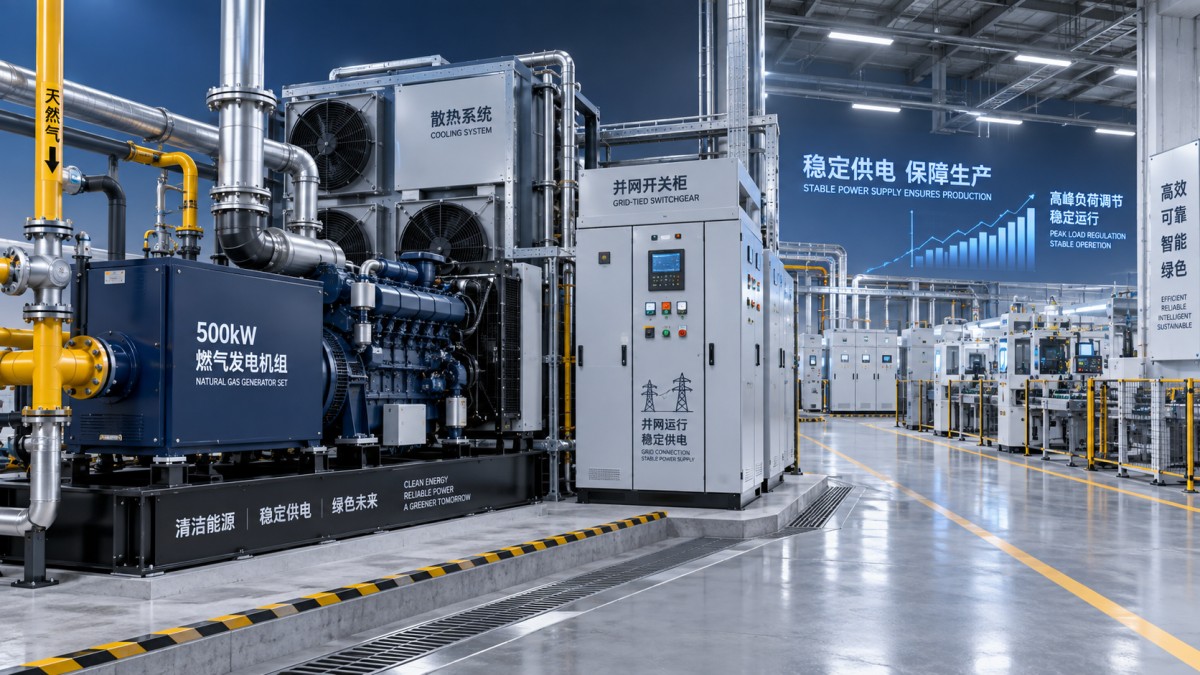
The 500 kW range supports modular decisions
A 500 kW unit is often evaluated because it allows a site to add capacity in increments. Modular generation can be easier to match with phased production expansion than a single large generator. It also creates more operational flexibility: one unit can follow a recurring peak, while multiple units can be sequenced as demand rises, maintenance is required, or resilience requirements change.
However, modularity should not be confused with redundancy. Two generator sets do not automatically provide a resilient system. The outcome depends on switchgear design, protection coordination, fuel supply, synchronisation controls, maintenance planning, and whether each unit can independently serve critical loads. A project that relies on one common gas regulator, one transfer panel, or one control point may still have a single point of failure.
For sites considering future expansion, engine platform selection also matters. Larger gas engines may support a different part of a distributed-power strategy where the load grows beyond the 500 kW range. For example, the 1100kW Gas-Powered Engine, model AMC1100DF-PN, is rated at 1100 kW at 1500 rpm and has an adjustable engine-speed range of 900 to 1800 rpm. Such specifications are relevant when assessing whether a supplier can support a wider capacity roadmap, but they do not make a larger unit a substitute for proper peak-load analysis. Oversizing a gas engine can reduce load factor and weaken both operating efficiency and project economics.
Fuel efficiency must be assessed at the expected load profile
Quoted fuel-consumption figures are frequently treated as if they represent annual operating cost. They do not, unless the stated load point matches the actual dispatch pattern. Gas engines generally perform best within a suitable operating band, while long periods at very low loading can reduce efficiency and complicate maintenance planning.
The financial model should therefore use an hourly or interval-based load profile where possible. It should identify:
- the site load before generator dispatch;
- the portion of load the generator is expected to carry;
- the anticipated number and duration of annual running events;
- minimum loading during those events;
- electricity tariff periods and demand-charge calculation rules;
- gas consumption at realistic, rather than ideal, operating points.
This approach reveals whether the generator is being used as a peak-shaving asset, a baseload asset, a reliability asset, or an attempt to perform all three roles without adequate sizing. These roles can coexist, but they create different design requirements. A set intended to run regularly at high load needs a different maintenance budget and spare-parts plan from a standby unit tested periodically.
Reliability is a system question, not an engine question
Industrial users often justify on-site generation partly through resilience. That reasoning is sound only when the system can transition safely and predictably during a grid event. A generator with adequate rated power may still fail to protect production if it cannot accept step loads, if starting currents are not managed, or if the control system is not configured for the site’s protection scheme.
Motor-driven loads require particular attention. Pumps, compressors, fans, conveyors, and chillers can impose high starting currents. Variable-frequency drives, soft starters, staged starting sequences, and load-shedding logic may be needed to ensure that the generator does not experience an unacceptable frequency or voltage dip. The practical usable capacity of a 500 kW set can therefore be lower than its nameplate rating during a poorly managed load transfer.
Parallel operation with the grid introduces further requirements. Controls must manage synchronisation, import limits, reverse-power protection, islanding behavior, and reconnection procedures. These are not minor engineering details: they determine whether a peak-power system can legally and safely deliver the expected commercial outcome. Local utility rules and permitting requirements should be reviewed before equipment procurement, not after installation design has been finalised.
Lifecycle cost is broader than fuel and equipment price
A low purchase price can distort the decision when the intended duty is frequent operation. A credible lifecycle model should separate capital expenditure from recurring cost and risk. Capital items can include the generator package, gas train, exhaust and ventilation systems, switchgear, civil works, acoustic treatment, grid-paralleling controls, commissioning, and utility-interface work. Costs that are often underestimated include permitting, gas connection upgrades, remote monitoring, critical spares, and operator training.
Recurring costs include fuel, lubricants, scheduled servicing, overhauls, replacement components, emissions-related consumables where required, insurance, and the cost of planned downtime. The model should also assign a value to lost production avoided during power interruptions, but only where that value can be established internally. Treating every outage as catastrophic can make any generation project appear attractive on paper.
Supplier capability affects this equation. The relevant questions are not limited to engine output and delivery lead time. Buyers should establish who is responsible for control integration, commissioning, warranty boundaries, spare-parts availability, remote diagnostics, field-service response, and long-term technical documentation. Gas generator projects can fail commercially when the package is purchased as equipment but operated as if it were a fully supported power system.
Where the case is compelling—and where it is not
The case for 500 kW gas generation is strongest when a facility has recurring expensive peaks, sufficient gas availability, a load profile that supports efficient engine operation, and a clear plan for grid interaction. It can also be a practical alternative to an expensive network-capacity upgrade when production expansion is approaching the limit of the existing connection.
The case is weaker where peak events are rare, gas supply is uncertain, emissions or noise restrictions create costly mitigation requirements, or the facility cannot support the operational discipline of a regularly dispatched engine. It is also weak when the proposed unit is sized only from connected load without reviewing interval demand data, starting loads, and tariff mechanics.
The central trend is not a simple move toward larger on-site generators. It is a shift toward more deliberate power-cost management. A properly evaluated 500 kW gas generator set can function as a controllable asset within that strategy, but only when capacity, fuel supply, controls, operating profile, and lifecycle obligations are assessed as one system rather than as separate procurement decisions.

Contact Us
Please use the form below to contact us.
If you require a response, we will contact you as soon as possible.