


Which emissions standards apply to gas generator sets at industrial sites?
The applicable emissions standard is determined by the installation, not by the generator label alone. A gas-fuelled engine at an industrial site is commonly assessed under a combination of national or regional engine-emissions rules, local air-permit conditions, fuel-gas requirements, and site-specific limits for stack discharge. The same rated unit can therefore face different compliance obligations when moved from standby service to continuous operation, from a remote oilfield to an urban industrial area, or from pipeline natural gas to associated petroleum gas.
For Gas Generator Sets, the main regulated pollutants are usually nitrogen oxides (NOx), carbon monoxide (CO), unburned hydrocarbons or volatile organic compounds (VOC), formaldehyde in some jurisdictions, and particulate matter. Carbon dioxide is normally handled through separate greenhouse-gas reporting, carbon-pricing, or project approval mechanisms rather than through the engine's local pollutant limit. Methane slip also deserves attention when the fuel contains a high methane fraction, because a low visible smoke level does not demonstrate low climate impact.
Start with the regulatory category of the installation
Authorities often distinguish between engines placed on the market and engines operating at a fixed industrial location. Product conformity requirements may apply when an engine or generating package is supplied, while stationary-source air rules govern the installed equipment after commissioning. A compliant engine certificate is therefore useful evidence, but it does not automatically satisfy the operating permit for the site.
Most jurisdictions classify a generator by several conditions at once:
- Duty cycle: emergency standby, limited-hours backup, peak-shaving, demand response, and prime or baseload service can be regulated differently. Annual run-hour limits are often as important as the emission concentration limit.
- Rated output: thresholds may be based on electrical output, mechanical engine output, heat input, or aggregate capacity of several units. Comparing a kW rating with a regulation written in thermal input can produce the wrong classification.
- Location: industrial zoning does not remove local air-quality obligations. Nearby residences, protected areas, existing pollution sources, and regional ozone conditions can lead to tighter permit terms.
- Fuel source and composition: pipeline gas, biogas, landfill gas, APG, and flare gas have materially different combustion and contaminant profiles.
A site with multiple small units should not assume that each machine is evaluated separately. Regulators may treat generators with a common fuel system, common exhaust discharge, coordinated operation, or a shared production purpose as one source group. This issue frequently appears late in a project, after the individual engines have already been selected.
Emission limits must be read with their measurement basis
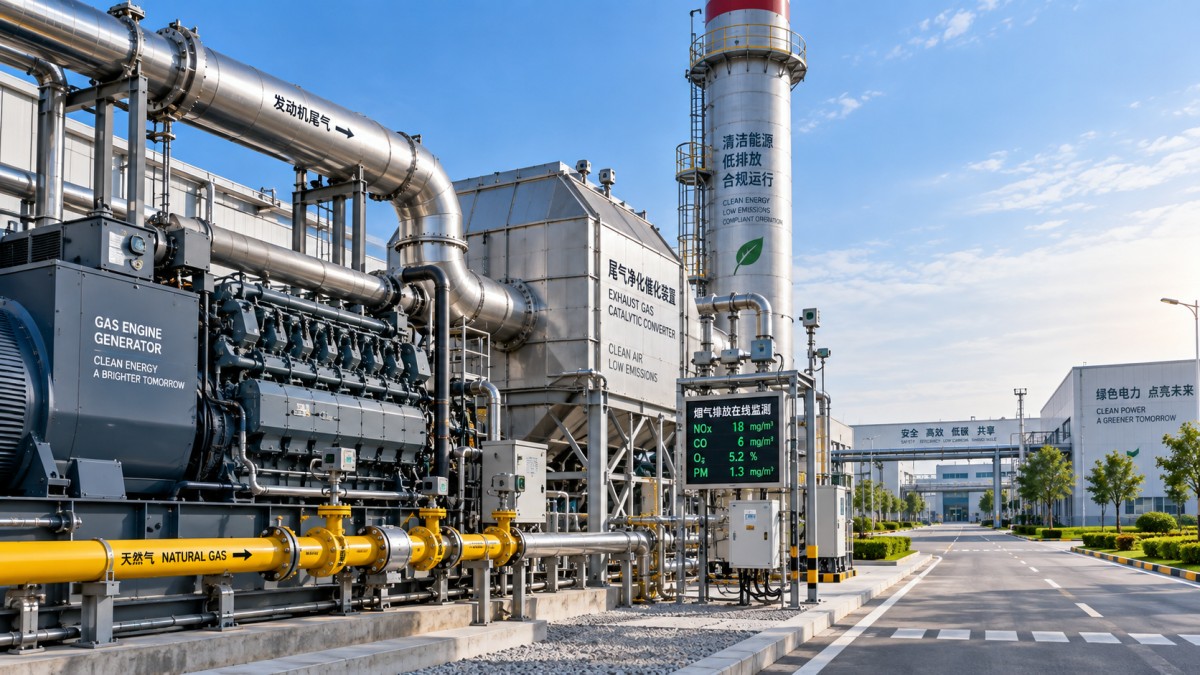
An emissions value has little meaning without its test basis. Limits may be expressed as concentration in dry exhaust gas, corrected to a specified oxygen reference, mass per unit of energy input, mass per unit of mechanical work, or total annual mass emitted. A lower-looking concentration is not necessarily better when the oxygen correction, gas moisture basis, engine load, or averaging period differs.
For example, a lean-burn gas engine generally operates with excess air. Its measured NOx concentration can change substantially with air-fuel ratio, ambient temperature, and load. If a permit specifies a dry, oxygen-corrected value but factory data are reported on a wet, uncorrected basis, the two numbers cannot be compared directly. The same problem arises when a package data sheet reports emissions at full rated load while the site will run at partial load for long periods.
Fuel quality can move an engine outside its original emissions envelope
Natural gas is not a single uniform fuel. Associated petroleum gas and flare gas may contain changing proportions of methane, heavier hydrocarbons, carbon dioxide, nitrogen, hydrogen sulfide, water vapor, and entrained liquids. These variations affect knock margin, combustion stability, exhaust temperature, and pollutant formation. A unit that meets an emissions target on a defined reference gas may require revised tuning, conditioning equipment, or a different aftertreatment arrangement when field gas composition changes.
Fuel treatment also has an emissions function. Liquid carryover can disturb air-fuel control and damage combustion components. Sulfur compounds may shorten catalyst life; siloxanes in certain renewable gases can form deposits that reduce catalyst activity and impair sensors. Removing these contaminants is not only a reliability measure. It protects the operating conditions under which the emissions performance was demonstrated.
At an oilfield, using APG or flare gas for power generation changes the comparison between flaring and engine exhaust, but it does not exempt the generator from applicable air rules. The project still needs a defined fuel specification, a method for responding to off-spec gas, and records that show whether the engine was operating within its approved range. A 1000kW Gas Generator set configured to convert APG or flare gas into electricity should therefore be evaluated against both the gas-analysis envelope and the local stationary-source requirements, rather than against nominal capacity alone.
Engine design and aftertreatment affect different pollutants
Lean-burn combustion is commonly selected for gas engines because it can provide efficient operation and comparatively low NOx formation. Its emissions profile is sensitive to mixture control and cylinder balance. Rich-burn configurations can be paired with three-way catalytic conversion, which can reduce NOx, CO, and hydrocarbons when the air-fuel ratio is maintained within a narrow control window. Neither approach is universally suitable: fuel variability, load transients, ambient conditions, and the required limit determine whether the control system can hold the needed operating window.
Selective catalytic reduction is another possible NOx-control route, particularly where low NOx limits apply. It introduces its own compliance points, including reagent storage, dosing control, catalyst temperature range, ammonia-slip management, and monitoring. A catalytic system should never be selected from its nominal reduction percentage alone. The relevant question is whether it maintains the required outlet concentration at the site's lowest expected load, highest expected ambient temperature, and expected fuel range.
CO and hydrocarbon limits can become difficult during starts, rapid load changes, misfire events, or cold catalyst operation. A permit may distinguish normal operating emissions from startup, shutdown, malfunction, or emergency operation. These definitions matter because an installation that cycles frequently may spend more time in transitional conditions than a continuously loaded unit. Counting only stable full-load test results can hide this exposure.
Permitting evidence should match the installed configuration
The evidence package should identify the exact engine family, rated output, combustion mode, fuel limits, control settings, exhaust stack arrangement, and aftertreatment fitted to the delivered unit. Generic brochures and test data for a different rating or fuel are weak support where permits require configuration-specific information.
Stack design is also part of the emissions assessment. Dispersion modelling, where required, depends on stack height, exit velocity, exhaust temperature, nearby buildings, and the interaction of multiple exhaust outlets. A taller stack may improve dispersion at a receptor without changing the mass emitted by the engine; it is not a substitute for meeting the source limit. Conversely, a compliant engine can still require a revised stack design if building wake effects cause elevated ground-level concentrations.
Commissioning and ongoing verification
Initial testing should be performed after the fuel system, engine controls, exhaust piping, catalyst, and ventilation arrangement are in their final operating condition. Calibration changes made after testing can alter emissions, especially on lean-burn units. Useful operating records include run hours by duty category, load history, fuel analyses, alarm and trip logs, catalyst maintenance records, replacement-part details, and documented engine tuning changes.
Continuous emissions monitoring is not required for every installation, but periodic stack testing alone may be insufficient where limits are tight or fuel quality varies substantially. Some permits instead require parameter monitoring, such as air-fuel ratio, exhaust temperature, catalyst temperature, oxygen level, or fuel-flow information. These parameters are valuable only when their acceptable ranges are linked to verified emissions performance.
Before final selection, the practical question is whether the intended operating pattern, fuel envelope, and exhaust arrangement can meet the applicable limit for the whole permitted life of the installation. A generator selected solely on rated output, a single full-load emissions figure, or a claim of compliance with an unspecified standard leaves too many of those conditions unresolved.

Contact Us
Please use the form below to contact us.
If you require a response, we will contact you as soon as possible.