


When gas generator sets make sense for combined heat and power
Gas generator sets make sense for combined heat and power when electricity demand and useful heat demand occur at the same site for enough hours to justify operating the engine steadily. The electrical output is only one part of the value. A CHP installation captures heat from engine cooling circuits and exhaust gases, then transfers it into hot water, process water, space heating, drying, or another local thermal load. When that heat is genuinely needed while the generator is running, fuel that would otherwise leave through radiators and exhaust equipment becomes a productive energy stream.
The strongest CHP opportunities are rarely defined by a single high utility bill. They are defined by a stable overlap: a site needs power, needs heat at a usable temperature, and can use both at roughly the same time. Facilities with continuous hot-water circulation, wash-down processes, low- or medium-temperature process heating, or year-round domestic hot-water demand often have a clearer CHP profile than sites whose heat load appears only during a short heating season.
Start with the heat load, not the generator rating
A common early mistake is sizing a gas generator from peak electrical demand and treating recovered heat as an added benefit. That approach can leave the engine operating when there is nowhere for the heat to go. Rejected heat reduces the practical advantage of CHP and can force part-load operation, cycling, or unnecessary heat-dump equipment.
Instead, build an hourly view of the thermal load before selecting the generating capacity. Separate heat demand by temperature and by purpose. Water required at a moderate temperature for cleaning, preheating, or hydronic distribution is different from steam demand or a process that needs a much higher supply temperature. Engine jacket-water recovery can serve many lower-temperature duties directly, while exhaust recovery often requires a carefully designed heat exchanger and controls to match the required delivery temperature.
Seasonality also changes the answer. A building with large winter heating demand can look attractive on an annual gas-consumption chart, yet the CHP unit may have limited use in warm months. By contrast, a process site with stable wash water or production heating may have a smaller peak load but better year-round heat utilization. Thermal storage can smooth short mismatches, but it cannot solve a long period in which recovered heat has no useful destination.
When the operating profile supports CHP
Gas Generator Sets are well suited to CHP where long operating hours and predictable loading allow the engine, alternator, heat-recovery circuit, and electrical interface to run as a coordinated system. Continuous or regularly scheduled operation is easier to optimize than short, irregular starts. Frequent stop-start duty can reduce the time available to recover energy and increases the importance of sequencing, warm-up, cooldown, and maintenance planning.
Electrical demand should be examined beyond the monthly total. Review the base load, daily peaks, large motor starts, reactive-power requirements, and any load that cannot tolerate a transfer interruption. A generator rated for a specific output may still be poorly matched if the normal site load is far below the intended operating range or if a single intermittent load repeatedly pushes the unit toward its limit. Paralleling multiple smaller units can be preferable where the electrical and thermal loads vary sharply, because capacity can be staged instead of forcing one large engine to run inefficiently.
Fuel availability deserves equal attention. Natural gas supply pressure, allowable pressure variation, gas quality, metering arrangements, and upstream capacity must be verified at the point where the package will connect. A supply that is adequate for boilers is not automatically adequate for an engine under fast load changes. Fuel treatment, filtration, pressure regulation, and shutoff arrangements need to be considered as part of the CHP scope rather than left as late piping details.
Electrical resilience and thermal use must be designed together
CHP can support resilience, but its behavior during a utility disturbance depends on the switchgear, protection philosophy, generator controls, and the loads intended to remain energized. A unit connected in parallel with the grid requires a defined response to a grid loss. Some applications need a controlled transition to isolated operation; others are designed only for grid-parallel generation and must disconnect. The heat-recovery system must also remain safe during an electrical event, especially when circulation pumps, valves, and heat-rejection equipment depend on power.
Critical loads should be identified by their real operating sequence. Pumps, ventilation, controls, refrigeration, compressors, and process equipment may have different starting currents and restart priorities. It is not enough to total their nameplate power. The electrical design must account for motor starting, harmonic-producing loads, fault levels, synchronizing requirements, and protection coordination. On the thermal side, pumps should maintain adequate flow through the recovery circuit, and control valves should avoid sudden flow changes that create unstable outlet temperatures.
A containerized arrangement can simplify site integration where space, weather exposure, or installation time is constrained, but it does not remove civil and access requirements. For example, the 250kW Containerized Gas Genset has a 250 kW rating, 230/400 V and 50 Hz output, and dimensions of 4800 x 1900 x 2910 mm. Those details must be reviewed alongside lifting access, foundation loading, cable routes, gas-pipe routing, exhaust discharge, combustion-air paths, ventilation, and service clearance. A container that physically fits on a plot can still be difficult to maintain if doors, radiators, filters, or heat exchangers cannot be accessed safely.
Heat recovery is an interface project
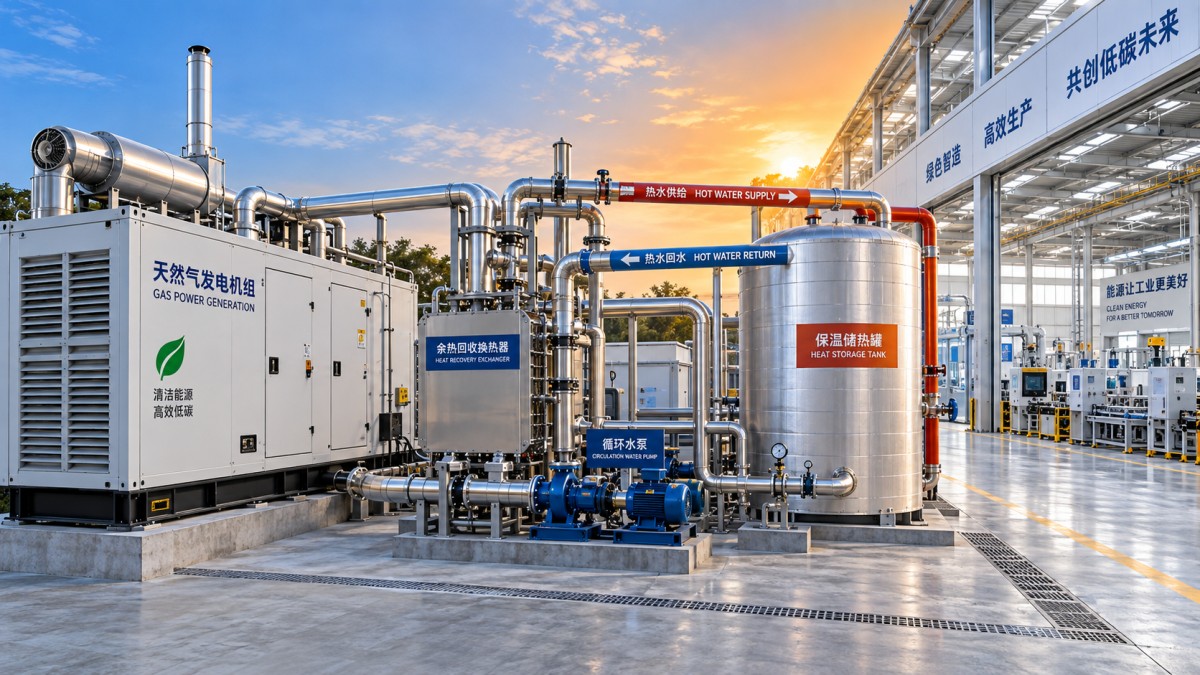
The engine package is only one boundary in a CHP plant. The project succeeds or fails at the interfaces between the generator, heat exchangers, buffer vessel, distribution pumps, building or process loop, switchgear, fuel train, and control system. Assigning ownership of these interfaces early prevents a familiar problem: the generator is commissioned, electrical output is available, but the thermal circuit is unfinished or incapable of accepting the recovered heat.
- Define the thermal sink: record required flow, return temperature, operating hours, minimum acceptable heat input, and periods when the load disappears.
- Protect the engine circuit: use suitable separation or control arrangements where process water quality, additives, pressure, or contamination risk differs from the engine cooling loop.
- Plan for rejected heat: a radiator or alternative rejection path may be necessary for commissioning, low-demand periods, and fault conditions. It should be sized for its actual duty, not assumed to be a permanent operating mode.
- Coordinate controls: electrical loading, heat demand, pump status, valve position, engine temperature, and alarms should be visible in a common operating logic. Heat recovery must not create a condition that forces an unsafe engine trip or overheating event.
Control quality becomes particularly important with lean-burn engines. Closed-loop fuel control and electronic speed regulation support stable generation, but site-level controls still need to avoid rapid load swings and poorly timed thermal valve actions. A heat-recovery loop that opens and closes abruptly can create temperature instability even when the generator itself is operating normally.
Economic sense comes from matched utilization
The relevant comparison is not simply gas cost against grid electricity cost. CHP economics depend on the value of electricity produced on site, the fuel consumed, the value of recovered heat that displaces another fuel or energy source, maintenance obligations, and the hours during which both outputs are usable. Heat that is dumped has little economic value, while heat that replaces a boiler load during the generator's normal electrical run time can materially change the project case.
Use realistic operating assumptions rather than a single annual average. Model weekdays and weekends separately where demand differs. Include planned production shutdowns, ambient-temperature effects on ventilation and cooling, expected maintenance windows, and the periods when thermal demand is lowest. A project with modest peak demand but a strong base-load match can be more practical than one with impressive peaks and long idle intervals.
Maintenance should be considered as an operating constraint rather than an afterthought. Engine service intervals, oil management, ignition-system inspection, filters, cooling-water condition, exhaust-side heat exchanger cleaning, and valve or pump maintenance all affect availability. The thermal system should be designed so essential heat service can continue through an alternative source during planned generator maintenance. Likewise, the electrical system should have a defined arrangement for grid supply or backup generation when the CHP unit is unavailable.
A gas-fueled CHP project is most defensible when it is treated as a matched power-and-heat system from the first load study through commissioning. The right installation has a durable use for recovered heat, a load profile that keeps the generator productively engaged, fuel and site conditions that support reliable operation, and interfaces engineered as deliberately as the generating package itself.

Contact Us
Please use the form below to contact us.
If you require a response, we will contact you as soon as possible.