


What maintenance costs should be budgeted for gas generator sets?
The maintenance budget for Gas Generator Sets should be treated as a lifecycle cost, not a small allowance added after the equipment purchase. A realistic plan covers scheduled servicing, consumable materials, replacement parts, labor, inspections, unplanned repairs, and eventual major engine work. The exact amount depends on operating hours, gas quality, loading pattern, site conditions, and the service model offered by the supplier.
For procurement decisions, the most useful question is not “What is the annual maintenance price?” It is “What work will be required over the expected operating period, who performs it, what is excluded, and what could interrupt power production?” A low initial service quote can become expensive when it excludes critical components, travel labor, remote support, or planned overhaul parts.
Build the Budget Around Operating Hours
Maintenance needs are driven more by runtime than by calendar age. A standby unit that operates only during outages has a different cost profile from a prime-power generator running daily, even when both have the same rated output.
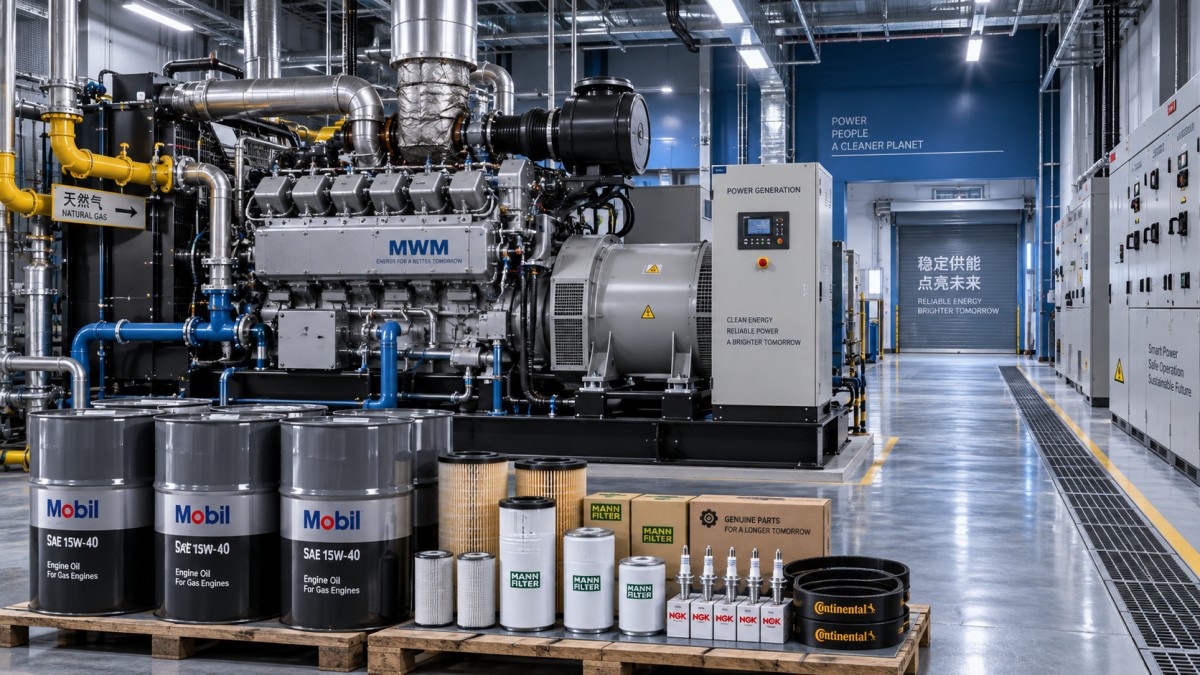
Ask suppliers to provide a maintenance schedule based on operating hours, with each service interval clearly identified. The schedule should distinguish routine work from major work. Routine items usually include oil and filter changes, ignition-system checks, cooling-system inspections, belt and hose checks, valve-clearance work where applicable, and control-system diagnostics. Major work may involve cylinder-head service, turbocharger inspection, replacement of wear components, or a full engine overhaul.
A buyer should model at least three operating cases: expected annual hours, high-utilization hours, and a lower-load or intermittent-use case. This prevents a budget from being built around an optimistic utilization assumption that does not match the actual site plan.
Cost Categories That Should Be Included
The overhaul reserve is frequently underfunded because it does not appear in the first year of operation. That does not make it optional. Major service work is a foreseeable lifecycle event, and the budget should spread its expected cost across the planned operating period rather than treating it as an unexpected capital expense later.
Fuel Quality Can Change Maintenance Cost More Than Expected
Gas engines depend on reasonably stable fuel conditions. Variations in methane content, heating value, pressure, moisture, contaminants, or corrosive compounds can affect combustion quality and accelerate wear. In practice, poor or inconsistent gas treatment can lead to more frequent ignition-system attention, deposits, sensor issues, unstable output, and shortened service intervals.
For pipeline natural gas, buyers should define the available gas conditions at the site and identify the responsibility for filtration, pressure regulation, moisture control, and gas analysis. For associated gas, biogas, landfill gas, or other variable fuels, the pre-treatment scope becomes even more important. A generator package may appear competitively priced until the required gas-conditioning equipment, monitoring, and additional maintenance are considered.
Do not compare maintenance quotes without comparing the fuel assumptions behind them. A supplier may price service around clean, stable gas, while the project site presents a more demanding fuel environment.
Loading Pattern Affects Wear and Service Planning
Gas Generator Sets generally perform best when they operate within a stable, appropriate load range. Frequent start-stop duty, long periods at very low load, sharp load changes, or poor synchronization with other units can increase stress on the engine and electrical system. The impact is not limited to fuel efficiency; it can also affect maintenance frequency and component life.
Procurement teams should therefore review the expected load profile, not just the peak demand. A unit sized only for the maximum load may spend most of its life lightly loaded. In a multi-unit plant, staged operation can sometimes provide better load matching and maintenance flexibility than relying on one oversized machine. It also allows planned service on one unit while others continue supplying part of the demand.
Service Contract Terms Matter as Much as the Service Price
A maintenance contract should state what is included at each service interval, who supplies consumables and parts, and how emergency failures are handled. “Preventive maintenance included” is too broad to support a meaningful cost comparison.
Look closely at the following contract points:
- Whether scheduled labor, travel, fluids, filters, spark plugs, and routine parts are included.
- Whether the agreement covers only planned maintenance or also corrective repairs.
- How quickly technical support can respond and whether remote diagnostics are available.
- Whether replacement parts are genuine, approved alternatives, or supplied by the owner.
- Who pays for site access equipment, lifting, transport, and disposal of used fluids.
- Whether missed maintenance intervals affect warranty coverage or performance commitments.
- How a planned overhaul is priced and whether its scope is defined in advance.
A fixed-price agreement can improve budget predictability for sites with stable operating conditions and predictable annual hours. It may be less suitable where fuel quality, duty cycle, or site access is uncertain, because exclusions can become significant. In those cases, a transparent parts-and-labor structure with a defined contingency may be easier to evaluate.
Do Not Treat the Generator as the Only Maintenance Item
Power reliability depends on the complete system. The maintenance budget should include the gas train, ventilation equipment, cooling circuit, starting system, exhaust system, switchgear, synchronizing controls, protection devices, and communications hardware. A healthy engine cannot deliver dependable power if a gas regulator, radiator fan, battery charger, breaker, or controller causes a shutdown.
For industrial applications evaluating alternative fuel pathways, equipment such as Methanol/Hydrogen generator sets should be assessed with the same discipline. The maintenance plan needs to cover not only the generating unit but also the fuel handling, safety controls, supply interface, and specialist service requirements associated with the selected energy system.
A Practical Procurement Checklist
Before approving a purchase, request a lifecycle maintenance proposal that separates recurring costs from event-based costs. It should show the maintenance schedule, expected parts categories, labor assumptions, recommended spare-parts inventory, and major-service scope. Require the supplier to state the operating conditions used to create the proposal, including fuel quality, ambient conditions, annual runtime, and load profile.
Then compare proposals on an equivalent basis. A lower maintenance estimate is meaningful only when the equipment capacity, fuel assumptions, service scope, parts quality, response arrangement, and overhaul treatment are comparable. It is also useful to ask which failures are most likely to create extended downtime and what parts should be held on site to reduce that risk.
AMICO’s work across gas power control, generation equipment, distributed energy applications, and oilfield engineering reflects why this system-level review matters. Maintenance planning is strongest when engine service, fuel conditions, electrical controls, and operating duty are evaluated together rather than purchased as separate cost lines.
The most defensible budget is one that includes routine maintenance from day one, sets aside funds for planned major work, and leaves a controlled allowance for site-specific repair risk. That approach gives procurement teams a clearer basis for comparing suppliers and protects the operational value of the power asset after commissioning.

Contact Us
Please use the form below to contact us.
If you require a response, we will contact you as soon as possible.