


When should gas generator sets run in parallel instead of standalone?
Run gas generator sets in parallel when the site needs more than peak capacity from one practical unit, or when losing one unit would interrupt an essential load. Parallel operation is also justified when the electrical demand changes widely through the day, when maintenance must occur without a shutdown, or when a single large engine would spend too much time at an inefficient low-load point. A standalone set remains preferable where the load is stable, interruption is acceptable, and the added switchgear, controls, commissioning effort, and maintenance burden of a multi-set plant do not produce a clear operational benefit.
The decision should start with the actual load profile rather than the connected-load total. A facility with a high installed load may still suit one generator if its simultaneous demand is predictable and modest. Conversely, a smaller facility can need parallel sets if it contains large motor starts, rapidly varying process loads, or critical circuits that cannot tolerate a planned maintenance outage.
Capacity is only the first threshold
Using two or more generators merely because the calculated peak demand exceeds one unit's rating is incomplete engineering. The selected arrangement must carry the required demand after allowing for site derating, auxiliary consumption, gas quality variation, and the load step that occurs when a major item starts. A unit that appears adequate under steady-state calculations can still experience an unacceptable frequency or voltage dip when a compressor, pump, or large fan motor starts.
Parallel sets create a practical capacity path. Units can be added as demand grows, and installed capacity can be divided into manageable blocks. This is useful where future expansion is likely but the final load is not yet certain. The initial plant should nevertheless include busbar capacity, circuit-breaker fault duty, cable routes, control-panel space, and gas-train allowance for the intended final configuration. Retrofitting these items after the first generator is installed often costs more than reserving them during the original design.
Redundancy has to match the protected load
Parallel operation is most defensible where continuity matters after one generator is unavailable. That unavailability may result from a mechanical fault, a control alarm, a scheduled oil change, or an inspection that requires the unit to be isolated. The useful question is not simply whether “backup” is wanted. It is whether the remaining online units can support the defined essential load, including its starting sequence, without violating voltage, frequency, or thermal limits.
A common error is to apply an N+1 concept only to the generator nameplate rating. The same logic must be applied to the common equipment. One shared synchronizing panel, common bus section, gas pressure-regulation train, cooling arrangement, or outgoing breaker can become a single point of failure. Sectionalized buses and selectively coordinated protection can preserve part of the plant when a fault occurs, but they need to be considered as a system rather than added later as isolated components.
Maintenance continuity is not identical to fault tolerance. A plant with two sets may continue during planned maintenance, yet still fail to meet its essential demand after an unexpected trip if each remaining set must be loaded beyond its preferred operating limit. Define these two conditions separately: normal maintenance coverage and loss-of-largest-unit coverage.
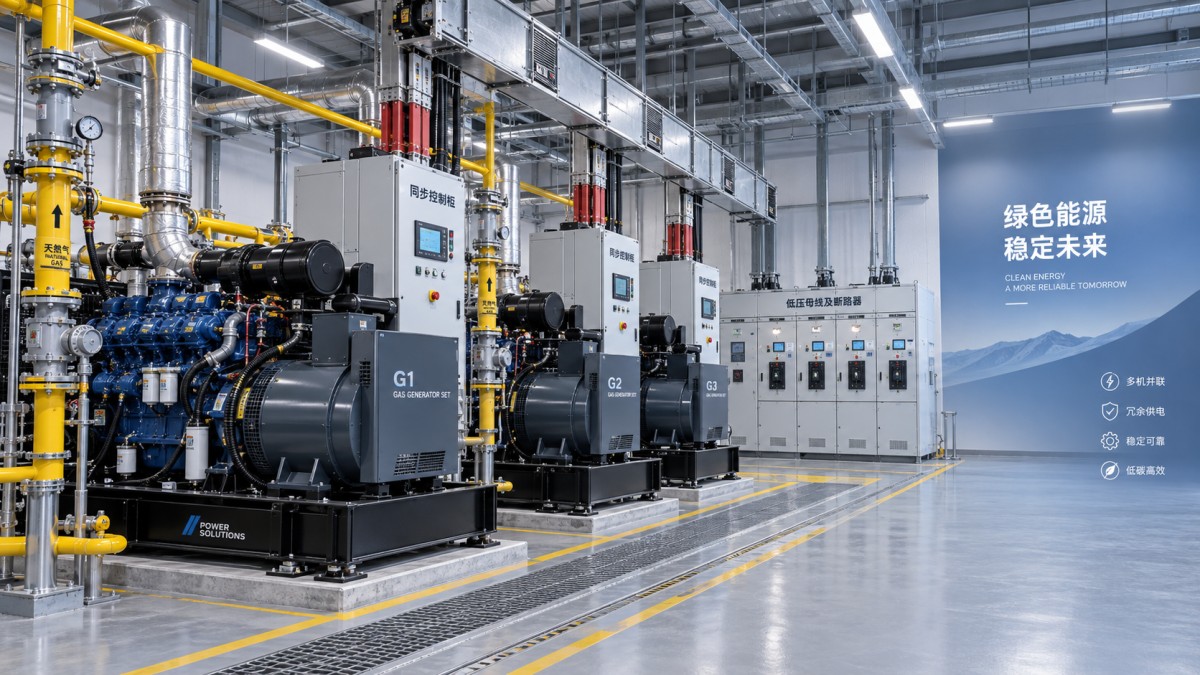
Wide load swings favor multiple smaller blocks
Gas engines generally perform best within a defined loading range established by the engine and emissions-control design. A single oversized generator that runs for long periods at light load may consume fuel inefficiently, accumulate deposits, and provide poor load response when demand suddenly rises. Several units allow the controller to start or stop engines as demand crosses chosen thresholds, keeping the running machines nearer their intended operating region.
That advantage depends on sensible unit sizing. Three equal units are easy to rotate and maintain, but equal sizes are not always the best match for the demand curve. A site with a small continuous base load and occasional high peaks may benefit from a smaller lead unit plus larger peak units. The trade-off is more complex dispatch logic and less interchangeability. Before choosing unequal ratings, compare the hours each machine will operate, anticipated loading bands, and the consequences if the smallest or largest unit is unavailable.
Short load fluctuations should not automatically start another engine. Starting a gas generator involves warm-up, synchronization, breaker closing, and stabilization. If load spikes last only briefly, repeated starts increase wear and can create unnecessary switching. Load-sharing controls should therefore use time delays, start thresholds, stop thresholds, and minimum run times suited to the process behavior. These settings are part of the plant design, not minor commissioning adjustments.
Transient behavior can decide the arrangement
A standalone unit can carry a large steady load but still struggle with its transient characteristics. Motor starting, transformer energization, rectifier loads, welding equipment, and abrupt process changes affect voltage distortion, frequency recovery, and governor response differently. Parallel generators contribute combined rotating inertia and available power, but their benefit is limited by the control strategy and the load-sharing response.
For a motor-starting assessment, identify the motor starting method, locked-rotor current, acceleration time, driven-equipment torque, and the operating load already connected to the bus. A soft starter or variable-frequency drive changes the generator duty, but does not eliminate it; harmonics, rectifier front-end behavior, and drive ride-through requirements still need review. Starting several motors sequentially can reduce the required generator capacity more effectively than adding an extra set simply to absorb a poorly planned start.
Parallel operation also demands stable real-power and reactive-power sharing. Governors must respond compatibly for kW sharing, while voltage regulators and reactive droop or cross-current compensation must prevent one unit from taking disproportionate kVAr load. Poor tuning can show up as circulating reactive current, hunting between units, unstable voltage, or repeated breaker trips even though the total connected load appears well below plant capacity.
Synchronization and protection are part of the cost decision
A multi-set plant needs more than extra engines. Each generator requires suitable protection, breaker control, metering, and a means to synchronize voltage magnitude, frequency, phase angle, and phase sequence before connecting to a live bus. The control system must decide which units start, which unit leads, how load is shared, and how units are removed without a disturbance. Manual synchronization may be acceptable for limited, supervised arrangements, while applications with frequent load changes normally require automatic control with clear fallback behavior.
Protection settings must account for generator decrement curves and the lower fault current available from generators compared with a utility source. A downstream fault may not produce enough current for a conventional coordination assumption. Differential protection, reverse-power protection, loss-of-excitation functions where applicable, bus protection, and breaker failure logic should be selected according to the electrical architecture. The objective is selective isolation: a faulted feeder or unit should be removed without unnecessarily dropping a healthy bus section.
Commissioning requires testing beyond a simple no-load parallel close. Verify phase rotation before first synchronization, simulated loss of a running unit, load acceptance and rejection, load-sharing stability at several load levels, black-start sequence, protective trips, and restoration of priority loads. Settings changes made after these tests should be controlled, because an apparently small adjustment to droop, gain, or breaker timing can alter plant stability.
Fuel supply can strengthen or weaken the case
Parallel generator capacity is only useful if the gas supply can support the combined demand through steady operation and transients. Pressure drop in long piping, undersized filters, cold ambient conditions, and pressure-regulator response can reduce fuel pressure at the engine during a rapid load increase. The resulting power loss may be misdiagnosed as an engine or governor problem.
Where LNG is vaporized on site, the gasification and pressure-control equipment should be evaluated with the same operating cases as the generator plant: one unit online, all units online, step loading, and recovery after a unit trip. A properly sized LNG gasification skid must maintain suitable gas pressure and temperature throughout these cases, while allowing for the pressure losses of valves, meters, and piping between the skid and each engine gas train.
Fuel composition matters as well. Changes in methane number, heating value, or moisture content can affect available engine output and combustion stability. The capacity reserve used in the parallel assessment should reflect the expected fuel envelope rather than a single nominal gas value.
When standalone remains the stronger choice
A single set is often the sounder selection for a stable load that fits comfortably within one properly derated generator, especially when downtime can be scheduled and the site already has an independent backup arrangement. It reduces control complexity, initial equipment count, commissioning scope, and the number of engines requiring routine service. The simplicity benefit is real when the operating profile does not demand staging or continuity.
Parallel operation earns its additional complexity when it solves a defined problem: capacity expansion, essential-load resilience, efficient operation across a broad demand range, or continuity during maintenance. The final configuration should be based on time-resolved load data, starting studies, one-unit-out operating cases, gas-supply behavior, and a protection philosophy that includes the common equipment as well as the generators.

Contact Us
Please use the form below to contact us.
If you require a response, we will contact you as soon as possible.