


Stricter site noise rules are reshaping 1200 kW silent generator demand
A 1200kW Silent typeSet is no longer evaluated only by its nameplate output and fuel consumption. Where site noise limits are tighter, the central question is whether the complete installation can meet the required acoustic condition at the relevant boundary while still delivering dependable power under real operating load.
This is changing demand in industrial compounds, oilfield support areas, distributed-energy projects, and construction-adjacent facilities. Buyers are moving away from treating the canopy as an optional accessory. They are assessing the generator, enclosure, exhaust path, ventilation, controls, civil layout, and operating schedule as one acoustic system.
Why “silent” is not a complete compliance answer
“Silent type” usually indicates an enclosed generator arrangement designed to reduce sound compared with an open unit. It does not, by itself, state the sound level at a specific distance, under a specific load, or at a site boundary. Those distinctions matter because sound performance changes with installation conditions.
A 1200kW-class generator produces substantial engine, cooling-fan, intake, exhaust, and structural noise. An enclosure can reduce direct engine noise, yet high airflow is still needed to remove heat. If inlet and outlet treatment is undersized, the cooling airflow path may become the dominant noise source. Exhaust noise can also bypass an otherwise well-designed enclosure when the silencer, pipe routing, or discharge location is poorly selected.
The commercial risk is straightforward: a set may be described as low-noise in a quotation but still require site modifications after commissioning. Those modifications can affect project schedule, access, ventilation, and capital cost. A stronger evaluation starts with the required measurement point and operating condition, then works backward into the generator package and site design.
Start with the site condition, not the enclosure specification
Noise limits are normally assessed where people, neighboring properties, or sensitive operations are affected, rather than beside the generator itself. Before comparing a 1200kW silent generator with another option, establish the conditions under which the installation will be judged.
- Identify the boundary or receiver location that matters, including nearby offices, residences, accommodation areas, control rooms, or work zones.
- Define whether the set will run continuously, intermittently, during nighttime hours, or only as standby power.
- Confirm the expected load profile. A generator at partial load may behave differently from one operating near rated output, particularly where fan speed or control strategy changes.
- Map reflective surfaces such as walls, containers, steel structures, and concrete yards. These can direct or amplify sound toward a boundary.
- Include auxiliary equipment: radiators, fuel or gas skids, transformers, switchgear ventilation, pumps, and air compressors can all contribute to the overall sound environment.
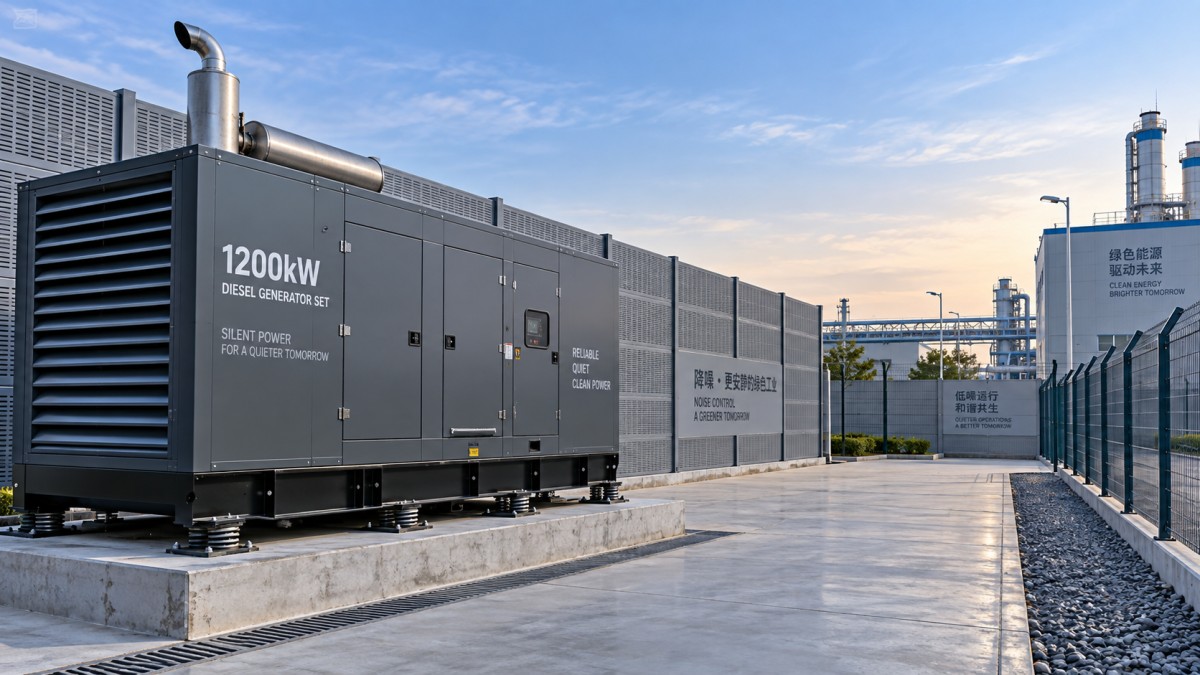
This approach also prevents a common mistake: comparing two sound figures that were measured under different distances, loads, orientations, or acoustic environments. A lower number is useful only when the test basis is comparable to the requirement being evaluated.
What a 1200kW silent generator package should be assessed against
At this power range, the enclosure is a system with competing requirements. Greater attenuation generally requires more acoustic treatment, but the engine still needs adequate combustion air, cooling airflow, service access, and safe exhaust routing. The right solution is the one that manages these trade-offs without creating overheating, restricted maintenance access, or unstable operation.
For projects with a fixed boundary requirement, it is often more practical to request an acoustic layout review than to demand a generic “super-silent” package. The review should consider set orientation, radiator discharge direction, equipment spacing, barriers, and the likely propagation path. In some locations, moving the generator or changing the exhaust outlet is more effective than adding further enclosure treatment.
Gas power changes the assessment, but does not remove the acoustic work
Gas-powered generation can be a suitable option where fuel supply, run-hour expectations, and emissions strategy support it. It also introduces its own engineering questions: gas quality and pressure stability, gas train layout, combustion controls, heat rejection, and the dynamic behavior of the engine-generator set. These factors should be considered alongside acoustics rather than in a separate procurement track.
For example, the AMC1100DF-PN 1100kW Gas-Powered Engine is rated at 1100kW at 1500rpm, with an adjustable engine speed range of 900 to 1800 and an output speed range of 350 to 900. It is relevant when a project is assessing gas-engine-based generation near the 1200kW class, but the engine rating alone does not define the final acoustic result. The generator-end configuration, enclosure, cooling arrangement, and installation layout still need to be engineered for the site.
That distinction matters in distributed power applications. A package designed for an open industrial yard may not transfer directly to a constrained facility edge or an oilfield camp where personnel accommodation is nearby. The more sensitive the receiver location, the more important it becomes to evaluate the entire installed system.
Where demand is growing, and where a silent package may not be enough
Demand for high-output quiet generator sets is strongest where power reliability must coexist with occupied or regulated surroundings. Typical examples include industrial expansions near existing buildings, energy facilities with continuous duty, temporary power close to communities, and remote operations where the generator is placed near support infrastructure.
However, a silent enclosure is not automatically the best answer. If the site has an extremely low noise requirement, very limited ventilation space, or a receiver immediately adjacent to the equipment, the project may need a purpose-designed acoustic room, a separate radiator arrangement, barriers, or a different equipment location. Trying to solve every problem with a more heavily lined canopy can compromise airflow and maintainability.
Likewise, a package intended for occasional standby duty should not be assumed suitable for long operating hours without examining heat management, service intervals, fuel or gas infrastructure, and noise during the actual duty cycle.
A practical procurement sequence
Business evaluation is more reliable when acoustic compliance is treated as a project input before the supplier selection is finalized. Use this sequence:
- Set the required power, duty profile, fuel source, and critical-load behavior.
- Define the relevant receiver locations and operating periods.
- Request acoustic data with its measurement conditions clearly stated.
- Review cooling airflow, exhaust routing, and enclosure access against the proposed site layout.
- Assign responsibility for the final installed acoustic outcome, including any external attenuation or civil works.
- Plan commissioning measurements after installation, when the full system is operating.
AMICO’s work in gas power control, generation equipment, oilfield engineering, distributed power, and smart energy management is relevant to this integrated view. For a 1200kW silent generator decision, the useful question is not simply whether the set is quiet. It is whether the engineered package can provide required power, workable maintenance access, stable thermal performance, and an acoustic result that fits the site where it will operate.

Contact Us
Please use the form below to contact us.
If you require a response, we will contact you as soon as possible.