


How much reserve capacity should a 1200 kW silent generator set have?
A 1200 kW silent generator set should not be assigned a fixed reserve percentage without first separating three different concepts: unused running capacity, emergency redundancy, and the generator’s published standby rating. A simple “add 20%” rule can either oversize the plant—creating poor part-load operation—or leave insufficient headroom for motor starting, temperature derating, step loads, and future connections.
For a single 1200 kW unit, a sound preliminary target is often to keep the planned continuous operating load below roughly 70% to 85% of the set’s applicable rating. That leaves 15% to 30% operating headroom, but it is not automatically an adequate reserve strategy. The appropriate figure depends on whether the set supplies a stable base load, intermittent process loads, large motors, critical standby loads, or an isolated site where loss of one unit is unacceptable.
Start by defining what “1200 kW” means
Generator ratings are commonly stated under defined duty classifications and reference conditions. A 1200 kW nameplate may refer to prime power, limited-time prime power, or standby/emergency power, depending on the manufacturer’s documentation and the applicable rating standard. These ratings are not interchangeable.
Standby power is intended for emergency operation during utility failure and is generally associated with variable load operation over limited annual hours. Prime power is intended for applications with no reliable utility source or for extended running periods, subject to the manufacturer’s load and maintenance conditions. If a project requires the generator to run as a daily production asset, selecting a set solely because it carries a 1200 kW standby rating can create an incorrect reserve calculation from the outset.
The first technical check is therefore:
- What duty rating applies to the intended operating profile?
- At what ambient temperature, altitude, and fuel condition is that rating declared?
- Is 1200 kW the net available output at site conditions, or a standard-condition figure?
- Does the load require uninterrupted service if the generator is unavailable?
A reserve calculation based on the wrong duty rating is more serious than a modest error in the selected margin.
Calculate reserve from the real load profile, not from connected load alone
Connected load is rarely the right basis for sizing. A facility may have 1,300 kW of installed equipment while its measured coincident demand is only 850 kW. Conversely, a process with an 800 kW average demand can impose a much higher transient requirement when pumps, compressors, crushers, or large ventilation motors start.
The relevant load schedule should identify continuous loads, cycling loads, intermittent loads, non-linear loads, motor ratings, motor-starting methods, expected operating sequence, and the largest credible step change. The key number is not merely the highest steady-state kW; it is the highest operating condition the generator must carry while maintaining acceptable voltage and frequency.
For example, if a 1200 kW set is expected to supply a stable 900 kW process load, the apparent 300 kW margin may be reasonable only if no major motor is started at that point and site derating is limited. If a 250 kW motor starts direct-on-line while the set is already carrying 900 kW, the momentary kVA demand and voltage dip may exceed what the alternator, engine, governor, and control system can support—even though the steady load remains below 1200 kW.
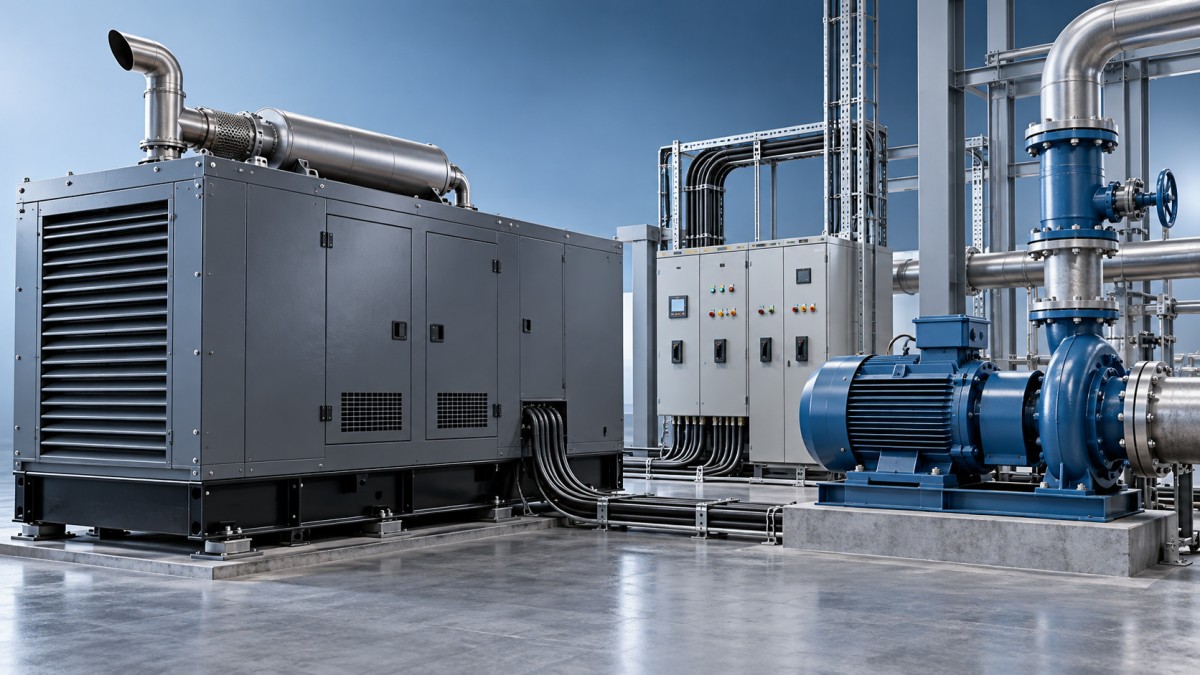
For this reason, reserve capacity should be assessed against both steady-state kW and dynamic kVA. Power factor matters. A generator rated at 1200 kW may be associated with a specified kVA rating at a defined power factor, often 0.8. Loads operating at lower power factor consume more kVA for the same kW output. Alternator heating and voltage regulation can become the limiting factors before the engine reaches its kW limit.
Motor starting can determine the entire sizing decision
Large induction motors are a common reason why a nominally adequate generator fails a site acceptance test. Direct-on-line starting can draw several times the motor’s rated current. The generator does not need to provide that current indefinitely, but it must tolerate the transient without an unacceptable voltage collapse, frequency excursion, protective trip, or disruption to other connected equipment.
A 1200 kW silent generator set serving motor-heavy loads should be evaluated using the actual start method:
- Direct-on-line starting: highest electrical inrush and often the most demanding condition for a single generator.
- Star-delta starting: reduces starting current but also reduces starting torque; it may not suit high-inertia loads.
- Soft starters: can reduce inrush, but their settings and bypass arrangement must be included in the study.
- Variable frequency drives: can control starting current effectively, yet harmonic distortion, rectifier configuration, and load-side regeneration must be evaluated.
Sequencing can be as valuable as extra capacity. Preventing two large motors from starting simultaneously may allow a 1200 kW set to serve the load reliably without selecting a larger unit. Conversely, a control philosophy that permits automatic restart of several motors after a utility interruption can create a transient demand well above the normal operating level.
Site derating changes the usable margin
Reserve capacity exists only after environmental corrections are applied. High ambient temperature reduces cooling margin and can reduce engine output. Altitude reduces air density, affecting combustion and cooling performance. Enclosure design, radiator arrangement, air recirculation, dust loading, and exhaust backpressure can further constrain available power.
“Silent” describes an acoustic enclosure configuration, not immunity from thermal limitations. A sound-attenuated enclosure must still provide sufficient airflow, radiator heat rejection, combustion air, and service access. In hot climates, an enclosure with inadequate ventilation can turn a nominal 20% reserve into little or no practical reserve during peak daytime conditions.
Fuel quality also affects available output, especially for gas-fuelled equipment. Methane number, calorific value, gas pressure stability, contaminants, and changes in associated gas composition can affect combustion stability and rated output. Oilfield projects using associated petroleum gas or flare gas should avoid treating fuel as a fixed input. Gas treatment, pressure control, and fuel composition monitoring may be as important to capacity reliability as the generator’s nominal kW rating.
In such applications, equipment designed to convert APG or flare gas into on-site electricity can reduce flaring while supplying field loads, but sizing still has to account for fuel variability and process transients. A 1000kW Gas Generator set may be relevant as part of a modular arrangement, yet adding units does not remove the need for load-flow, protection, and synchronisation review.
Reserve margin is not the same as redundancy
A single 1200 kW generator operating at 800 kW has 400 kW of unused output capacity, but it has no generation redundancy. If the unit is out of service for maintenance, fault repair, or a protection trip, the available capacity falls to zero.
Where the consequence of outage is material, the decision is normally between a larger single set and multiple synchronised sets. Two or more units can provide maintenance flexibility and allow an N+1 arrangement, where the remaining installed capacity can carry the defined critical load after one unit is unavailable. This is a resilience decision rather than a simple reserve-percentage decision.
Multiple units can also improve fuel efficiency where demand varies substantially. Large engines generally should not be held at very low load for extended periods without confirming the engine manufacturer’s operating guidance. Persistent light loading can contribute to poor combustion conditions, carbon deposits, wet stacking in diesel applications, and unstable operating behaviour. Oversizing to create a large “safety margin” can therefore introduce an operating penalty.
A practical sizing range for a 1200 kW set
Where loads are predominantly resistive or stable, site conditions are within the declared rating envelope, and no large transient events occur, an expected operating load of approximately 900 to 1,000 kW can leave a useful margin. That corresponds to about 17% to 25% unused capacity.
Where motor starting, rapidly changing process loads, high ambient temperatures, altitude, poor power factor, or likely future expansion are significant, the prudent operating target may be closer to 70% to 80% of available site-rated capacity. In that case, a 1200 kW unit might be planned around 840 to 960 kW until transient analysis confirms otherwise.
These ranges are screening values, not final design criteria. A project requiring 1,050 kW continuously may still be suitable for a 1200 kW set if its duty rating, site derating, power factor, harmonic conditions, and load-step response have been verified. A project averaging only 800 kW may require a larger or parallel-generator solution if it must start a large compressor under full load.
What should be verified before release for procurement
The final decision should be supported by a load list and a generator performance review rather than a nominal percentage. Required inputs include maximum coincident kW and kVA, load power factor, largest motor and starting method, permitted voltage and frequency dip, harmonic profile, ambient temperature, altitude, enclosure ventilation conditions, fuel characteristics, and the required duty classification.
The supplier’s data should clearly state the available output after site derating, alternator capability, transient response assumptions, overload conditions if any, and limits on continuous loading. It should also identify whether ratings are based on standard reference conditions and whether auxiliary loads—such as cooling fans, fuel treatment equipment, pumps, or gas compression—have been excluded from the net exported power figure.
For a 1200 kW silent generator set, the best reserve capacity is therefore not a universal 10%, 20%, or 30% number. It is the margin remaining after the generator has been corrected for site conditions and tested against the facility’s worst credible steady and transient load conditions. When that margin cannot be demonstrated, additional generator capacity, revised motor-starting arrangements, or a parallel-unit architecture should be considered before the equipment specification is fixed.

Contact Us
Please use the form below to contact us.
If you require a response, we will contact you as soon as possible.