


How to prevent overheating inside a 1200 kW silent generator enclosure
Overheating inside a 1200 kW silent generator enclosure is not a minor comfort issue for the machine. Once enclosure temperature rises beyond the cooling system's effective operating range, operators may see high jacket-water temperature, reduced output capability, repeated alarm trips, alternator heating, and accelerated deterioration of hoses, wiring, insulation, and control components.
For a 1200kW Silent typeSet, the practical objective is not simply to make the enclosure cooler. It is to maintain a controlled path for combustion air, radiator discharge air, and equipment-room ventilation while preventing hot air from circulating back into the unit. Most persistent overheating problems come from an airflow path that has been restricted, bypassed, or unintentionally recirculated.
Start by separating engine cooling from enclosure ventilation
Operators often treat every high-temperature alarm as a radiator problem. In a silent enclosure, however, the engine radiator and the enclosure ventilation system are linked but do different jobs. The radiator removes heat from coolant. The enclosure airflow removes the heat rejected by the radiator, engine surface, exhaust shielding, alternator, and electrical equipment.
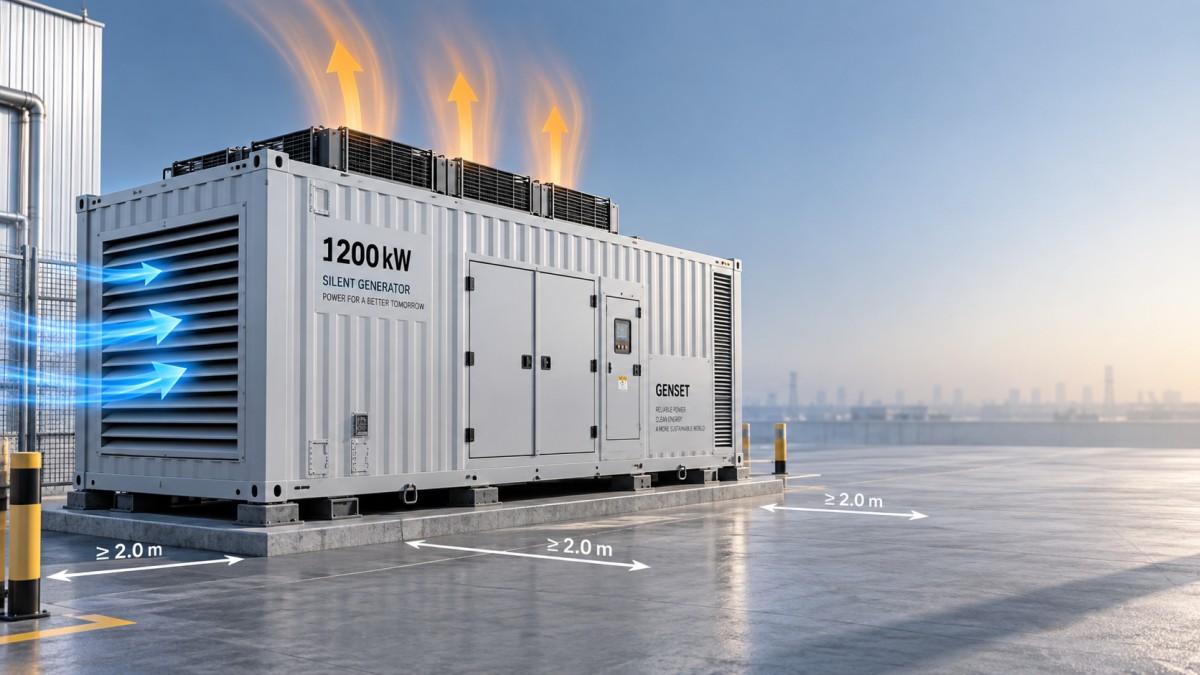
A clean radiator cannot compensate for inadequate intake or discharge openings. Likewise, increasing fan speed will not solve a poorly designed discharge route. If the hot air leaving the radiator remains trapped near the outlet, or if it can flow back toward the inlet louvers, the cooling circuit will gradually ingest hotter and hotter air. The generator may operate acceptably at low load but overheat after a sustained high-load period.
Begin with a basic airflow inspection while the genset is running at a meaningful load. Confirm where air enters the enclosure, how it travels across the engine and alternator area, and where it exits. The discharge route should be direct and unobstructed. Temporary site structures, acoustic barriers, nearby containers, walls, stacked materials, or a closed equipment canopy can all disrupt the intended path.
Pay particular attention to the space around the radiator discharge. A large silent unit moves a substantial volume of air. An outlet that appears visually open may still be too close to a wall or roof, allowing heated discharge air to accumulate and return through intake louvers.
Check the conditions that change as load and ambient temperature rise
An enclosure may appear healthy during a short no-load test yet fail during afternoon operation or when the machine carries a high, steady electrical load. Heat rejection rises with output, while high ambient temperature reduces the temperature difference available for cooling. That combination exposes restrictions that were not obvious during commissioning.
Record trends rather than relying only on a final shutdown alarm. Useful operating observations include:
- Coolant temperature at startup, during load acceptance, and after sustained operation.
- Enclosure air temperature near the engine, alternator, control cabinet, intake side, and radiator discharge side.
- Ambient temperature outside the enclosure, especially near the fresh-air intake.
- Load level and duration when temperature begins to climb.
- Fan operation, louver position, ventilation fan status, and any unusual fan noise or vibration.
- Whether the issue occurs only after paralleling, after a load step, or during particular wind conditions.
The pattern matters. A rapid temperature rise immediately after loading may point to insufficient airflow, cooling-fan failure, low coolant level, or a control fault. A slow rise over several hours more often suggests recirculation, fouled heat-transfer surfaces, or a ventilation path that cannot reject heat continuously. If temperature rises only on hot days, intake-air temperature and discharge-air recirculation deserve early attention.
Do not overlook pressure loss across silencers, louvers, and filters
Silent enclosures achieve noise reduction through acoustic louvers, baffles, sound-absorbing passages, and sometimes additional ventilation attenuators. These components are necessary, but each one adds resistance to airflow. Dust screens, insect mesh, weather hoods, and aftermarket filter media can add further restriction.
A common operational mistake is to improve dust protection or reduce noise by adding mesh or closing louvers without reassessing ventilation capacity. The result can be a clean-looking enclosure with inadequate airflow under full load. The same risk applies when damaged acoustic material sags into an air passage, when loose insulation is drawn toward a fan, or when paint, oil mist, and dust accumulate on louver blades.
Inspect inlet and outlet components from both sides. Look for blocked free area, bent blades, detached baffles, accumulated debris, and seals that have shifted into the airflow path. Check that motorized louvers fully open under the conditions intended by the control system. A louver that opens only partially can be difficult to notice during a brief walk-around but can materially reduce available ventilation.
Maintain the cooling circuit, but diagnose it in context
Cooling-system maintenance remains essential. Confirm coolant level and mixture, inspect for external leaks, verify belt condition and tension where applicable, and keep radiator fins free of dust, oil film, insects, and debris. Clean fins carefully in the correct direction so contamination is removed rather than driven deeper into the core. Bent fins, internal scale, degraded hoses, a weak pressure cap, and a thermostat that does not open properly can all reduce heat transfer.
Yet a clean cooling circuit should not be used to close the investigation. If the radiator is rejecting heat into an enclosure that cannot discharge it, coolant temperature will still rise. Comparing intake-air temperature with air temperature around the radiator outlet can help distinguish a radiator-side problem from an enclosure-side problem. A large increase in the air surrounding the discharge zone, especially with hot air returning toward the intake, points to ventilation and layout rather than coolant chemistry alone.
For gas-fueled units, combustion-air temperature also deserves attention. High intake-air temperature can affect engine operating margins and may change how the engine control system manages the fuel-air mixture. A lean-burn, closed-loop system can support controlled operation, but it does not remove the need to keep intake air within the engine manufacturer's allowed conditions.
On a containerized package such as the 1200kW Containerized Gas Genset, the overall enclosure dimensions and integrated ventilation layout make site clearances especially important. A unit can be properly configured at delivery and still overheat after it is placed in a narrow compound, under a low canopy, or beside other equipment discharging hot air into the same area.
Inspect the exhaust system as a source of enclosure heat
Engine exhaust carries a high thermal load. In a silent enclosure, exhaust piping, flexible sections, silencer connections, expansion joints, and insulation must be inspected as part of any overheating investigation. Damaged or missing insulation can raise local enclosure temperature sharply, particularly around control wiring, battery systems, and service access areas.
Exhaust leakage requires prompt attention. It adds heat to the enclosure, may affect personnel safety, and can distort temperature readings near sensors or wiring harnesses. Check for discoloration, soot marks, loose clamps, failed joints, damaged lagging, and heat damage to nearby components. Do not assume an external exhaust stack eliminates the issue; an uninsulated section inside the enclosure can still impose a significant local heat burden.
Also confirm that exhaust routing has not been altered in a way that raises backpressure or places a hot stack outlet close to ventilation intakes. The cooling problem may then be compounded by reduced engine performance or hotter intake air.
Use the control system to identify, not merely reset, temperature events
Automatic shutdown protection is valuable, but repeated alarm resets can conceal a developing fault. Review the alarm sequence: coolant temperature, enclosure temperature, fan failure, low coolant level, low oil pressure, and load changes should be considered together. A high-temperature shutdown following a ventilation-fan fault has a different corrective path from one that occurs with all fans operating normally.
Verify sensor condition and wiring before replacing larger components. A loose connection, sensor drift, or damaged harness can generate misleading readings, but treating every alarm as an instrumentation error is equally risky. Compare control-panel values with carefully taken local measurements where safe procedures allow. The purpose is to establish whether the issue is real, where it begins, and how it develops.
Automatic start and paralleling functions also need operational review. If a unit accepts load too quickly after starting, or if several generators discharge heat into a confined area at the same time, the ventilation arrangement must handle that duty. One-key operating functions simplify normal operation; they do not replace a load-dependent cooling check after changes to the site or operating schedule.
Make site changes part of the maintenance decision
Silent enclosure overheating frequently appears after a change that did not seem related to the generator: a new fence, a storage rack near an outlet, an added roof, temporary weather covering, another container placed alongside, or a newly installed ventilation fan blowing in the wrong direction. These changes should be reviewed before high-load operation, especially when the genset supports continuous production or critical standby loads.
A sound corrective sequence is to remove visible restrictions, restore the specified opening and clearance conditions, clean heat-transfer and ventilation surfaces, verify fan and louver operation, inspect the coolant and exhaust systems, then test under a representative load long enough for temperatures to stabilize. If the temperature issue remains, the enclosure airflow arrangement may require engineering review rather than repeated component replacement.
For a 1200 kW unit, reliable heat control depends on treating the enclosure as part of the generator system. Keeping the radiator clean matters, but preserving fresh-air access, preventing discharge-air recirculation, and watching temperature trends under real load are what keep a silent package from becoming a heat trap.

Contact Us
Please use the form below to contact us.
If you require a response, we will contact you as soon as possible.