


- ▶ What drives the installed cost of a 1200 kW silent generator set?
- ▶ When a 1200 kW silent generator set suits hospital backup power
- ▶ Can a 1200 kW silent generator set meet urban boundary noise limits?
- ▶ Overseas Clients Visit Ameco for On-site Inspection, Deeply Empowering Global Green Energy Cooperation
What drives the installed cost of a 1200 kW silent generator set?
The installed cost of a 1200 kW silent generator set is shaped by the package around the engine as much as by the engine itself. Two quotations with the same standby rating can differ substantially because they assume different acoustic targets, electrical interfaces, delivery conditions, civil works, emission controls, and commissioning responsibilities. A low equipment price can therefore become an expensive installation when exclusions emerge after the order is placed.
Start by separating the cost of the generating set from the cost of putting dependable power at the required point of use. The first figure normally covers the engine, alternator, base frame, enclosure, standard controls, and factory testing. The installed figure must also account for fuel supply, exhaust routing, ventilation, switchgear integration, cabling, foundations, lifting access, site labor, testing under load, and documentation. A quotation should state which boundary it covers.
Rating, duty profile, and configuration
A 1200 kW nameplate rating is not a complete technical requirement. Prime power, standby duty, continuous operation, load factor, expected annual running hours, ambient temperature, altitude, and fuel type affect the selected engine and cooling system. A set intended for intermittent emergency duty may not require the same thermal margin, fuel storage arrangement, or maintenance provisions as one that supports regular production loads.
Derating is frequently missed during early budget comparisons. High ambient temperature, elevated site altitude, restricted airflow, and hot recirculated discharge air can reduce available output. If the site conditions require a larger engine platform to deliver 1200 kW reliably, the cost change extends beyond the engine. The enclosure, radiator, exhaust system, fuel consumption, transport weight, foundation loading, and crane requirements may all increase.
Electrical performance also changes the package. Large motor starts, nonlinear loads, rapid load steps, parallel operation, and sensitive electronic equipment place different demands on alternator sizing, voltage regulation, governor response, harmonic capability, and control logic. Specifying only “1200 kW” leaves room for unlike designs to be priced as though they were directly comparable.
Silence is a system requirement
The silent enclosure is often one of the largest sources of variation. “Silent” is not a universal acoustic level. Sound pressure must be tied to a stated distance, operating load, measurement environment, and installation arrangement. An enclosure measured in an open test area will not necessarily produce the same result beside a reflective wall, inside a plant room, or under a canopy that traps discharge noise.
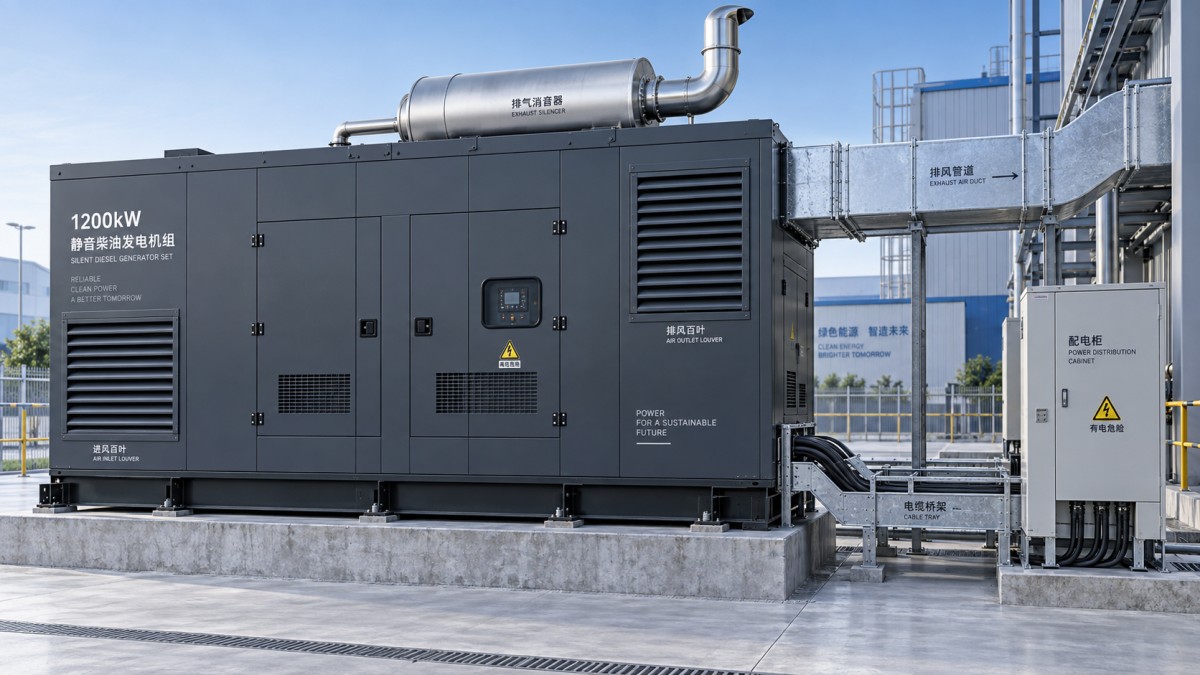
Lower noise targets usually require more than thicker panels. They can require mineral wool insulation, perforated inner liners, acoustic intake and discharge attenuators, splitters in ventilation paths, quieter fans, insulated personnel doors, gasketed cable entries, and more carefully controlled air velocity. Each feature consumes internal space or increases enclosure dimensions. At 1200 kW, airflow demand is large, so reducing noise without starving the radiator or combustion air system requires careful duct and louver design.
A common pricing error is to compare an acoustic enclosure with a weatherproof canopy. Both may appear as containerized outdoor packages, yet their panel construction, air paths, door seals, service access, and tested sound performance can be very different. Ask for the guaranteed acoustic condition and clarify whether external duct silencers, site barriers, or a dedicated acoustic room are included.
Site work hidden behind the delivery price
Foundation scope changes with soil condition, local drainage, frost exposure, seismic requirements, enclosure weight, and whether the set sits at grade, on a roof, or on a raised steel platform. A level concrete slab is not automatically sufficient. The design may need inertia mass, embedded anchor points, vibration isolation, cable trench coordination, fuel containment, and clearance around doors, radiators, and exhaust components. Rework becomes likely when the foundation is poured before the final approved general arrangement drawing is available.
Ventilation and exhaust are similarly site-specific. Outdoor packages need unobstructed airflow and a discharge path that prevents hot air from returning to the radiator intake. Indoor installations require duct sizing, static-pressure calculations, intake louvers, motorized dampers where applicable, and fire-rated penetrations where required by the building design. Long exhaust runs add backpressure. Multiple bends, small-diameter pipe, poorly supported silencers, and rain caps selected without considering flow resistance can force a redesign after installation.
Where the unit uses gaseous fuel, the gas train deserves its own scope review. Supply pressure, pressure stability during load changes, gas quality, filtration, isolation valves, vent routing, hazardous-area interfaces, and pipe length influence the final arrangement. Fuel piping is often treated as a local trade item, but its capacity must be verified against the engine’s actual consumption and inlet-pressure requirement rather than the nominal generator rating.
Emissions equipment and exhaust routing
Exhaust compliance is not interchangeable with noise control. Requirements vary by jurisdiction, fuel, operating hours, permitting conditions, and the site’s proximity to occupied areas. The generator package may include a basic silencer while the project requires oxidation, catalytic, particulate, or other gas treatment equipment. The selected exhaust treatment arrangement can affect exhaust temperature, allowable backpressure, structural supports, instrumentation, maintenance access, and the space reserved outside the enclosure.
Do not evaluate this item as a single accessory line. A treatment device without suitable pipe routing, expansion sections, drains, insulation, monitoring points, and service clearance may appear complete on paper but still leave substantial field work. If the unit is containerized, confirm whether the exhaust leaves through the roof, side wall, or an external manifold and who supplies the weathering details at the penetration.
Controls, switching, and the interface boundary
A generator controller starts and protects the engine, but it does not by itself complete the electrical system. The installed cost changes when the set must communicate with an automatic transfer switch, main distribution board, building management system, remote monitoring network, load-shedding scheme, or parallel switchgear. The number of generators, utility sources, breakers, metering points, and interlocks determines the complexity.
Parallel operation deserves early clarification because it affects both hardware and commissioning time. A single set operating against a dead bus is a different project from a set that synchronizes with another generator or the utility. Protective relay settings, breaker coordination, synchronization checks, communications testing, and witnessed functional tests add engineering and site labor. Leaving these interfaces vague can lead to a quotation that includes controls on the generator but excludes the equipment and programming required to operate the system safely.
Cable cost is also sensitive to layout. A 1200 kW low-voltage output may require several parallel cable runs, substantial copper or aluminum conductor, tray support, termination hardware, and carefully planned bend radius. Long runs introduce voltage-drop and fault-level considerations. Moving the generator twenty meters after routing has been designed can affect material quantities, trench work, fire stopping, and installation duration.
Freight, access, and commissioning conditions
Large silent sets are constrained by shipping dimensions, axle loads, road access, turning radii, unloading area, and crane reach. A price that includes delivery to a regional port or curbside location is not equivalent to delivery, offloading, positioning, and final placement. Remote sites, restricted hours, temporary road reinforcement, roof lifts, and enclosed plant rooms need separate assumptions.
Commissioning cost should cover more than a first start. Meaningful acceptance work includes inspection after transport, fluid and battery checks, control verification, safety shutdown tests, electrical protection checks, load testing, and confirmation that ventilation and exhaust behavior remain acceptable at operating temperature. Load-bank supply is especially important where site load is unavailable or cannot safely absorb the test power.
Comparing proposals on the same basis
Use a single project data sheet for every quotation: duty rating, site temperature and elevation, fuel characteristics, acoustic limit and measurement point, emission requirement, enclosure location, electrical single-line diagram, cable route length, fuel boundary, exhaust route, civil scope, delivery point, lifting responsibility, and acceptance-test requirement. Then require each proposal to mark inclusions, exclusions, assumptions, and optional items against that same document.
The strongest comparison is not the lowest generator line item. It is the proposal that exposes the full installed boundary, identifies conditions that could force a change, and leaves enough physical and technical allowance for safe access, heat rejection, exhaust performance, and future maintenance.

Contact Us
Please use the form below to contact us.
If you require a response, we will contact you as soon as possible.