


Do You Need Exhaust Treatment for Indoor Gas Generator Operation?
Indoor Gas Generator Operation Changes the Exhaust Question Completely
For an outdoor gas generator, exhaust is largely a dispersion problem. For an indoor installation, it becomes a containment problem. That difference is why exhaust treatment is not a nice-to-have accessory but part of the generator system itself. In a closed or semi-enclosed room, the exhaust stream does not simply disappear after leaving the engine. It carries heat, carbon monoxide, nitrogen oxides, unburned hydrocarbons, carbon dioxide, and in some cases fine particulates or odor-causing compounds. Even when a gas-fueled unit burns cleaner than a diesel set, “cleaner” does not mean safe for indoor release.
The first misunderstanding is that natural gas or LPG automatically solves the indoor emissions issue. Gas engines do reduce soot and often simplify emissions control compared with liquid-fuel engines, but they still produce hazardous exhaust. Carbon monoxide is the most immediate concern because it is colorless, odorless, and dangerous at low concentrations in enclosed spaces. Heat load is another issue that is easy to underestimate. If the exhaust piping, silencer, and discharge path are not designed correctly, the room can become difficult to ventilate even before pollutant levels trigger alarms.
In practice, “exhaust treatment” for indoor generator operation usually refers to a combination of measures rather than a single device. It may include sealed exhaust routing to the outdoors, thermal insulation, residential or industrial silencers, catalytic treatment where project requirements demand lower emissions, and a ventilation design that keeps engine room pressure, temperature, and fresh-air supply within acceptable limits. The exact package depends on the fuel, engine calibration, local regulatory expectations, building layout, and whether the generator is prime power, standby, or peak-shaving equipment.
A useful way to think about it is this: the engine produces exhaust, but the building determines the risk. A generator in a dedicated power room with engineered air intake, exhaust ducting, gas detection, and fire separation is a different scenario from a unit placed in a workshop, basement, containerized room, or utility enclosure that was never designed for combustion equipment. Many indoor problems come from treating the room as storage space with a generator inside it, instead of as a power plant enclosure with its own environmental controls.
What Exhaust Treatment Actually Needs to Do
There are three jobs to solve at the same time. One is personnel safety. Another is compliance with local building, fire, and air-quality requirements. The third is stable engine operation. People often focus on the first two and miss the third. Poor exhaust backpressure, undersized piping, or an overly restrictive aftertreatment device can affect engine performance, fuel efficiency, and service life. So the right question is not simply whether treatment is required, but what level of treatment the engine and site conditions require.
That is why exhaust design is normally reviewed together with ventilation, combustion air supply, noise control, and control-system logic. An indoor gas generator should never be judged only by its electrical rating. A 300 kW unit, for example, is not just an electrical asset; it is also a steady source of hot gases that must be removed without creating backpressure or recirculating fumes into the air intake.
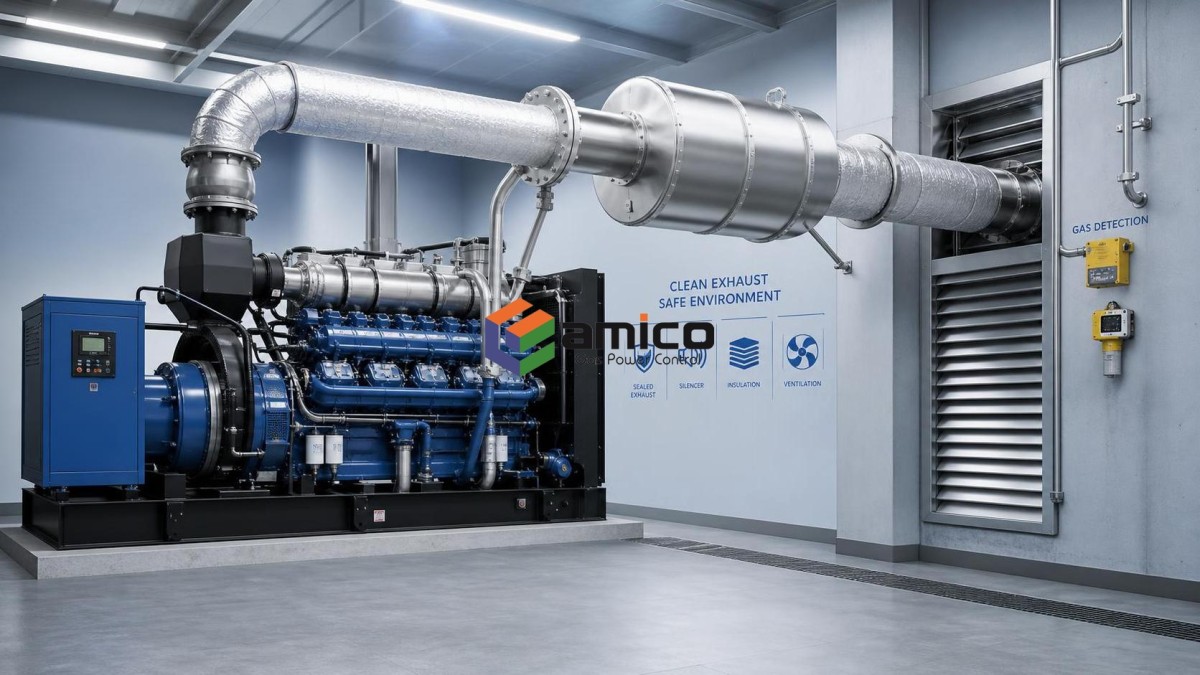
For buyers comparing equipment options, it helps to separate exhaust discharge from exhaust treatment. Discharge means getting the exhaust out of the building safely. Treatment means changing its characteristics through silencing, heat management, or emissions reduction. Some projects need only robust discharge and ventilation. Others, especially in noise-sensitive buildings or stricter urban environments, may also need oxidation catalysts or more advanced emission-control arrangements. The requirement is site-specific, and any absolute answer without reference to the installation environment is too simplistic.
Where Indoor Projects Usually Go Wrong
One common error is assuming that the engine room fan alone is enough. Ventilation fans help remove radiant and ambient heat, but they are not a substitute for sealed exhaust piping. Another is focusing only on the engine exhaust outlet while ignoring leakage points at flexible joints, flanges, condensate sections, or poorly supported pipe runs. Small leaks become serious in enclosed rooms because exposure is continuous and dilution is limited.
A third mistake is treating all gas generator fuels the same. LPG, pipeline natural gas, associated petroleum gas, and biogas each bring different combustion characteristics and operational considerations. Fuel quality affects emissions stability, and that can influence whether a catalytic solution performs reliably. In real engineering work, exhaust treatment is tied to fuel consistency and engine tuning more closely than many non-specialists expect.
There is also a procurement mistake: selecting a generator before confirming the room can support it. Manufacturers and integrators working in gas power know that enclosure dimensions, duct routing, discharge height, maintenance access, and air-change capability can determine the final solution as much as the engine model does. AMICO’s background in gas power control technologies, generation equipment, and smart energy systems reflects this broader reality. Indoor power systems are rarely just about the genset; they are about how the genset behaves as part of the site.
How to Judge Whether a Project Needs More Than Basic Venting
A few questions usually clarify the answer quickly:
- Is the generator located in a fully enclosed room or a partially open plant area?
- Will people occupy adjacent spaces for long periods?
- Are there local limits on noise or exhaust emissions at the property line or building discharge point?
- Does the exhaust route require long pipe runs, multiple bends, or vertical discharge that may affect backpressure?
- Is the fuel stable enough for any planned catalyst or emissions-control device?
If several of those answers point to constraints, the project probably needs a more engineered exhaust solution rather than a basic pipe-to-outdoor arrangement. That does not always mean a complex aftertreatment package, but it does mean the exhaust system must be treated as a designed subsystem with calculations, not an accessory added at the end.
This is also where equipment selection becomes practical. A model such as LPG generator sets may fit indoor applications well when the site already has suitable fuel handling and room design. For example, the AMC300LS is listed at 300KW, 415V, and 542A, which gives a clear electrical starting point. But electrical fit is only half the decision. The indoor exhaust path, ventilation balance, and emissions expectations still determine whether the installation will be workable.
A Better Way to Frame the Decision
Instead of asking, “Do I need exhaust treatment?” the better question is, “What exhaust control level does this indoor installation require?” For some sites, the answer is a properly sealed exhaust system, insulation, a silencer, and well-designed ventilation. For others, especially where indoor occupation, discharge proximity, or local air-quality requirements are tighter, additional emission-control hardware may be necessary.
If you are evaluating indoor gas generation, look at the exhaust system as early as you look at generator capacity. Ask for backpressure limits, ventilation assumptions, discharge routing requirements, and any fuel-related constraints on aftertreatment. Those questions reveal whether a proposal reflects real engineering or just a catalog selection. In indoor operation, exhaust treatment is not a separate issue from the generator. It is part of whether the generator can be used safely at all.

Contact Us
Please use the form below to contact us.
If you require a response, we will contact you as soon as possible.