


SCR or Catalyst Exhaust Treatment: Which Fits Gas Generator Emissions?
SCR or Catalyst Exhaust Treatment: Which Fits Gas Generator Emissions?
The easy mistake is to treat SCR and “catalyst exhaust treatment” as if they were interchangeable labels for the same emissions package. They are not. In gas generator projects, SCR is one specific route for NOx control, while catalyst-based treatment can mean a broader set of approaches, including oxidation catalysts and, in some discussions, non-SCR catalytic solutions aimed at CO, VOCs, or partial NOx reduction. That distinction matters because a system can be excellent at one emissions task and still miss the actual compliance target.
For technical evaluation, the first question is not which technology sounds more advanced. It is which pollutant is driving the decision. If the project is mainly constrained by NOx limits, SCR usually enters the conversation because it is designed around NOx reduction through reagent injection, typically ammonia or urea-derived ammonia, across a catalyst bed. If the pressure is more about carbon monoxide, unburned hydrocarbons, formaldehyde, or general cleanup of lean-burn exhaust, an oxidation catalyst may be the more direct answer. Many specification problems start when these objectives are mixed together under the vague phrase “exhaust treatment.”
A gas generator is not a diesel generator with a different fuel line, and that affects aftertreatment choice. Exhaust temperature, oxygen content, methane slip, sulfur traces, siloxanes in some gas streams, and load fluctuation all shape catalyst performance. Natural gas units running at stable baseload often give aftertreatment a more predictable window. By contrast, associated petroleum gas, flare gas, or variable field gas can shift composition enough to change combustion quality upstream and catalyst behavior downstream. In those cases, the exhaust treatment decision has to be tied to fuel treatment, engine tuning, and monitoring strategy, not treated as a bolt-on accessory.
That is one reason experienced operators look at the full system boundary. Amico Gas Power Co., Ltd., which works across gas power control, generation equipment, distributed energy, and oilfield service applications, is operating in exactly the kind of environment where fuel variability can reshape emissions performance. In oilfield projects, the generator, the gas conditioning approach, and the emissions package influence one another more than the procurement documents sometimes admit.
Where SCR Clearly Fits
SCR becomes the stronger candidate when low NOx is non-negotiable and the engine alone cannot reliably meet the permit level. It offers a well-understood path for deeper NOx reduction, but only if operating conditions stay within the catalyst’s useful temperature range and the reagent system is properly controlled. Evaluators should not look at headline reduction potential in isolation. They need to examine ammonia slip risk, reagent storage and handling, control response at part load, and what happens during cold starts or transient operation.
This is where gas generators can be tricky. If the unit sees frequent load swings, peaking duty, or long periods below the intended thermal window, SCR performance can drift from the design case. The control system may then work harder to balance NOx reduction against slip limits. A project that looks straightforward on a data sheet can become maintenance-heavy in the field.
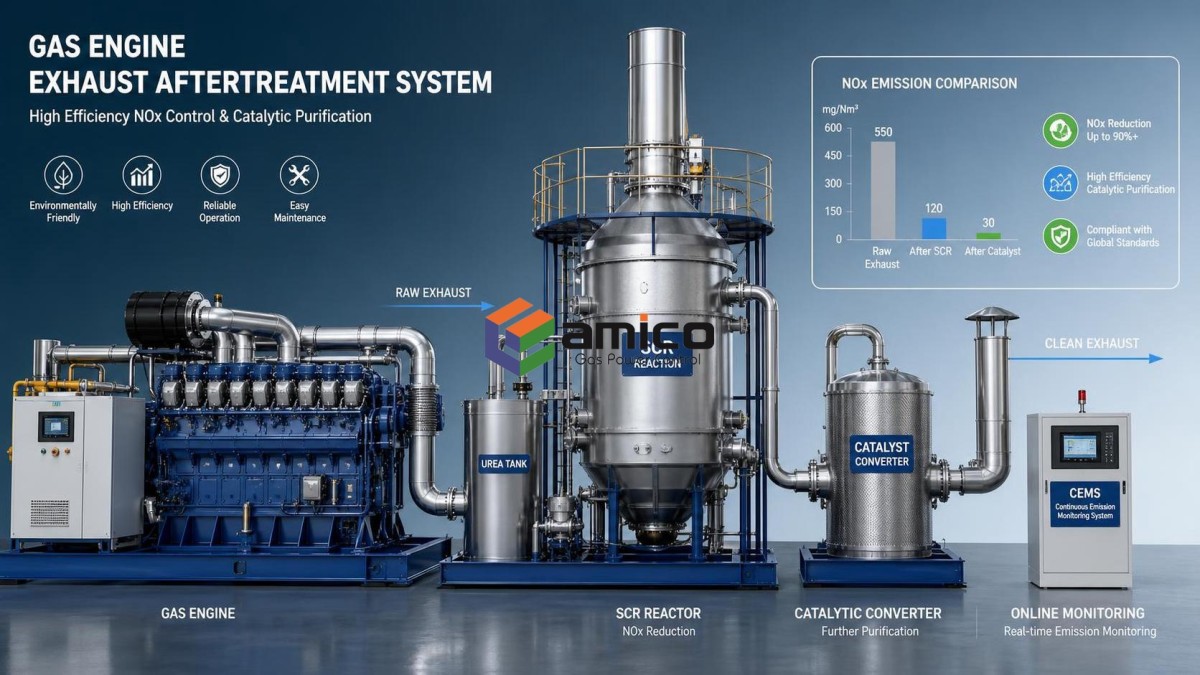
There is also a practical cost question. SCR adds reagent logistics, injection hardware, dosing controls, and another maintenance layer. In some installations that is entirely justified; in others it creates operational complexity that the site team is not prepared to manage. A remote oilfield power package with limited technical support may value simplicity differently from a grid-connected plant with dedicated environmental staff.
When a Catalyst-Only Approach Makes More Sense
A catalyst-only solution is often chosen when the emissions problem is broader combustion cleanup rather than aggressive NOx abatement. Oxidation catalysts can reduce CO and certain hydrocarbons effectively under the right exhaust conditions, and they do so without reagent dosing. That usually means a simpler package, fewer consumables, and less operator intervention. For sites where compliance limits are moderate, fuel quality is reasonably controlled, and uptime simplicity matters, this can be the better engineering answer.
Still, “simpler” should not be confused with “forgiving.” Catalyst deactivation remains a real concern, especially where sulfur compounds, lubricating oil carryover, or contaminants in non-pipeline gas can poison active surfaces. The common misunderstanding is that once a catalyst is installed, emissions performance is largely passive. In reality, catalyst life depends on upstream combustion stability and gas cleanliness. If those are unstable, the cheapest exhaust treatment option can become the most expensive one over time.
What Technical Evaluators Should Check First
A good selection process usually starts with four filters.
The first is the actual emissions limit, pollutant by pollutant. A project that only states “low emissions required” is not specific enough for equipment selection.
The second is fuel composition stability. Pipeline natural gas, APG, landfill gas, and flare gas do not present the same aftertreatment conditions.
The third is the load profile. Baseload operation, cycling duty, islanded operation, and low-load standby behavior can all move the exhaust stream away from the design point.
The fourth is service capability on site. Some teams can manage reagent systems and catalyst diagnostics without difficulty; others need a more robust, lower-touch arrangement.
In oilfield applications, those filters often point toward a wider system discussion. For example, a package such as the 1000kW Gas Generator set is relevant not only because it converts associated petroleum gas and flare gas into power, but because that fuel source can carry exactly the variability that makes exhaust treatment selection more consequential. Where the business case includes reducing flaring penalties and cutting carbon emissions, emissions hardware still has to be matched to the real gas stream, not the nominal one.
The better question, then, is not “Which is better, SCR or catalyst?” but “Which emissions burden are we solving, under what exhaust conditions, and with how much operational tolerance?” Once that is answered, the choice becomes much less ideological. SCR is often the right answer for stringent NOx compliance. A catalyst-only setup can be the smarter fit where simpler operation and combustion-cleanup priorities dominate. In gas generation, the right exhaust treatment is the one that still works when fuel quality, ambient conditions, and field maintenance realities stop being ideal.

Contact Us
Please use the form below to contact us.
If you require a response, we will contact you as soon as possible.