


How to Inspect a Pressure Regulator After Generator Load Fluctuation
How to Inspect a Pressure Regulator After Generator Load Fluctuation
After generator load fluctuation, a faulty pressure regulator can quickly lead to unstable output, fuel imbalance, and repeated shutdowns. For after-sales maintenance teams, knowing how to inspect the pressure regulator accurately is essential to restoring generator performance and preventing further system stress. This guide outlines the key inspection points, common warning signs, and practical checks needed to diagnose regulator issues efficiently in gas-powered generator systems.
When a gas generator starts hunting after a sudden load change, many teams go straight to ignition, governor settings, or the control panel. That is understandable, but in field work the pressure regulator is often where the trouble becomes visible first. If it cannot hold outlet pressure steady, the engine will keep chasing a moving fuel condition. You see it as speed drift, uneven exhaust response, delayed recovery, or nuisance trips that seem unrelated until you watch the gas train closely.
What follows is the checklist most technicians actually need on site.
Start with the symptom, not the part
Before touching the pressure regulator, confirm what kind of load fluctuation happened. A step load increase, repeated load rejection, poor paralleling, and unstable upstream gas supply can all produce similar complaints. The regulator may be the failed component, or it may simply be showing the effect of another problem.
- Check alarm history and event sequence. Did the engine stumble first, or did gas pressure move first?
- Ask the operator whether the fluctuation happened during load acceptance, unloading, or steady operation.
- Compare generator voltage, frequency, and fuel pressure trends if the controller has logs.
That small bit of context saves time. A regulator problem usually shows up as unstable fuel delivery under changing demand, not just a single electrical anomaly.
Look for the warning signs technicians tend to miss
Some regulator faults are obvious: leaking diaphragm, damaged gauge, broken adjustment screw, icing, or blocked vent. Others are quieter. The unit still runs, but response gets lazy and the engine never feels settled.
- Outlet pressure overshoots after a load drop, then slowly returns.
- Pressure dips too far during load pickup and recovery takes longer than normal.
- The regulator body vibrates or chatters.
- Gas-air ratio alarms appear even though ignition parts are in good condition.
- Frequent manual readjustment has been needed to keep the set running.
If someone has already “tuned around” the issue by opening or tightening the regulator repeatedly, note that before doing any test. Field over-adjustment is common, and it hides the original fault.
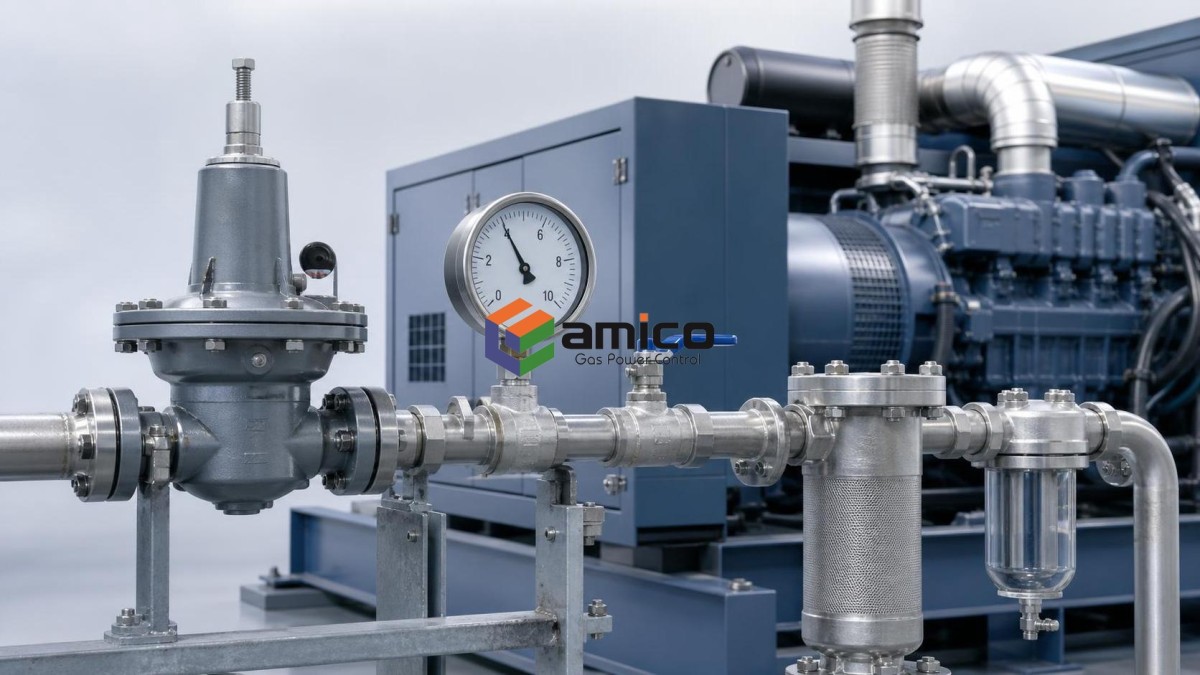
Do the mechanical inspection before the live test
This is where experienced teams usually find something useful. Inspect the regulator and the nearby gas line as an assembly, not as an isolated component.
- Check for external leakage around threaded joints, flanges, impulse lines, vent paths, and gauge ports. If site procedure allows, use the approved leak detection method for that installation.
- Inspect the vent opening. A blocked vent can make the pressure regulator behave unpredictably, especially after rapid load changes.
- Look for contamination: oil carryover, dust, rust scale, condensate, or sticky residue. In gas systems, contamination often causes sluggish regulator movement before complete failure.
- Check whether upstream and downstream isolation valves are fully in the intended position. Half-open valves can mimic regulator instability.
- Inspect supports and piping stress. A regulator under mechanical strain from misaligned piping may not hold settings consistently.
If the regulator has a filter element upstream, inspect that as well. A partially clogged filter can produce pressure drop under load and fool the team into replacing a regulator that is still serviceable.
Watch pressure behavior under real load transitions
A static reading at idle tells you very little. The meaningful test is how the pressure regulator reacts when fuel demand changes. Use calibrated instruments where possible, and compare upstream pressure with downstream regulated pressure during a controlled load step.
What you are looking for is not just the number, but the shape of the response. Stable systems dip slightly on load acceptance, then recover cleanly. Troubled regulators dip hard, oscillate, or recover too slowly. If upstream pressure remains steady while downstream pressure swings, suspicion moves strongly toward the regulator or blockage near it. If both sides swing, the issue may be supply-side.
Be careful with adjustment screws
This is where good intentions create second faults. If the baseline setting is unknown, do not start turning the regulator blindly while the generator is unstable. Record the current position first, review the equipment documentation, and confirm site limits. Setpoint changes without confirming upstream condition can make the engine look better for one load band and worse everywhere else.
On lean-burn gas units, this matters even more because fuel control is tied to combustion stability. A package such as the 250kW Containerized Gas Genset, using electronic speed control and closed-loop lean-burn fuel control, still depends on steady regulated gas pressure to keep response clean during load changes. Controls can compensate only within their designed range.
Know when the regulator is not the root cause
After-sales teams lose time when every fluctuation gets labeled as a pressure regulator problem. There are a few situations where replacing it early is usually the wrong move.
- The engine responds poorly only at one specific load band. That may point to control tuning or air-fuel mapping rather than pure pressure regulation.
- Upstream gas composition has changed【待核实】. Variations in gas quality can affect combustion and apparent regulator performance.
- Paralleling events are rough, but single-unit loading is stable. Check synchronization and load sharing logic.
- Pressure signals are inconsistent between gauges and controller readings. A bad sensor line or transmitter can send the team in the wrong direction.
In containerized sets, space layout sometimes makes this harder because several fuel and control components are close together. For units in the AMC250NS class, take the extra minute to trace the gas path physically instead of relying only on memory or a partial schematic.
What to record before you leave site
A clean inspection is not finished when the genset restarts. Record the pre-fault complaint, upstream pressure, downstream pressure, load condition during testing, adjustments made, parts cleaned or replaced, and whether the unit was verified under a real load step. That record matters the next time the same machine shows intermittent instability.
If you have to make a judgment call in the field, keep it simple: do not replace the pressure regulator just because load fluctuation happened nearby. Replace it when the inspection shows it cannot hold stable downstream pressure, reacts abnormally under demand change, or has clear mechanical or contamination-related faults. Everything else needs one more layer of checking before parts are swapped.
That approach usually gets the generator back online faster, and with fewer repeat visits.

Contact Us
Please use the form below to contact us.
If you require a response, we will contact you as soon as possible.