


- ▶ What drives the installed cost of a 1200 kW silent generator set?
- ▶ When a 1200 kW silent generator set suits hospital backup power
- ▶ Can a 1200 kW silent generator set meet urban boundary noise limits?
- ▶ Overseas Clients Visit Ameco for On-site Inspection, Deeply Empowering Global Green Energy Cooperation
When a 1200 kW silent generator set suits hospital backup power
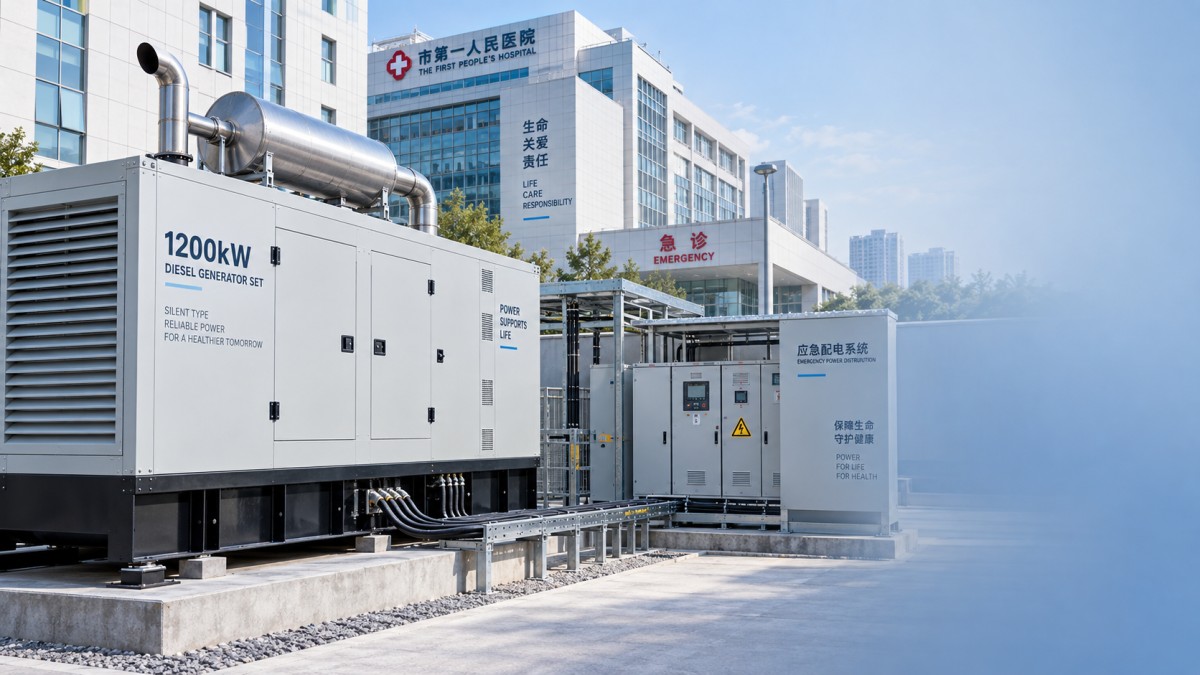
For hospitals, backup power is not simply a facility asset waiting in the background. It supports operating theatres, intensive care units, emergency departments, diagnostic systems, medication storage, communications, and the practical work of keeping patients safe when the utility supply is lost. A 1200kW Silent typeSet can be a sensible emergency-power choice for a medium-to-large hospital, but only when its rating matches the actual essential-load profile—not a rough estimate of the whole site’s electricity bill.
The “silent” requirement matters as much as the kilowatt rating. A generator located near wards, residential boundaries, ambulance access routes, or a rooftop plant area must control noise without compromising ventilation, cooling, maintenance access, or emergency readiness. The right decision is therefore less about buying the largest available unit and more about building a backup-power arrangement that can respond calmly and predictably during a difficult moment.
When 1200 kW is the right range for hospital emergency power
A 1200 kW generator set is often considered when a hospital’s essential electrical system includes several high-priority areas at the same time: critical care, surgical services, emergency lighting, security systems, selected elevators, fire and life-safety equipment, medical gas support equipment, IT infrastructure, and limited HVAC for clinical zones.
It may be particularly appropriate where the facility has grown in phases and the emergency load is no longer comfortably served by a smaller single unit. It can also suit a hospital that needs to maintain a substantial portion of clinical operations through a utility interruption rather than merely powering lights and a few emergency circuits.
Yet 1200 kW is not automatically suitable because a hospital has a certain number of beds or a large building footprint. Two sites of similar size may have very different emergency demand. One may support high imaging loads, multiple operating rooms, extensive cooling equipment, and data-heavy clinical systems. Another may have a more selective emergency distribution scheme. The electrical one-line diagram, load priorities, motor starting characteristics, and future expansion plan will reveal more than floor area alone.
A useful early question for decision-makers is: What must stay online during the first seconds, first hour, and first day of an outage? The answer commonly changes as clinical leaders, engineers, and risk managers review the plan together.
Do not size the set from connected load alone
Connected load is rarely the same as emergency running load. Some systems do not operate simultaneously; others can be staged after the generator has stabilized. Conversely, a load list can understate the real challenge if it ignores inrush current from motors, pumps, air-handling equipment, compressors, and certain medical-support systems.
Before specifying a 1200kW Silent typeSet, the project team should examine:
- Life-safety loads: fire protection, emergency lighting, alarms, essential communications, and egress systems.
- Clinical continuity loads: ICU circuits, operating rooms, emergency care, laboratory functions, blood and medicine refrigeration, and selected imaging or sterilization services where required.
- Motor starting and step loads: the sequence in which pumps, fans, chillers, and elevators are restored can determine whether the generator sees a stable transition or an excessive voltage dip.
- Power factor and harmonics: UPS equipment, variable-frequency drives, and nonlinear electronic loads can affect alternator and control-system selection.
- Capacity reserve: allowance for planned clinical growth, equipment replacement, and changed operating practices over the generator’s service life.
The key figure is not just the generator’s advertised output. Engineers need to confirm the usable rating under the site’s ambient temperature, altitude, enclosure configuration, fuel arrangement, and operating duty. A unit that looks adequate on paper may lose practical margin if conditions are not accounted for during design.
Quiet operation is a site-design issue, not an enclosure label
In hospital environments, noise is more than a neighbour-relations concern. Persistent sound can disturb recovery areas, interfere with staff communication, and create unnecessary stress at a time when the building is already managing an emergency. A silent enclosure is a valuable starting point, but the final acoustic result depends on the entire installation.
Assess the generator room or outdoor location, exhaust routing, intake and discharge air paths, vibration isolation, cable penetrations, and reflected sound from nearby walls. Acoustic louvres and exhaust silencers must be selected carefully, because aggressive sound attenuation can restrict airflow and raise operating temperatures. The solution needs to protect both patient comfort and engine performance.
For a hospital close to residential properties, it is wise to review predicted sound levels at sensitive boundaries rather than assessing the set only at a standard measurement distance. Local noise rules and planning conditions should be addressed early, before civil works or equipment procurement lock in a difficult layout.
Single 1200 kW unit or multiple generator blocks?
A single set can simplify the footprint, controls, fuel connections, and maintenance planning. For a clearly defined emergency load around the 1200 kW range, it may provide a practical, direct solution. However, many hospitals also evaluate parallel generator arrangements because resilience is not identical to capacity.
Multiple sets can support staged loading, maintenance flexibility, and a degree of redundancy. If one machine is unavailable for scheduled service, another may still carry a defined essential load. The trade-off is a more sophisticated switchgear and control design, along with careful attention to synchronization, protection coordination, and testing procedures.
Natural gas generation can also form part of a distributed energy strategy where site gas supply, operating economics, and local regulations support it. For example, AMICO’s 1000kW Natural Gas Genset is configured as a 4 × 250 kW package, with 600 V, 50 Hz, and 1500 rpm specifications. A modular configuration is not a like-for-like replacement for a 1200 kW emergency generator; rather, it illustrates how multiple generation blocks may be evaluated when a hospital wants greater operational flexibility or is planning broader on-site energy capability.
Gas-based systems require a particularly honest review of fuel resilience. During an extended utility emergency, the availability and pressure stability of the gas network must be assessed alongside any applicable emergency-fuel requirements. In many jurisdictions, healthcare backup systems are governed by strict codes that influence fuel choice, runtime, transfer performance, testing, and redundancy. These requirements should guide the architecture from the outset.
Transfer time and load sequencing deserve executive attention
Hospital leaders often focus naturally on generator capacity, but the transfer path is just as important. Automatic transfer switches, emergency switchboards, UPS systems, and control logic determine how quickly critical circuits receive stable power and how noncritical loads are kept from overwhelming the set during startup.
A well-designed sequence may restore life-safety and critical-care circuits immediately, then add pumps, selected ventilation, food-service support, or other operational loads in controlled steps. This approach can reduce transient stress and may prevent a single large motor start from affecting sensitive equipment.
Testing should reflect that sequence. A no-load start test confirms only part of the system’s readiness. Periodic tests under meaningful load, including transfer and return-to-utility procedures, offer a far clearer view of whether controls, batteries, breakers, ventilation, and staff procedures will work together when needed.
A practical decision checklist before approving the project
Before committing to a 1200 kW rating, ask the design team to provide a load study that separates mandatory, critical, and deferrable circuits. Request motor-starting calculations and a proposed load-addition sequence, rather than accepting a total kW figure without context. Confirm whether the capacity is intended for standby operation only or a different operating duty, since the rating basis affects equipment selection and lifecycle planning.
Also review space for service access, air movement, exhaust discharge, electrical clearances, switchgear, and future expansion. A quiet set that cannot be maintained safely or ventilated properly is not a resilient solution. Finally, include hospital operations personnel in commissioning and emergency drills. Their familiarity with alarms, transfer states, and manual overrides can be as important as the equipment itself.
The right fit is measured in continuity, not nameplate size
A 1200kW Silent typeSet suits hospital backup power when the essential-load study, transient analysis, acoustic design, and compliance requirements all point to that range. It can provide substantial emergency capacity while helping protect the calmer environment patients and clinicians need.
For decision-makers, the strongest path is to treat the generator as one part of an integrated emergency-power system: generation, transfer, distribution, controls, fuel security, maintenance, and people. When those elements are planned together, backup power becomes more than an obligation—it becomes dependable support for care when the grid cannot provide it.

Contact Us
Please use the form below to contact us.
If you require a response, we will contact you as soon as possible.