


- ▶ Can a 1200 kW silent generator set meet urban boundary noise limits?
- ▶ Overseas Clients Visit Ameco for On-site Inspection, Deeply Empowering Global Green Energy Cooperation
- ▶ How fuel quality changes the cost of a 400kw biogas generator set
- ▶ How to choose a 1000kW gas generator set for standby power
Can a 1200 kW silent generator set meet urban boundary noise limits?
Can a 1200 kW Silent Generator Set Meet Urban Boundary Noise Limits?
Can a 1200kW Silent typeSet deliver reliable power while meeting strict urban boundary noise limits? It can, but the word “silent” should never be treated as a compliance guarantee. At this output level, a generator package contains several substantial noise sources: engine combustion, cooling-air flow, alternator vibration, exhaust discharge, and structure-borne transmission through the base and connected pipework. Whether the installation passes at the property line depends as much on siting and verification as it does on the acoustic enclosure supplied with the unit.
For quality-control and safety teams, the practical question is not whether a brochure lists a low sound level. The question is: under what operating condition, at what distance, in which acoustic environment, and with which accessories? A 1200 kW generator that is acceptable at a factory test position may still create a problem beside apartments, hospitals, schools, or offices if the project team overlooks exhaust routing, reflected sound, night-time limits, or the effect of full-load cooling demand.
“Silent” Is a Design Category, Not a Boundary Result
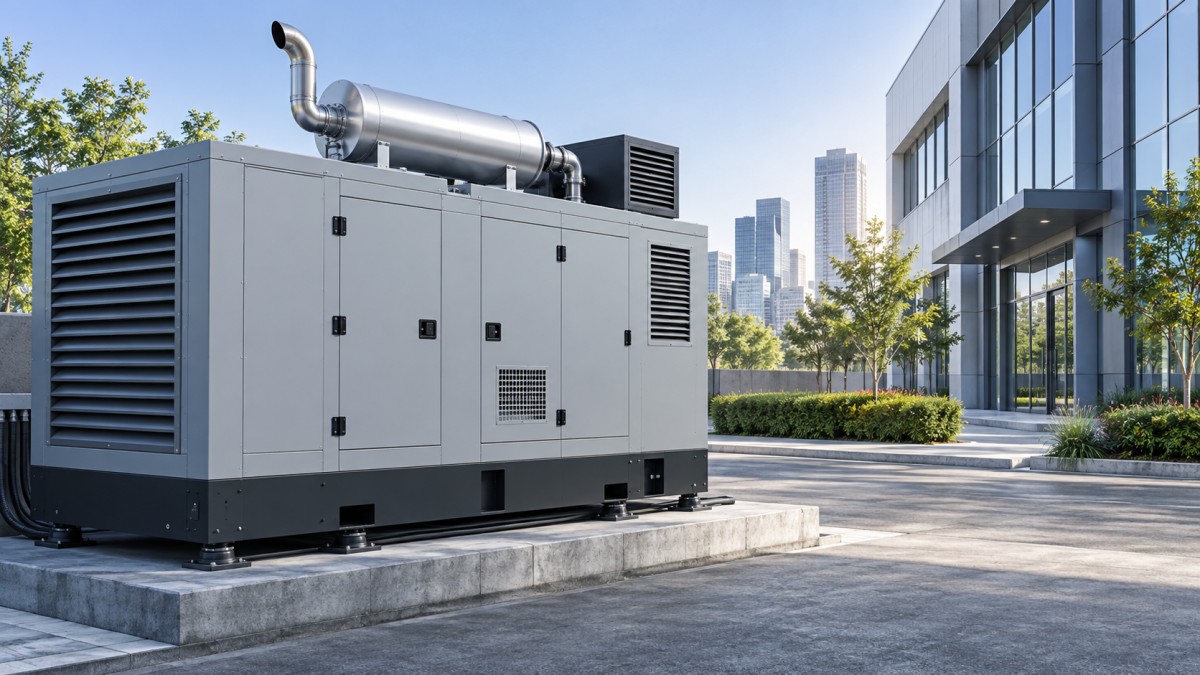
Large generator sets are commonly described as open type, weatherproof, sound-attenuated, or silent type. These labels are useful for procurement, but they are not equivalent to a measured boundary result. The acoustic performance of a 1200kW Silent typeSet is usually influenced by the canopy panel construction, insulation and absorption materials, intake and discharge attenuators, fan selection, door sealing, exhaust silencer configuration, and vibration isolation.
At 1200 kW, cooling air is often the point where an apparently quiet design loses ground. The radiator and fan need a high volume of airflow, and that air must enter and leave the enclosure. If intake louvers are undersized, airflow restriction can raise temperatures. If they are opened up without acoustic treatment, radiated noise rises. A well-designed package balances thermal performance and attenuation; an enclosure that is quiet only at light load is not an adequate urban solution.
It is also important to distinguish sound power from sound pressure. Suppliers may quote either, and the figures are not interchangeable. Sound pressure level is commonly what a field measurement captures at a stated location. Any evaluation should confirm the measurement distance, the generator load, whether the figure is free-field or affected by reflections, the weighting used, and whether the cooling fan was operating. Without those conditions, a single dB value has limited value in a compliance review.
The Boundary Is Where the Project Is Judged
Urban requirements are normally assessed at a site boundary, a sensitive receptor, or another location defined by the applicable local authority or project specification. That makes layout critical. A set located behind a loading bay wall can behave very differently from the same set placed in an open service yard. Concrete facades, basement ramps, glass curtain walls, and narrow building gaps may reflect or channel sound toward the nearest receiver.
Distance helps, but it is not a substitute for analysis. The expected reduction with distance assumes broadly open conditions. In a dense urban plot, reflections can reduce that benefit. A boundary may also be much closer than the generator location appears on a general site plan. Quality teams should review the actual legal boundary, adjacent residential windows where relevant, rooftop property lines, and public-access areas rather than relying on the centerline of the plot.
Night operation deserves separate attention. A standby unit may run only during utility interruptions, but its noise can be most noticeable when traffic and mechanical background noise are low. Routine monthly testing can create similar complaints if it is scheduled without regard to neighboring occupancy. A project can be technically safe and still become operationally difficult when test-run controls are absent.
What Should Be Reviewed Before Approval?
A useful review starts with the applicable local environmental requirement and the client’s own noise criterion. Do not assume that one country’s industrial-area limit applies to another city, or that a daytime requirement can be used for overnight emergency power. Where the requirement is unclear, it should be resolved before selecting the enclosure, because retrofitting attenuators after civil works are complete is usually more disruptive and expensive.
- Confirm the required measurement location, time period, weighting, and whether the limit applies to continuous, emergency, or test operation.
- Request acoustic data for the proposed engine, radiator, enclosure, exhaust system, and stated operating load—not merely a generic canopy figure.
- Check the complete noise path: intake, radiator discharge, exhaust outlet, enclosure leakage, doors, ventilation openings, and fuel-system equipment.
- Review generator orientation. Directing the radiator discharge toward a sensitive boundary is a common avoidable mistake.
- Identify vibration bridges, including rigid exhaust supports, cable trays, fuel lines, and poorly isolated steelwork.
- Define who will perform post-installation measurements and what corrective action is required if results are above the project criterion.
The supplier’s manufacturing capability matters because noise control is not only about adding heavier panels. It involves integration between engine controls, combustion behavior, cooling design, alternator loading, enclosure fabrication, and test procedures. Amico Gas Power Co., Ltd., headquartered in Chengdu, develops gas power control technology and generation equipment alongside distributed-energy and oilfield service solutions. Its more than 20,000 square meter R&D and manufacturing facility includes engine and generator development, testing, and inspection resources. For a project review, this type of integrated capability is relevant when the generator package must be matched to site conditions rather than selected as a standard enclosure alone.
Exhaust Noise Is Often Underestimated
On a high-capacity set, the exhaust system can dominate the audible result at certain frequencies. A residential neighbor may not describe the issue as “high sound level”; they may report a low-frequency rumble, pulsation, or vibration. A basic silencer may not be sufficient where the discharge is near upper-floor windows or where long ducting creates resonance. The exhaust silencer type, pipe diameter, bends, supports, thermal expansion arrangement, termination height, and discharge direction should be reviewed as one system.
Gas supply equipment should be included in the same assessment when the project uses gas generation. Pressure regulation and decompression skids can introduce valve noise and pipe vibration, particularly during changing load conditions. Components such as a Pressure relief pry may be used in decompression skid or gasification skid arrangements, but their installation should be considered with the wider piping, venting, and safety design. A correctly selected generator enclosure cannot compensate for untreated noise from adjacent gas-handling equipment.
Factory Testing Is Valuable, but It Does Not Replace Site Testing
Factory acceptance testing can confirm that the supplied 1200kW Silent typeSet operates correctly and can provide a controlled baseline for acoustic performance. It is particularly useful for checking abnormal fan noise, rattling panels, air leaks around access doors, loose exhaust components, and vibration-related defects before shipment. However, the factory cannot reproduce the final building geometry, nearby reflective surfaces, installed exhaust route, or the city’s ambient noise pattern.
Commissioning should therefore include a site acoustic verification plan. Measurements should be taken at the locations required by the project, during a documented operating condition, using suitable calibrated instruments and a method agreed in advance. If load-bank testing is necessary to represent a realistic operating state, that should be planned early. Testing at idle and assuming the result represents full-load emergency operation is a weak quality-control practice.
If readings are close to the limit, leave margin rather than declaring success too quickly. Ambient conditions, receiver position, maintenance condition, and later site modifications can change the result. Fan wear, damaged acoustic seals, corroded exhaust silencers, or an open service door during operation can all undermine an initially compliant installation.
A Defensible Selection Decision
A 1200 kW silent generator set can meet urban boundary noise limits when the requirement is defined clearly, the acoustic package is selected for the actual duty, and the installation is engineered as a complete system. The least reliable approach is to buy on a “silent” label and solve the boundary issue after commissioning.
For quality and safety managers, the most defensible approval record contains the local criterion, supplier acoustic documentation, site layout review, exhaust and ventilation details, isolation strategy, commissioning method, and final field-test results. That record does more than support compliance: it exposes problems while there is still room to adjust orientation, attenuation, or operating procedures.

Contact Us
Please use the form below to contact us.
If you require a response, we will contact you as soon as possible.