


What Affects the Total Cost of Ownership of Gas Generator Sets
What Affects the Total Cost of Ownership of Gas Generator Sets
When evaluating Gas Generator Sets, purchase price is only the beginning. For financial decision-makers, the total cost of ownership depends on fuel efficiency, maintenance frequency, operating reliability, service support, and lifecycle performance. Understanding these cost drivers helps businesses make smarter investments, reduce long-term risk, and select power solutions that deliver stronger returns over time.
If you are the person approving budget, the mistake to avoid is comparing quotes as if the machine ends at delivery. It does not. In generator projects, the expensive surprises usually show up later: unstable fuel adaptation, too many shutdowns, parts delays, poor control integration, or operating costs that looked acceptable on paper but drifted badly in real use. A better approach is to treat total cost of ownership as a checklist before you sign anything.
Start with fuel, because it keeps paying the bill
For most gas power projects, fuel cost will outweigh the initial purchase price over the equipment life. That means a small difference in efficiency can matter more than a discount in the original quotation. Ask for fuel consumption data under the load conditions you actually expect, not only at ideal rated output. Many sites run at partial load for long periods, and that is where operating cost can move in the wrong direction.
Also check fuel quality assumptions. Natural gas composition can vary by region and source. If the supplier does not clearly explain how the set handles gas fluctuation, methane number variation, or site-specific impurities, you are carrying future cost risk. In practice, poor fuel matching often appears as unstable output, higher maintenance frequency, or derating. None of that helps a finance team trying to forecast lifecycle cost.
- Ask for fuel consumption curves, not a single headline number.
- Confirm expected efficiency at partial load.
- Check what gas quality range the unit is designed to tolerate.
- Flag any performance claim that cannot be tied to test conditions.
Maintenance intervals are a cost line, not a footnote
A low-capex machine can become expensive if it needs frequent service stops, specialist labor, or imported parts with long lead times. This is where procurement teams sometimes get trapped by incomplete comparison tables. You want to know more than the maintenance schedule. You want to know how that schedule translates into labor hours, spare parts consumption, planned downtime, and whether your site team can handle routine work without calling the manufacturer every time.
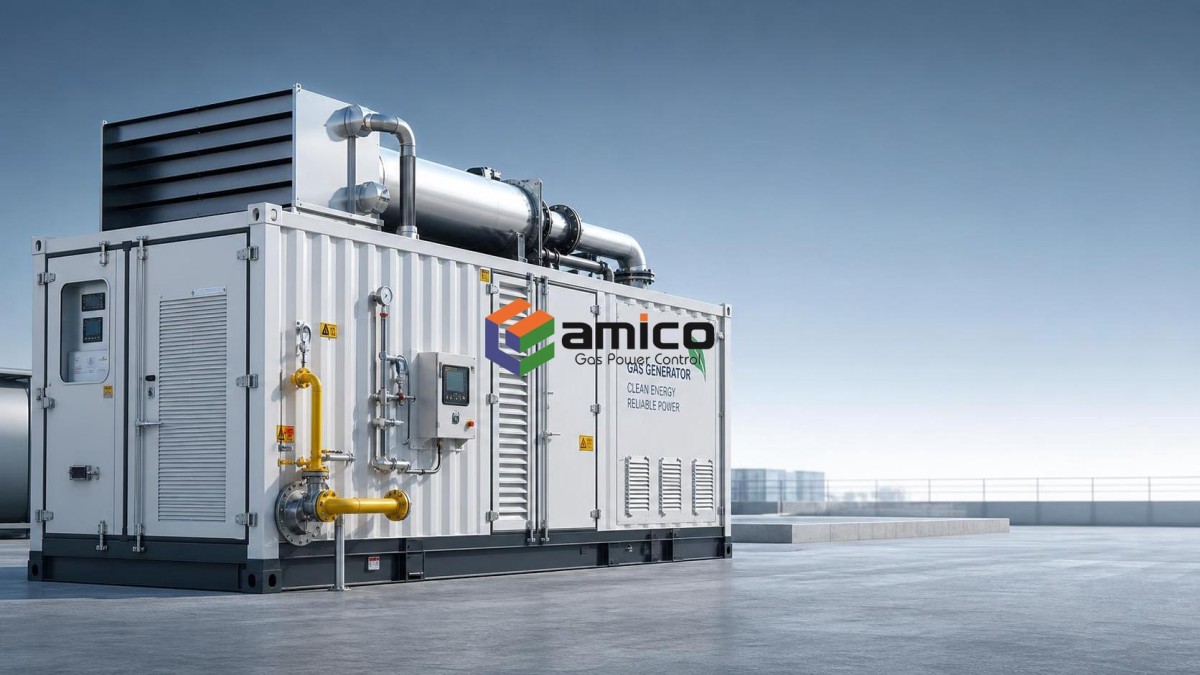
This is one reason buyers often prefer systems with mature gas control and automated operation logic. For example, a containerized unit with electronic speed control, lean-burn closed loop fuel control, and one-key automatic start and paralleling may reduce avoidable operator errors in daily use. In that context, a model such as the 1000kW Containerized Gas Genset is not just a hardware purchase; it affects staffing, routine operating consistency, and the likelihood of intervention costs later.
Downtime usually costs more than people estimate
If the power unit supports production, field operations, distributed energy, or critical facility loads, every unplanned stop has a financial consequence. Sometimes it is lost output. Sometimes it is idle labor, process interruption, flaring issues, restart loss, or penalty exposure under service commitments. Even where the exact cost is hard to model, the risk is real.
So when reviewing Gas Generator Sets, do not stop at rated power. Ask how the supplier addresses ignition control, protection logic, start-stop stability, synchronization, and remote diagnostics. These details decide whether the equipment behaves like an asset or a recurring problem ticket. If reliability data is presented, verify the test basis and operating conditions. If it cannot be verified, treat it cautiously and mark it 【待核实】 in your approval notes.
Site fit can quietly change project economics
One item people often miss: the cost of making the generator fit the site. Containerized design can reduce civil work and simplify transport or deployment, but you still need to check layout, ventilation, noise expectations, fuel supply interface, control cabling, exhaust routing, grid connection, and access for maintenance. A unit that looks economical in the quotation stage can become expensive after site modification orders begin.
For example, if you are reviewing a 1000kW-class package, dimensions and weight matter immediately for logistics and installation planning. A set in the 10,500×3,000×3,000mm range and around 20,000kg may be suitable for many industrial sites, but transport route, lifting plan, and foundation readiness still need to be checked against the actual project conditions. This is basic, but skipped more often than it should be.
After-sales support belongs in the cost model
A generator supplier is not only selling equipment. They are also selling response time, spare parts access, technical depth, and the ability to support troubleshooting when the unit is under pressure in the field. That matters even more in gas power projects, where engine control, fuel management, and operating environment interact closely.
This is where manufacturer background becomes relevant, but only insofar as it reduces practical risk. AMICO Gas Power Co., Ltd, for example, positions itself as an integrated energy equipment manufacturer and oilfield service provider, with R&D in gas power control technologies, equipment manufacturing, distributed power applications, and smart energy management. A supplier with real engineering depth may be better equipped to support lifecycle operation, though buyers should still validate local service capability, spare parts arrangements, and escalation pathways rather than assuming capacity from a company profile alone.
Look beyond the machine to the operating model
Some ownership costs come from how the asset will be run, not just how it is built. Ask these questions early:
These questions are not glamorous, but they are usually where total cost moves from acceptable to painful.
What to pin down before approval
Before signing off on a Gas Generator Sets purchase, make sure your file includes a usable ownership view, not just a procurement summary. At minimum, ask for expected fuel consumption under real load ranges, preventive maintenance scope, recommended spare parts list, commissioning scope, warranty boundaries, and service response commitments. If the project depends on grid parallel operation, gas adaptability, or automated control functions, those points should be stated clearly in the technical attachment.
A good approval decision usually comes down to one practical test: can you explain, in simple numbers and operating assumptions, why this unit will cost less to own over time than the alternatives? If that answer depends too heavily on optimistic assumptions, the comparison is not finished yet.
The cheapest quote is rarely the cheapest power. For finance teams, the better buy is the one with believable efficiency, manageable maintenance, stable operation, and support that holds up when the site is under load.

Contact Us
Please use the form below to contact us.
If you require a response, we will contact you as soon as possible.