


Key Site Conditions to Check Before Installing Gas Generator Sets
Key Site Conditions to Check Before Installing Gas Generator Sets
Before a gas-fired unit is placed on site, the real question is not whether the equipment fits on the drawing. It is whether the location can support stable fuel quality, safe heat rejection, predictable maintenance access, and a power interface that will not cause trouble after commissioning. Many installation delays come from details that seem secondary during early planning: a narrow turning radius for container delivery, insufficient fresh-air path around the enclosure, or a gas source that is available on paper but unstable in pressure during actual operation. For Gas Generator Sets, those details usually decide whether the project starts cleanly or enters a cycle of field modifications.
This becomes even more obvious in distributed energy projects, oilfield support stations, industrial plants, and remote utility supplementation. The equipment may be similar, but site conditions are not. A factory with a reliable natural gas line and a defined electrical room presents one set of priorities. A wellhead-associated gas project, where gas composition and operating load can fluctuate, requires a more cautious review from the beginning.
Fuel Supply Is the First Site Reality Check
Project teams often start with civil layout and only later ask whether the gas source is truly suitable. That sequence is backwards. A gas generator installation should first confirm what type of gas will be supplied, how stable the pressure is, whether pretreatment is needed, and how often quality variation is expected. A unit can tolerate design-based operating ranges, but repeated fluctuation in methane content, impurities, or moisture will affect combustion stability, emissions behavior, and maintenance intervals.
In pipeline natural gas applications, the main issue is usually continuity and pressure matching. In oilfield or associated gas projects, the more serious concern may be gas composition drift and contaminants. That changes not only engine tuning strategy but also filtration, gas train design, and startup reliability. If site teams do not clarify this early, they may end up solving fuel problems with repeated control adjustments after installation, which is inefficient and expensive.
For this reason, experienced EPC and operations teams usually ask a simple question before anything else: is the gas source operationally stable enough for the intended duty cycle, not just theoretically available?
Access, Lifting, and the Space Around the Unit
A site can have enough area and still be difficult to build. Containerized gas generating units reduce field assembly work, but they also impose practical transport and handling requirements. Road width, bridge limits, crane positioning, unloading sequence, and door clearance for later service all matter. A compact site layout that leaves no room for radiator-side airflow or maintenance access around the alternator end may look efficient on a plan, but it usually creates avoidable operating problems.
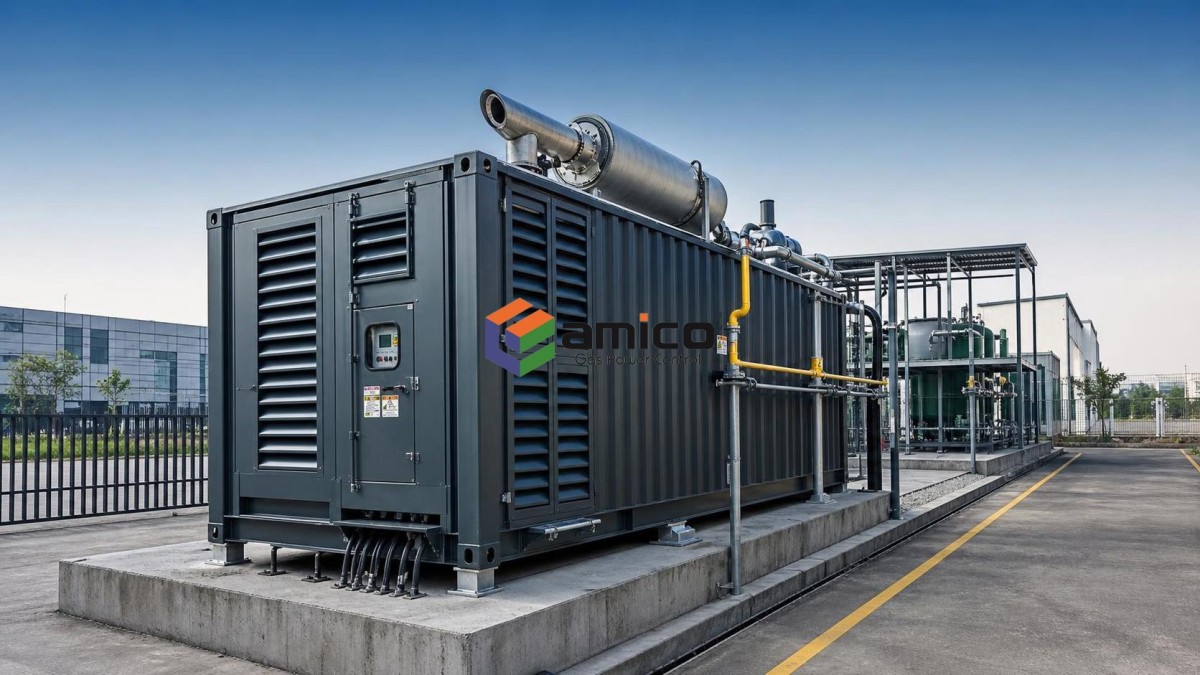
This is where containerized configurations are often selected for industrial or remote energy projects. A unit such as 1200kW Silent type Containerized Gas Generator Set can simplify transport, enclosure integration, and acoustic treatment, but only if the site has been checked for delivery path, lifting capacity, and service clearances. Silent-type design helps in noise-sensitive locations, yet it does not remove the need for proper inlet and outlet air paths.
Ventilation Is Often Underrated Until Summer Operation
Heat management is one of the most common field oversights. Gas engines are sensitive to intake and ambient conditions, and poor ventilation can gradually reduce output stability even when the generator appears electrically healthy. Enclosed yards, wall-adjacent installation, or structures added later around the genset can recirculate hot air back into the container. That raises internal temperature, affects control components, and can force derating depending on site conditions.
The problem is not limited to hot climates. At high altitude, lower air density already changes cooling effectiveness and combustion conditions, so a layout with marginal airflow becomes even less forgiving. Where local conditions include seasonal dust, operators should also consider filter loading and cleaning access rather than only the nominal ventilation path.
Foundation Design Should Follow Dynamic Load, Not Just Static Weight
A concrete pad that can carry the unit weight is not automatically a proper foundation. Gas Generator Sets introduce dynamic forces, vibration transfer, and alignment requirements that can affect both machine life and surrounding structures. Weak subgrade, uneven settlement, or poor drainage around the foundation can show up later as vibration issues, coupling stress, or enclosure deformation. These are not always dramatic failures; more often they become chronic reliability problems.
Drainage is worth mentioning because it is frequently ignored in early civil work. Water accumulation near cable trenches, gas piping interfaces, or the foundation edge can shorten component life and complicate maintenance. On sites with monsoon rainfall or poor surface runoff, this deserves attention before the pad is poured, not after the unit arrives.
Noise, Exhaust, and Neighboring Equipment
Noise control is not only about community compliance. It also affects operator comfort, control room placement, and whether nearby process instruments remain in a suitable working environment. On industrial campuses, the challenge is often less about reaching a low absolute noise figure and more about preventing reflected sound between buildings or conflict with existing plant operations.
Exhaust routing should be reviewed with the same practical lens. The shortest path is not always the right one. Structural supports, thermal expansion, safe discharge location, and the impact on adjacent walkways or air intakes all need review. A silent container may help reduce external acoustic burden, but exhaust layout remains a separate engineering issue.
Grid Interface and Load Profile Decide Control Strategy
Some projects require standby support. Others expect continuous base-load operation or parallel running with the utility. Those are very different situations, and the installation site should be reviewed accordingly. Cable routing distance, switchgear location, grounding conditions, synchronization requirements, and load step characteristics all influence the final configuration.
Where the load includes large motor starts, rapid cycling, or sensitive electronics, the electrical side must be evaluated together with the mechanical site conditions. This is one reason integrated control capability matters in practice. For example, the AMC1200NS specification includes one-key automatic start, one-key paralleling, one-key delivery, and one-key shutdown, which is useful where operation needs to be simplified, but that convenience only delivers value when the site’s protection logic and interconnection plan are already clear.
A Short Field Checklist That Usually Prevents Rework
Companies working across gas power equipment, field engineering, and smart energy management tend to see the same pattern repeatedly: the equipment itself is rarely the main source of trouble. Misread site conditions are. That is especially true for medium and large units, where electrical integration, fuel handling, and enclosure airflow have to work together rather than as separate design packages.
AMICO’s background in gas power control technologies and field-oriented energy applications reflects that reality. In practical terms, a 1200kW-class generator with stable 50Hz output, lean-burn closed-loop control, and containerized deployment can be a strong fit for distributed energy or industrial self-generation. The fit still has to be earned on site. Before placing an order or finalizing civil drawings, it is worth confirming fuel behavior under real operating conditions, not just design assumptions, and checking whether the installation space can support the machine through commissioning and years of service access. That is usually where the best projects separate themselves from the expensive ones.

Contact Us
Please use the form below to contact us.
If you require a response, we will contact you as soon as possible.