


Exhaust Treatment Requirements for Gas Generators at Data Centers
Exhaust Treatment Requirements for Gas Generators at Data Centers
For data centers relying on gas generators, exhaust treatment is not only an environmental issue but also a critical part of quality control and safety management. From emission compliance to indoor air protection and operational stability, proper exhaust treatment directly affects facility reliability and regulatory performance. Understanding the key treatment requirements helps quality and safety teams reduce risks, improve inspection standards, and support cleaner, more efficient backup power systems.
In practice, exhaust treatment usually gets attention late, often after the generator set has already been selected and the room layout is nearly fixed. That is where trouble starts. By then, the stack route is compromised, maintenance clearance is tight, catalyst temperature windows are ignored, and somebody assumes the local authority will accept the same configuration used in another country. For quality control and safety teams, the better approach is to treat exhaust compliance as a pre-commissioning checklist item, not a finishing item.
What needs to be checked before you approve a system
- Confirm which emission limit actually applies to the site. Do not work from a supplier brochure alone. Data center projects may be reviewed under local air pollution rules, emergency generator provisions, building permits, or industrial source standards depending on jurisdiction. The legal basis needs to be identified from the start, because the allowed limits for NOx, CO, VOC, and particulate matter may differ significantly.
- Check whether the generator is classified as emergency-only, prime power, or continuous support. This changes both runtime expectations and the exhaust treatment strategy. A system intended for frequent testing or peak support may face tighter scrutiny than a unit used strictly for emergency backup.
- Ask for the engine-out emission data at the actual operating point, not only at rated load. Gas generators in data centers often spend time at partial load during testing. Some aftertreatment systems perform well at one load band and poorly at another.
- Verify the fuel gas quality assumptions. If the engine and catalyst are designed around pipeline natural gas but the site sees composition swings, sulfur traces, siloxanes, or other contaminants【待核实 based on local gas source】, catalyst life and emission performance can change fast.
That last point is often underestimated. Exhaust treatment is never just about the muffler and the stack. It starts with combustion quality, air-fuel ratio control, and fuel consistency. If the combustion process drifts, the aftertreatment unit is forced to compensate for problems it was never meant to solve.
On projects using medium-to-large gas gensets, including units in the range of the 1000kW Natural Gas Genset, this matters even more because higher exhaust flow and heat load leave less room for poor duct routing or undersized treatment components.
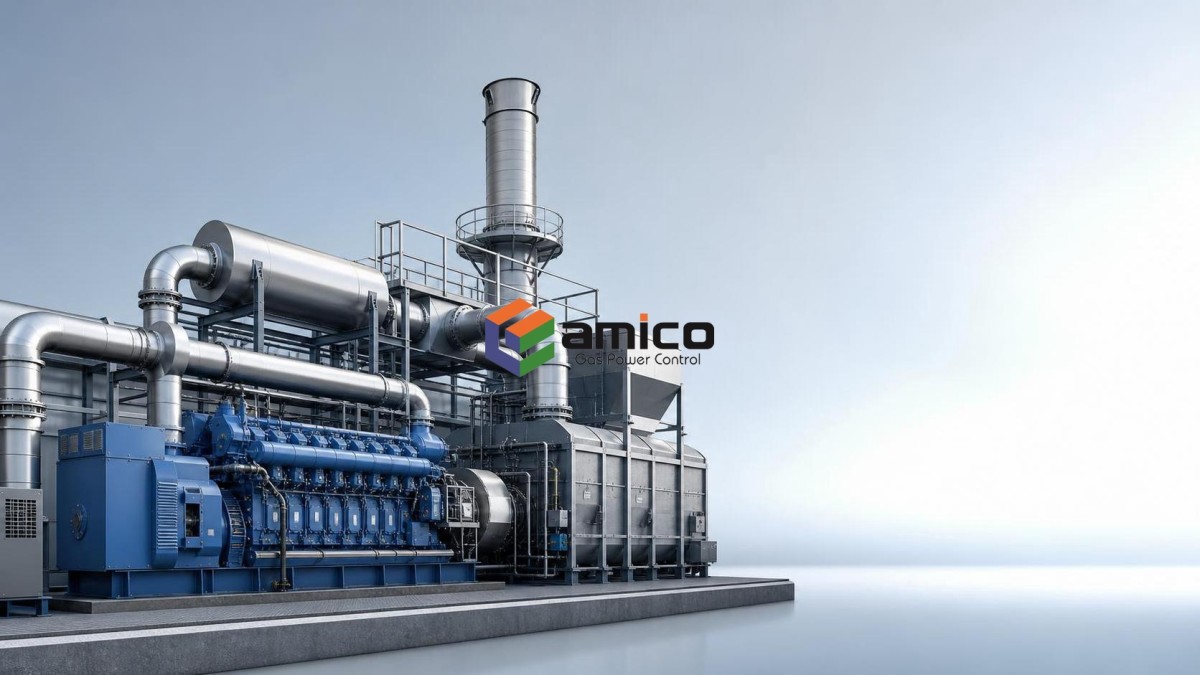
The exhaust treatment checklist that catches most field problems
If I am reviewing a package for a data center, these are the points I want signed off before factory acceptance or site installation:
- Emission control method matches the target pollutant. Lean-burn gas engines often focus on NOx control through combustion tuning and, where required, oxidation or other catalyst arrangements. The wrong technology selection usually shows up later as unstable compliance or excessive backpressure.
- Exhaust backpressure stays within the engine manufacturer’s limit. This is a non-negotiable quality checkpoint. Treatment devices, silencers, flexible joints, elbows, rain caps, and long vertical runs all add resistance. If the calculated backpressure is already close to the limit on paper, the installed system will likely disappoint.
- Catalyst operating temperature window is realistic for the duty cycle. A catalyst that needs sustained high exhaust temperature may not light off properly during short test runs or low-load operation. In data centers, weekly or monthly tests are common, so this should be reviewed against the actual maintenance routine.
- Sampling ports and monitoring access are included. If there is no proper test port, third-party emission verification becomes awkward and sometimes unsafe. Quality teams should not accept a system that cannot be reasonably inspected.
- Thermal insulation is complete and durable. Hot surfaces near personnel routes, cable trays, or intake paths are a safety issue, not just an efficiency issue.
- Condensate management is addressed where exhaust cooling or specific routing conditions can create it. Poor drainage corrodes components and can affect sensor readings.
- The stack discharge point is reviewed for recirculation risk. This is one of the most common design misses. If exhaust re-enters building air intakes or adjacent ventilation openings, the project may technically pass generator tests and still create an indoor air problem.
That recirculation issue deserves a hard look. In dense data center campuses, roof space is crowded. Generator flues, HVAC intake louvres, cooling equipment, and maintenance walkways all compete for the same area. You do not need a dramatic failure for this to become serious. A poor wind condition plus a long generator test can be enough to trigger odor complaints, elevated CO readings, or a safety investigation.
Documentation that should exist, but often does not
A compliant exhaust treatment package should be supported by documents that a site team can actually use. Not marketing sheets. Working documents.
If a supplier cannot provide these clearly, that is already useful information. It usually means the project team will be left arguing about responsibility later.
A few practical acceptance notes
Do not sign off based only on unloaded start-up or short-duration witness runs. A proper acceptance view should consider warm operation, realistic load, alarm behavior, and whether the exhaust treatment setup remains stable during the test period. For some projects, local rules or third-party testing methods will define the exact measurement approach; for others, that needs to be agreed in advance and written into the inspection plan.
Also, be careful with the phrase “meets standards.” Which standards? Engine manufacturing standards, local emissions permit conditions, electrical package certification, and building/fire review are not the same thing. Keep those separated in your checklist. Mixing them is how gaps survive until commissioning.
Manufacturers with in-house gas engine development and test capability, such as Amico Gas Power Co., Ltd., usually have an advantage here because combustion control, generator packaging, and exhaust integration can be reviewed together instead of by disconnected vendors. That matters when you are evaluating a high-capacity set like the AMC1000GFJ6-4PN, rated 1000kW at 600V, 50Hz, 1500rpm, where system coordination affects both emissions behavior and operating margin.
If you are building your own review sheet, keep it simple: identify the applicable emission basis, verify engine-out data, confirm treatment selection, check backpressure, review stack discharge risk, and demand inspection documents before installation starts. That sequence catches most of the expensive mistakes while they are still easy to correct.

Contact Us
Please use the form below to contact us.
If you require a response, we will contact you as soon as possible.