


- ▶ Can a 1200 kW silent generator set meet urban boundary noise limits?
- ▶ Overseas Clients Visit Ameco for On-site Inspection, Deeply Empowering Global Green Energy Cooperation
- ▶ How fuel quality changes the cost of a 400kw biogas generator set
- ▶ How to choose a 1000kW gas generator set for standby power
Which Standards Matter Most When Buying Industrial Gas Generator Sets
Which Standards Matter Most When Buying Industrial Gas Generator Sets
The biggest mistake in buying Gas Generator Sets is treating standards as paperwork that comes after the technical proposal. In practice, standards determine whether a unit can be installed legally, operated safely, accepted by internal inspection, and maintained without constant disputes over responsibility. For quality and safety teams, the question is not “Does this generator have certificates?” but “Which standards actually govern this project, and do the documents match the machine, fuel, and site conditions?”
That distinction matters because industrial gas-fired generation sits at the intersection of rotating machinery, electrical systems, combustion control, emissions compliance, and hazardous-area risk. A vendor may present a long certification list, yet some items relate to components only, some apply only to export markets, and some say little about how the full package behaves under load, transient events, or poor gas quality. A useful review starts by separating mandatory compliance from commercial extras.
Start with the standards that define safe integration
For an industrial generator set, the first layer is usually the framework for the electrical generating set itself. In many international projects, IEC-aligned requirements are the practical reference point, especially for generator performance, protection philosophy, insulation, control interfaces, and test conditions. If the equipment is going into a market that applies CE-related requirements, then the conversation broadens beyond the alternator or engine and into the assembled machine: electrical safety, machinery safety, electromagnetic compatibility, and, where relevant, pressure-related assemblies.
This is where buyers often overlook a simple issue: compliance of the engine, alternator, and control cabinet as separate parts does not automatically prove compliance of the complete Gas Generator Set. The skid, pipework, ventilation arrangement, shutdown logic, emergency stop chain, and enclosure configuration can all change the compliance picture. A complete document package should therefore show system-level conformity, not only supplier brochures for individual parts.
If the unit connects to plant distribution or operates in parallel, grid interconnection and protection coordination also become part of the standards discussion. Synchronization, anti-islanding logic, fault ride-through expectations, and breaker protection are not minor controls details; they are acceptance issues. In distributed energy projects, these points can affect whether commissioning proceeds on schedule.
Gas safety and pressure systems usually decide the real risk profile
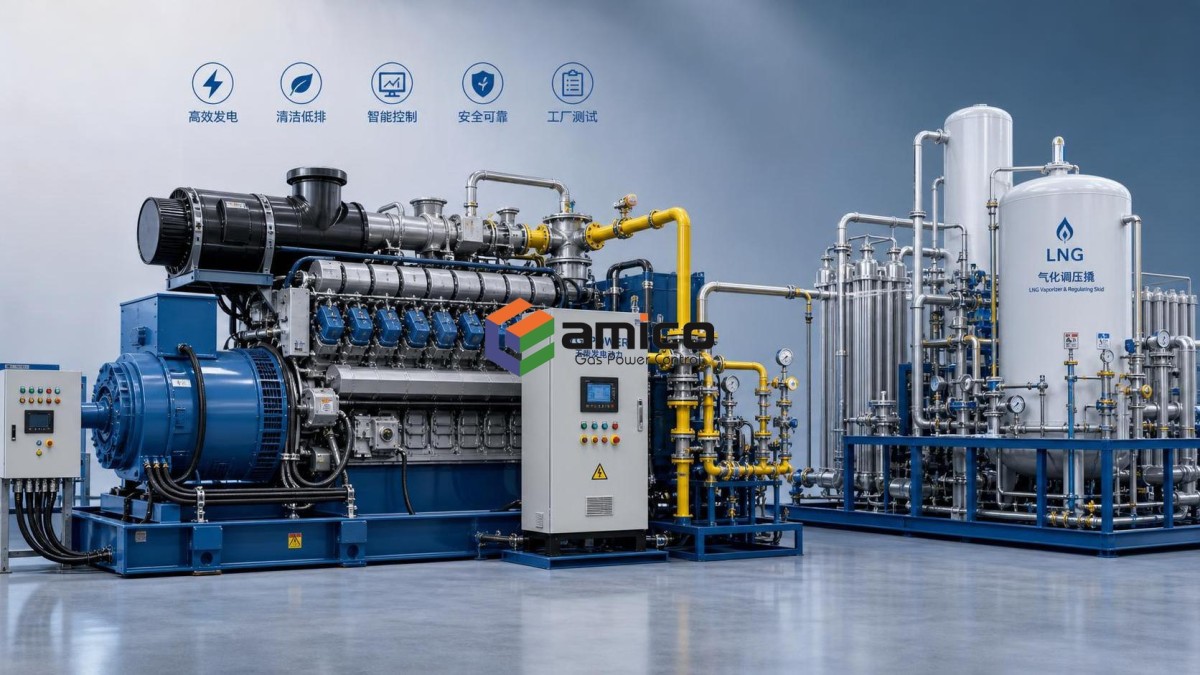
For safety managers, the gas train deserves more scrutiny than the headline power rating. Shut-off valves, pressure regulation, leak detection, venting logic, flame-related protections where applicable, and emergency isolation should be reviewed against the project’s governing code set. The applicable standard can vary by region and by whether the fuel is pipeline natural gas, associated gas, biogas, or regasified LNG. What matters is that the gas handling system is documented as a designed safety function, not treated as piping added around the engine.
This becomes even more important when upstream equipment is involved. In projects using a LNG gasification skid, the generator set cannot be assessed in isolation. Pressure stability, gas temperature, vaporization capacity, and fuel quality consistency influence combustion behavior and knock control. A generator may satisfy its factory test on standard natural gas, yet still perform poorly if the site gas conditioning package does not hold the required inlet conditions. That is not a minor tuning issue; it sits on the boundary between process design and equipment compliance.
Emissions standards are not interchangeable with engine quality
Another common misunderstanding is assuming that low emissions certification proves overall generator quality. It does not. Emissions compliance only tells you that, under defined conditions and test methods, the engine package can meet specified pollutant limits. It says little by itself about load acceptance, overhaul interval, gas adaptability, or maintenance burden.
Still, emissions standards matter because they affect permit risk and aftertreatment complexity. Depending on jurisdiction, the project may need to control NOx, CO, unburned hydrocarbons, or formaldehyde, and the applicable limit can differ sharply between standby, prime, and continuous-duty use. A buyer should ask two direct questions: under which test standard were emissions measured, and under what operating mode were those values declared? Without that context, a quoted number has limited meaning.
Hazardous areas change the specification more than many buyers expect
In oilfield and gas-related sites, area classification can reshape the entire package. If electrical or instrumentation components are installed in classified zones, explosion protection requirements such as ATEX or IECEx may apply to selected parts or to the installation concept. This affects sensors, junction boxes, actuators, cable glands, control panels, and sometimes ventilation or purge strategies for enclosures.
The important point is that “suitable for hazardous area projects” is not a standard. Buyers need to see the actual protection concept and certificate scope. A control panel built from certified components is not necessarily certified as an assembled panel. Quality teams should verify nameplate data, certificate validity, and whether the declared temperature class and gas group fit the site classification.
Factory testing standards often reveal more than the brochure
When comparing offers, the factory acceptance test plan is often more informative than the sales datasheet. Reputable suppliers should be clear about test conditions, measured parameters, instrument traceability, and pass/fail criteria. For Gas Generator Sets, witness testing may cover load steps, voltage and frequency stability, protection trips, alarm logic, insulation checks, and, where relevant, gas leak testing or functional shutdown tests.
This is also where a manufacturer’s background matters in a practical sense. Companies with in-house gas engine development, control R&D, and dedicated testing capability are generally better positioned to explain how standards are applied across the complete package instead of only at component level. For a manufacturer such as AMICO, whose work spans gas power control technologies, generation equipment, distributed power applications, and oilfield engineering services, that system view is especially relevant when the project includes process-side equipment like decompression or gasification skids.
A short checklist that actually helps procurement decisions
In real purchasing work, the most useful standard is often the one that exposes a hidden interface problem. It may be the emissions test basis, the hazardous-area certificate boundary, or the gas pressure requirement upstream of the mixer. In one project, the key risk may sit in switchgear coordination; in another, it may sit in the interaction between the generator package and an LNG gasification skid. That is why the right review process is less about collecting the longest list of acronyms and more about checking whether the standards align with the actual operating scenario.
When evaluating industrial generator sets, ask for the standards matrix early: which standards govern design, which govern testing, which govern market access, and which assumptions were used for fuel, duty class, emissions, and site classification. If a supplier can answer those questions clearly and document them at package level, the certification file is probably meaningful. If the answers stay vague, the risk is rarely administrative; it usually surfaces later in commissioning, inspection, or operation.

Contact Us
Please use the form below to contact us.
If you require a response, we will contact you as soon as possible.