


- ▶ What drives the installed cost of a 1200 kW silent generator set?
- ▶ When a 1200 kW silent generator set suits hospital backup power
- ▶ Can a 1200 kW silent generator set meet urban boundary noise limits?
- ▶ Overseas Clients Visit Ameco for On-site Inspection, Deeply Empowering Global Green Energy Cooperation
What Size Pressure Regulator Does a Gas Generator Set Need?
What “Size” Really Means for a Gas Generator Pressure Regulator
The most common mistake in regulator selection is to treat size as a pipe-diameter question. For a gas generator set, that is only part of the picture. A pressure regulator is sized by its ability to deliver the required gas flow at a stable outlet pressure across the real range of inlet conditions. A 1-inch regulator can be oversized, undersized, or simply wrong depending on gas composition, pressure drop, and how the engine fuel train is configured.
That matters because a gas engine does not just need fuel to arrive. It needs fuel to arrive steadily enough for the air-fuel control system to do its job. If the regulator cannot hold pressure when the generator picks up load, the engine may run lean, hunt, derate, or trip. If the regulator is too large and poorly matched, control can become unstable at low flow. Procurement decisions often focus on rated generator output, but regulator sizing is usually settled by three working parameters: required gas flow, inlet pressure variation, and the pressure the engine mixer or fuel control valve must actually see.
Start with the Engine’s Fuel Demand, Not the Regulator Catalog
For a purchasing team, the practical starting point is the generator manufacturer’s fuel consumption data at full load and, where available, at part load. This is more useful than trying to infer regulator size from kW alone. Two generator sets with similar electrical output may need different gas flow because of engine efficiency, site elevation, gas quality, or emissions settings.
The regulator must pass the maximum required flow while maintaining the target downstream pressure. In natural gas applications, that target is often defined by the engine package supplier, not by the regulator vendor. The fuel train may include shut-off valves, filters, zero-pressure governors, pressure switches, and controls that all add resistance. That is why a regulator that looks adequate on paper can still become the bottleneck in the field.
A useful selection question is not “What size regulator fits this generator?” but “At the lowest expected inlet pressure, can this regulator still deliver the engine’s peak gas demand without unacceptable pressure droop?” That is the condition that exposes undersizing.
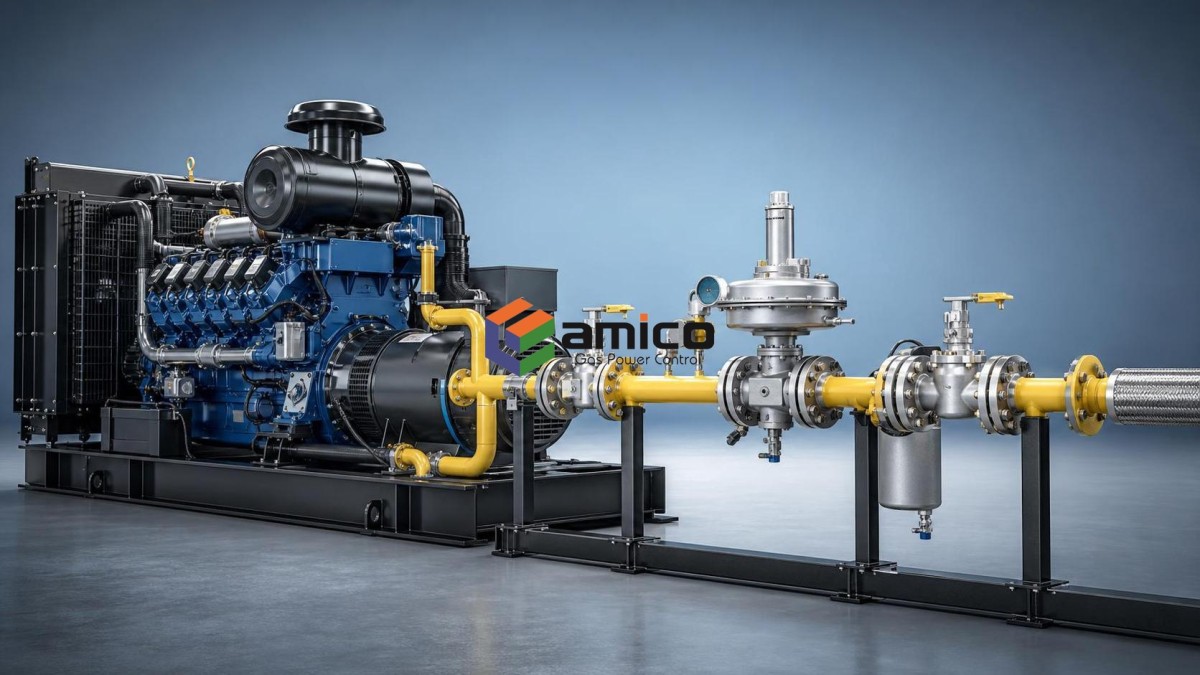
In gas power projects, especially where supply pressure fluctuates, engineers normally review the regulator flow curve rather than relying on nominal connection size. This is one reason integrated manufacturers such as Amico Gas Power Co., Ltd, which work across gas power control, generation equipment, and oilfield-related gas applications, tend to evaluate the regulator as part of the whole fuel system instead of as an isolated accessory.
Inlet Pressure Range Changes the Answer
Procurement specifications often list a single inlet pressure, but real projects usually operate across a range. Pipeline gas can drift. Wellhead-associated gas can be even less predictable. When inlet pressure falls close to the required outlet setpoint, a standard regulator may no longer have enough differential pressure to control properly. When inlet pressure is much higher, material compatibility, lock-up behavior, and pressure relief strategy become more important.
This is why regulator sizing and regulator type cannot be separated. A direct-acting regulator may work well for a small, steady installation. A pilot-operated design may be more suitable where flow swings are large and pressure control needs to be tighter. The “right size” therefore includes internal capacity and control behavior, not just connection diameter.
If the fuel source is biogas, flare gas, or gas with heavier components, the assessment becomes stricter. Contaminants, condensate risk, and composition changes influence both sizing and service life. In those cases, upstream gas conditioning can matter as much as the regulator itself. That is where related gas treatment equipment, including exhaust treatment, may enter the broader package discussion, although it serves a different function from pressure control.
What Buyers Should Ask Suppliers to Confirm
A sound RFQ for a pressure regulator should ask for more than model number and port size. At minimum, the supplier should confirm these points:
- Maximum and normal gas consumption of the generator set
- Gas type and, if known, heating value or composition range
- Minimum, normal, and maximum inlet pressure
- Required outlet pressure at the engine fuel train inlet
- Allowable pressure droop during step loading
- Ambient conditions, especially low temperature or altitude
- Required safety devices in the gas train
If a supplier cannot explain selection against those inputs, the proposal is incomplete. A regulator that is merely “suitable for gas generators” is not a technical answer.
Common Misunderstandings That Distort Selection
One misunderstanding is that oversizing is always safe. It is not always harmful, but it is not automatically better. Some regulators lose controllability when operating far below their intended flow range, especially in systems with frequent load cycling. Another misunderstanding is that line size determines regulator size. Pipework is selected for velocity and pressure-loss considerations; the regulator is selected for controllable capacity under defined conditions. They interact, but they are not interchangeable decisions.
There is also a tendency to ignore transient behavior. Generator sets rarely live at one fixed load. Start-up, block loading, and sudden unloading can all expose weak pressure control. A regulator that passes enough steady-state flow may still be a poor choice if response is too slow or outlet pressure recovery is unstable.
A Practical Way to Judge the Right Regulator Size
In practice, the right pressure regulator for a gas generator set is the one that can maintain the specified downstream pressure at maximum fuel demand, under minimum expected inlet pressure, with acceptable stability during load changes. That judgment usually comes from capacity charts, pressure-drop calculations, and the engine maker’s fuel requirement data. Where the gas source is non-standard, the margin for error gets smaller, so selection should be reviewed together with filtration, heating, knock control, and emissions requirements.
For procurement work, this means the most reliable purchasing decision is rarely based on nominal size alone. Ask for the sizing basis. Ask for the operating envelope. Ask how the regulator behaves at both full load and low load. If those answers are clear, the selected unit is far more likely to match the generator, the site gas conditions, and the commercial expectations behind the project.
In some packages, related environmental or gas-handling components may be discussed alongside the fuel train, including a second reference to exhaust treatment. Even then, pressure regulation should be evaluated on its own technical basis: flow, pressure, response, and compatibility with the engine control strategy.

Contact Us
Please use the form below to contact us.
If you require a response, we will contact you as soon as possible.